
NASA counted down to T-minus 29 seconds during a smooth rehearsal for a historic launch that could send astronauts around the moon for the first time in more than half a century.
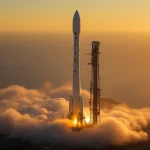
The run-through at Launch Complex 39B, at Kennedy Space Center in Florida, was known as a wet dress rehearsal because it involved filling up the propellant tanks on NASA’s Space Launch System, a 322-foot-tall rocket that made its debut with 2022’s uncrewed Artemis 1 mission.
The only major component that was missing at the launch pad was the crew. NASA astronaut Reid Wiseman, the commander for the Artemis 2 mission, said in a posting to X that he was watching the proceedings from NASA’s Launch Control Center.
Once NASA reviews the results of the two-day rehearsal, mission managers will decide whether to give the final go-ahead for the Artemis 2 crew’s 10-day trip around the moon and back.
Lori Glaze, acting associate administrator for NASA’s Exploration Systems Development Mission Directorate, said the space agency is targeting March 6 for liftoff. “Every night I look at the moon, and I see it, and I get real excited because I can really feel she’s calling us,” she told reporters today. “And we’re ready.”
This week’s simulated countdown provided an opportunity for NASA to check out the Space Launch System rocket, the Orion crew capsule and ground support systems in advance of the actual launch.
An initial rehearsal on Feb. 2 was stopped at roughly T-minus 5 minutes due to a liquid hydrogen leak. Engineers made repairs at the pad, including a replacement of the hydrogen seals, to clear the way for a replay of the rehearsal.
On Thursday night, NASA worked through some communication problems at the pad — and the team dealt with what it called a “booster avionics system voltage anomaly” during the final minutes of the countdown. But the count eventually proceeded as planned to T-minus 33 seconds. At that point the countdown was paused and recycled to T-minus 10 minutes.
It took about an hour to reconfigure the rocket’s fueling system for another terminal count. Then NASA’s launch team went through an even smoother second countdown and reached the scheduled stopping point at T-minus 29 seconds.
Charlie Blackwell-Thompson, Artemis 2’s launch director, said the maximum hydrogen leak rate during fueling was 1.6% — far below NASA’s 16% limit. “Really no leakage to speak of,” she said.
John Honeycutt, the chair of Artemis 2’s Mission Management Team, had a similarly positive assessment. “Overall it was a good day for us,” he said.
The four crew members for Artemis 2 are due to go into quarantine today. In addition to Wiseman, the crew includes NASA astronauts Christina Koch and Victor Glover, plus Canadian astronaut Jeremy Hansen. Glaze said the crew was in Florida for this week’s rehearsal, but will start their quarantine back in Texas.
Artemis 2’s flight plan calls for sending the astronauts on a figure-8 route around the moon and back. The trip will take them as far as 4,600 miles beyond the far side of the moon — farther out than any human has gone before.
Although Artemis 2 will be historic in its own right, the mission’s main purpose is to prepare the way for Artemis 3, which aims to land humans on the lunar surface for the first time since Apollo 17 in 1972. That mission is officially set for no earlier than mid-2027, but industry experts expect the schedule to slip.
Several companies headquartered in the Seattle area have a significant interest in the Artemis moon program. A facility in Redmond operated by L3Harris (previously known as Aerojet Rocketdyne) builds thrusters for the Orion spacecraft — and Jeff Bezos’ Blue Origin space venture, based in Kent, is developing a Blue Moon lander that’s meant to put Artemis crews on the lunar surface starting in 2030. Blue Origin’s New Glenn rocket is expected to send an uncrewed cargo version of its lander to the moon sometime in the next few months.
This report has been updated with information from today’s NASA news conference.