
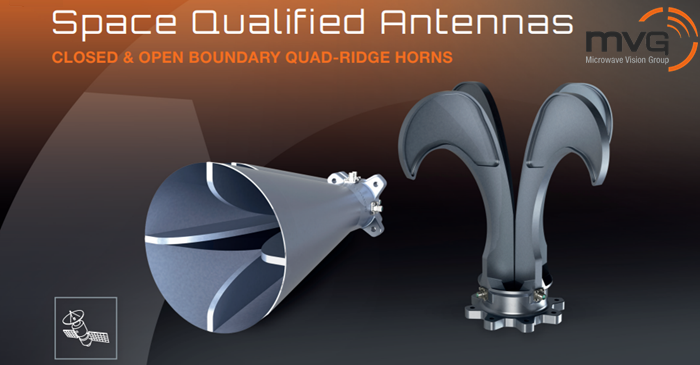
Microwave Vision Group has expanded its antenna product portfolio with a range of closed boundary quad-ridge horn antennas and open boundary quad-ridge horn antennas specifically designed for space applications. Qualified for space through industry standard testing: rf performance, mechanical and vibrational testing, thermal qualifications and outgassing tests, this selection of space-qualified antennas provides engineers with wideband antenna solutions from 0.8 to to 55 GHz for use in space.
Closed Boundary Quad-Ridge Horn Antennas are broadband, dual-polarized horn antennas that incorporate metallic sidewalls around the aperture to better confine the radiated electromagnetic fields and improve radiation control. Closed boundary quad-ridge antennas are most often used for high-gain, precision, long-distance links. Whereas, Open Boundary Quad-Ridge Horn Antennas are also broadband, dual polarized and use the same four-ridge internal structure but are unconstrained by the waveguiding side walls. This open configuration simplifies the mechanical design, reduces weight, and supports wide frequency coverage across the operating band. The open boundary quad ridge antennas are used for space applications where broader coverage, lower complexity, or specialized beam shapes are required.

Space Qualified Closed-Boundary Quad-Ridge Horn Antennas
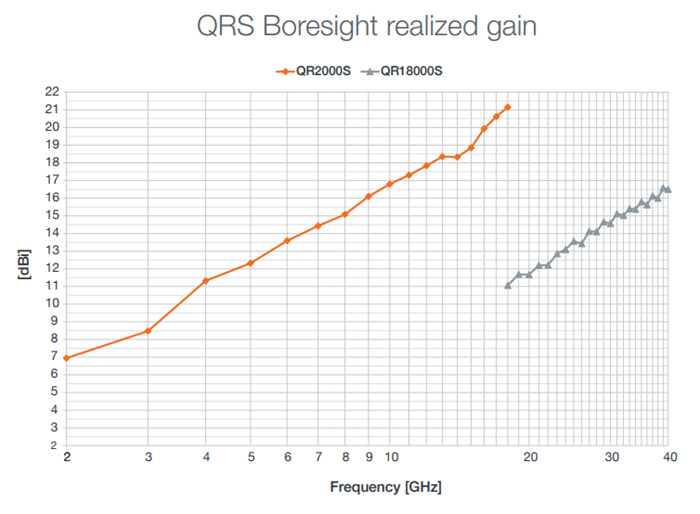
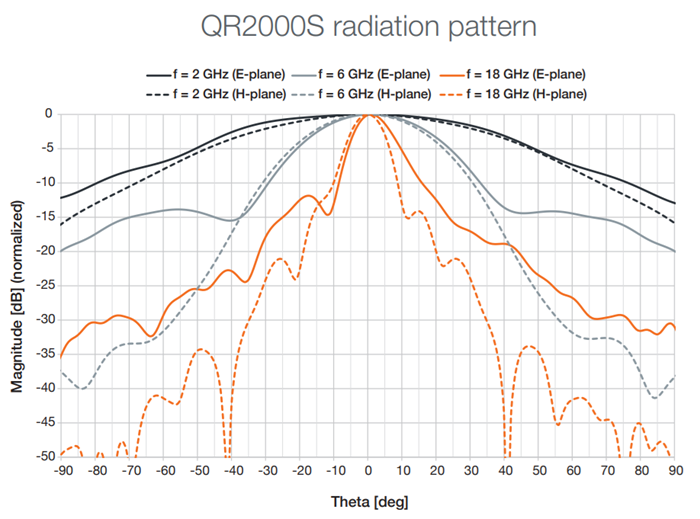
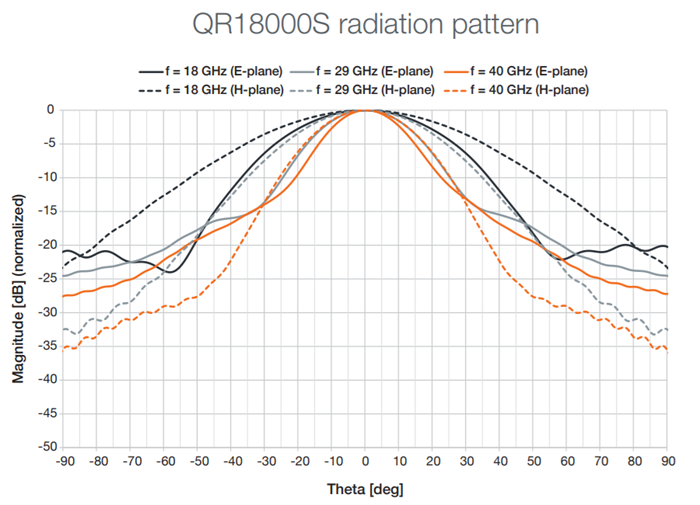
MVG offers two closed boundary quad-ridge horn antenna models – the QR2000, which operates across the 2 -18 GHz frequency range, and the QR18000, designed for 18 – 40 GHz operation, together providing continuous wideband coverage from S-band through Ka-band. These two designs offer low VSWR, high port-to-port isolation, and strong cross-polarization discrimination, supporting reliable signal integrity across wide operating bandwidths. According to the technical data, gain ranges from 7 to 21 dBi for the lower-frequency model and 11 to 16 dBi for the higher-frequency version, making them suitable for a range of space payload applications.
These closed boundary quad-ridge horn antenna use a monolithic aluminum construction to minimize interfaces and moving parts, improving robustness during launch vibrations. Lightweight designs- approximately 0.8 kg for the QR2000 and 0.2 kg for the QR18000 help satellite integrators meet payload mass constraints without compromising performance. Integrated high-precision coaxial transitions and standardized mounting flanges further simplify system integration.
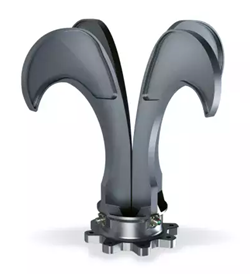
Space Qualified Open-Boundary Quad-Ridge Horn Antennas
The new space-qualified antenna portfolio also comprises of three open boundary quad-ridge horn antenna models: The QH800S operates from 800 MHz to 6 GHz, the QH2000S covers 2 to 20 GHz, and the QH18000S extends operation to 18 to 55 GHz.
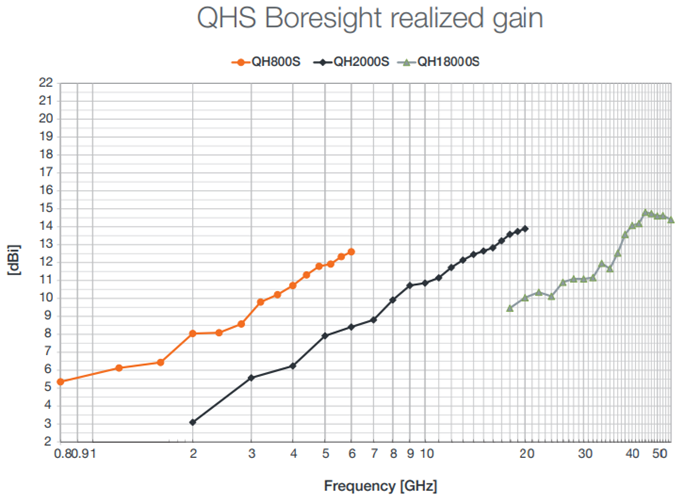
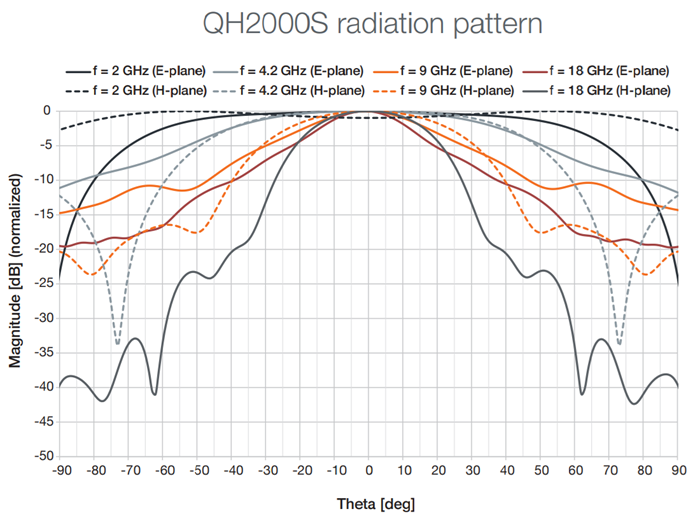
The QH2000S from Microwave Vision Group is a quad-ridge horn satellite antenna designed to support wideband space connectivity applications across multiple orbital regimes. Operating over a broad frequency range of 2 to 20 GHz, this open-boundary antenna supports dual linear polarization and delivers gain performance from 3-14 dBi, satellite communication and in-orbit measurement applications. This space-qualified antenna offers stable electrical performance across the operating band, having an impedance value of 50 ohms and a return loss better than 10 dB.
It provides port-to-port isolation greater than 35 dB and cross-polar discrimination exceeding 30 dB, ensuring accurate polarization purity and signal integrity. The QH2000S features a robust monolithic mechanical design that minimizes interconnections, enhancing durability and resistance to launch-induced vibration. The lightweight construction supports payload mass constraints, while the off-the-shelf architecture simplifies deployment and integration.
The antenna is scalable for both frequency coverage and mechanical customization, allowing adaptation to specific mission requirements. Fully space qualified through comprehensive RF, mechanical, thermal and outgassing testing, the QH800S is built to operate reliably in harsh space environments. Measuring 105 x 105 x 110 mm, it is ideally suited for LEO, MEO and GEO payloads, enabling satellite-to-satellite crosslinks, constellation connectivity, space-to-ground communication links and reflector feed applications for high-gain systems.
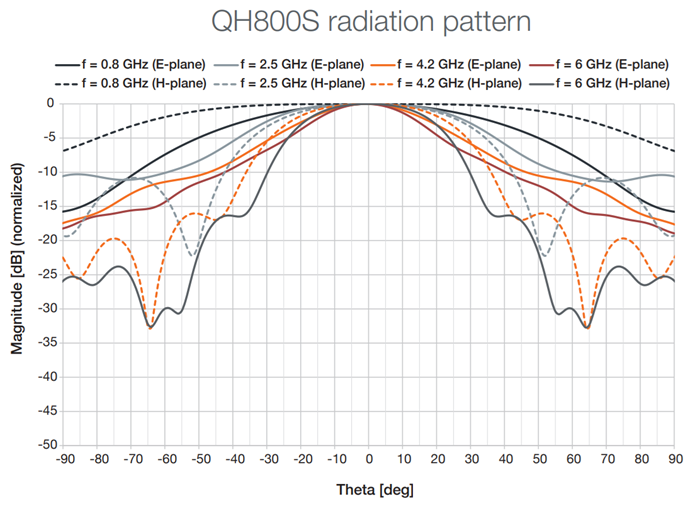
The QH800S from Microwave Vision Group is a quad-ridge horn satellite antenna designed to support wideband space connectivity applications across multiple orbital regimes. Operating over a broad frequency range of 800 MHz to 6 GHz, this open-boundary antenna supports dual linear polarization and delivers gain performance from 5-13 dBi, enabling reliable RF operation for satellite communication. This space-qualified antenna offers stable electrical performance across the operating band, having an impedance value of 50 ohms and a return loss better than 10 dB.
It provides port-to-port isolation greater than 35 dB and cross-polar discrimination exceeding 30 dB, ensuring accurate polarization purity and signal integrity. The QH800S features a robust monolithic mechanical design that minimizes interconnections, enhancing durability and resistance to launch-induced vibration. The lightweight construction supports payload mass constraints, while the off-the-shelf architecture simplifies deployment and integration into space payloads.
The antenna is scalable for both frequency coverage and mechanical customization, allowing adaptation to specific mission requirements. Fully space qualified through comprehensive RF, mechanical, thermal and outgassing testing, the QH800S is built to operate reliably in harsh space environments. Measuring 264 x 264 x 242 mm, it is ideally suited for LEO, MEO and GEO payloads, enabling satellite-to-satellite crosslinks, constellation connectivity, space-to-ground communication links and reflector feed applications for high-gain systems.
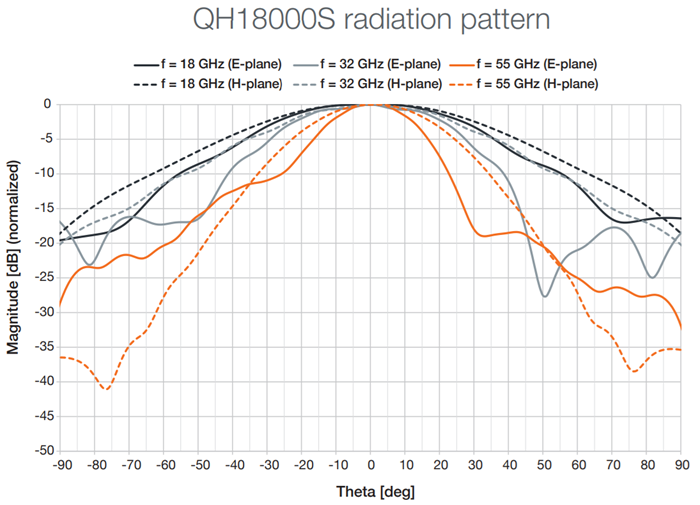
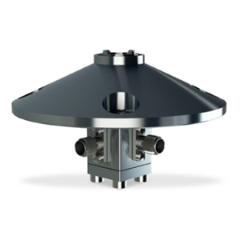 Open Boundary Quad-Ridge Horn Antenna from 18 to 55 GHzThe QH18000S, from Microwave Vision Group is a quad-ridge horn satellite antenna designed to support wideband space connectivity applications across multiple orbital regimes. Operating over a broad frequency range of 18 to 55 GHz, this open-boundary antenna supports dual linear polarization and delivers gain performance from 9–15 dBi, enabling reliable RF operation for satellite communication and measurement use cases. This space-qualified antenna offers stable electrical performance across the operating band, having an impedance value of 50 ohms and a return loss better than 10 dB.
It provides port-to-port isolation greater than 35 dB and cross-polar discrimination exceeding 30 dB, ensuring accurate polarization purity and signal integrity. The QH18000S features a robust monolithic mechanical design that minimizes interconnections, enhancing durability and resistance to launch-induced vibration. The lightweight construction supports payload mass constraints, while the off-the-shelf architecture simplifies deployment and integration.
The antenna is scalable for both frequency coverage and mechanical customization, allowing adaptation to specific mission requirements. Fully space qualified through comprehensive RF, mechanical, thermal and outgassing testing, the QH18000S is built to operate reliably in harsh space environments. Measuring 80 x 80 x 50 mm, it is ideally suited for LEO, MEO and GEO payloads, enabling satellite-to-satellite crosslinks, constellation connectivity, space-to-ground communication links and reflector feed applications for high-gain systems.
MVG puts these antennas undergo rigorous space qualification procedures, including RF performance verification, mechanical shock and vibration testing, thermal cycling to simulate extreme temperature variations and outgassing assessments in accordance with space environment standards. These evaluations help confirm the reliability and suitability for long-duration operation in demanding orbital conditions. In addition to the hardware, MVG provides complementary services such as calibration, maintenance and customization to meet specific mission and integration requirements.