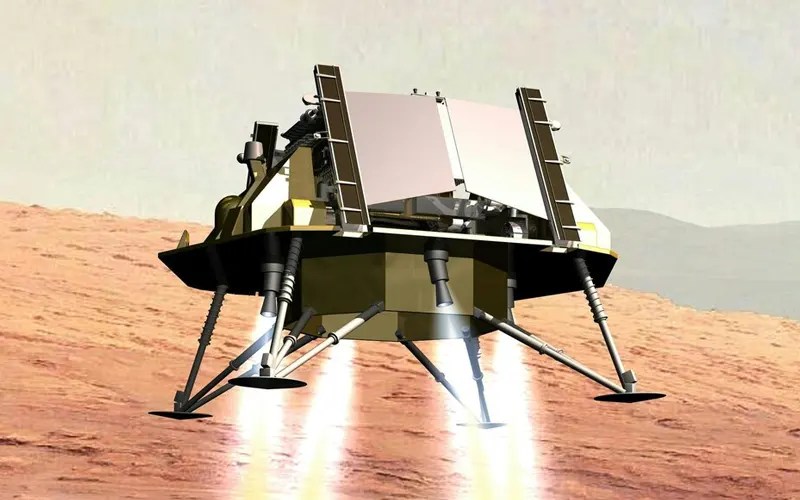
NASA has delivered the first braking engines for the European Space Agency’s (ESA) Rosalind Franklin Mars mission, marking an important milestone in the agencies’ collaboration to return the rover mission to flight.
The braking engines are one of three major contributions NASA is providing to the mission, alongside launch services and Radioisotope Heater Units (RHUs) that will keep the rover’s instruments warm during the cold Martian nights.
International Collaboration
NASA joined the mission following ESA’s decision to suspend cooperation with Russia in March 2022 after the invasion of Ukraine, leaving the programme without its planned Russian-built landing platform and Proton-M launch vehicle.
ESA subsequently awarded a €522 million contract to Thales Alenia Space in April 2024 to replace much of the Russian-built hardware, including the landing platform.
NASA’s role was formalised through a Memorandum of Understanding signed in May 2024, under which the agency agreed to provide launch services, braking engines and RHUs.
Earlier this year, NASA selected SpaceX’s Falcon Heavy rocket to launch the mission.
Hardware Progress
Speaking after ESA’s 347th Council meeting, ESA Director of Human and Robotic Exploration Daniel Neuenschwander confirmed that the first braking engines had now been delivered.
Neuenschwander also said procurement of the Radioisotope Heater Units was progressing.
“The third and last topic is the procurement of RHUs. And there we are on a very good path.”
“This is still something which needs to progress until launch, and we will have to take a number of decisions but I can underline that also here it looks good so far.”
European RHU Development
While NASA is supplying the mission’s operational RHUs, ESA is also working to establish an independent European capability.
Under its ENDURE programme, ESA is supporting development of a European-produced Radioisotope Heater Unit.
The first flight-ready unit, developed by UK-based Perpetual Atomics, is expected to fly aboard the Rosalind Franklin landing platform as a technology demonstrator.
However, the NASA-supplied RHUs remain mission-critical, providing the thermal protection required to keep the rover’s electronics operational as it searches for signs of ancient life on Mars.