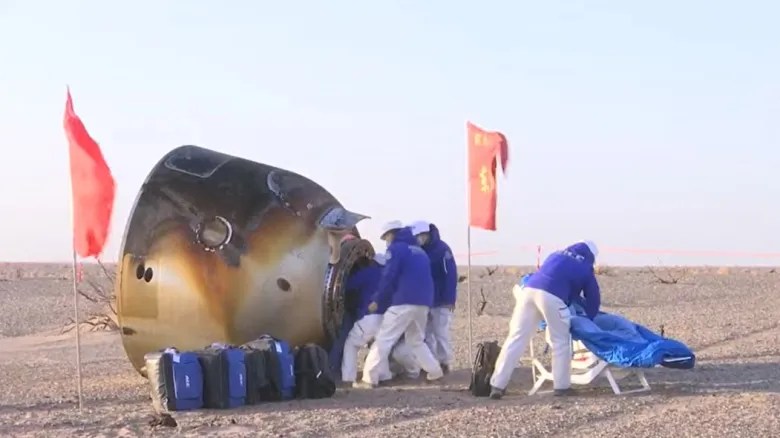
Three Chinese astronauts returned to Earth on Friday after their trip home was delayed when space debris struck their spacecraft last week, China’s state broadcaster CCTV reported.
The China Manned Space Agency (CMSA) disclosed the extent of the damage for the first time, saying that “tiny cracks” were discovered in a small window of the Shenzhou-20 return capsule. “The capsule does not meet the safety requirements for a crewed return, Shenzhou-20 will remain in orbit and conduct relevant experiments,” the agency said.
The crew had been scheduled to return nine days earlier after completing a six-month mission aboard the Tiangong space station when the damage was identified. CMSA said the astronauts instead departed Tiangong aboard the Shenzhou-21 spacecraft, landing at the Dongfeng site in Inner Mongolia at 4:40 p.m. (0840 GMT).
The mission, which began in April, had proceeded without incident until the debris strike forced the return delay—an unusual interruption for a programme known for tight scheduling and steady milestones, including China’s first astronauts born in the 1990s, a record-setting spacewalk, and preparations to send the station’s first foreign astronaut next year.
Each Shenzhou rotation includes a handover period in which two spacecraft are docked at Tiangong. But with the Shenzhou-20 crew returning on Shenzhou-21, the station is now without a flightworthy return vehicle. The newly arrived Shenzhou-21 crew, who reached the station two weeks ago, will remain aboard until a replacement craft is launched.
Under China’s safety protocols, an unmanned emergency rescue vehicle can be dispatched in the event astronauts need to be brought back to Earth urgently. CMSA said Shenzhou-22 will launch “at an appropriate time in the future.”
Growing risk from orbital debris
The incident underscores the mounting challenge posed by space debris in low-Earth orbit. “Due to the sharp increase in orbital debris, the likelihood of damage to spacecraft and space stations of all countries has risen significantly,” Igor Marinin of the Russian Academy of Cosmonautics told Reuters.
While this is the first debris-related disruption for a Shenzhou mission, past missions to the International Space Station (ISS) have faced similar hazards. NASA’s SpaceX Crew Dragon capsules have maneuvered to avoid suspected debris, and the ISS has executed multiple avoidance maneuvers over its 25-year lifespan.
Old satellites, failed components and anti-satellite tests continue to produce long-lasting debris fields. The breakup of a Russian satellite last year generated at least 180 trackable fragments, while a spent Chinese rocket stage created nearly 1,000 pieces of junk after an apparent collision.
Experts and policymakers have urged greater international cooperation on debris mitigation and space-traffic coordination, though U.S. law restricts NASA from working directly with China’s space programme. Even so, the two countries have expanded ad-hoc coordination on orbital safety notifications, including maneuver alerts communicated to U.S. operators, the Pentagon and NASA.
The incident follows a recent example from the United States: two NASA astronauts spent nine months aboard the ISS in 2023–2024 after technical issues emerged with the Boeing Starliner spacecraft that ferried them to orbit.