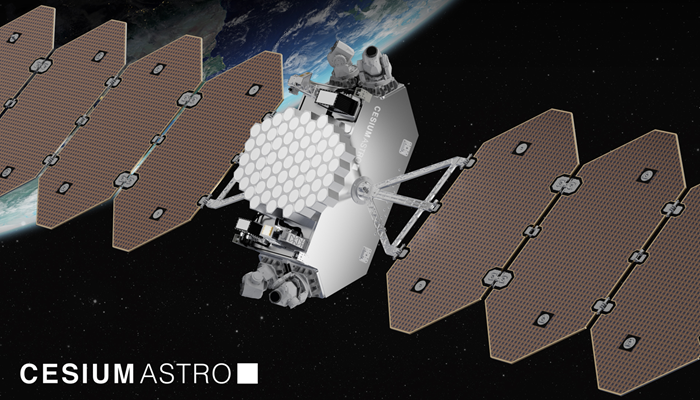
Austin-based CesiumAstro, founded in 2017 and headquartered in Austin, Texas, develops advanced active phased-array communications payloads and integrated satellite systems for commercial, civil and defense applications. The company’s Element platform is a fully integrated LEO satellite system built to host CesiumAstro’s electronically steerable Ka-band payloads, combining a modular satellite bus with software-defined communications hardware. Designed to support missions requiring high-throughput links, multi-beam operation, dynamic beam steering and in-orbit reconfigurability, Element provides a mission-ready architecture that can accommodate a range of payload configurations. The flexible design allows operators to adapt the platform for broadband services, inter-satellite links, data-relay missions and other communication-focused operations in low Earth orbit.
Core Payloads
CesiumAstro equips the Element platform with a suite of in-house developed communications payloads Nightingale, Vireo, and the company’s configurable Transceiver module, each designed to support high-throughput, electronically steerable satellite communications.
Nightingale – Single-Beam Ka-Band Active Phased Array
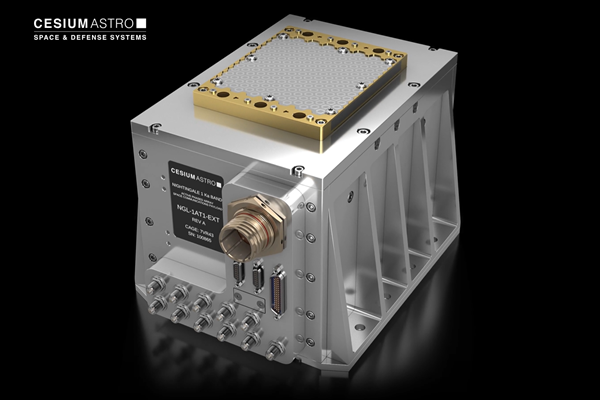
Nightingale is CesiumAstro’s single-beam Ka-band active phased-array antenna system designed for applications requiring wide coverage and electronically steerable connectivity in low Earth orbit. The system integrates an electronically steerable aperture with an onboard software-defined radio (SDR), enabling real-time beam steering without mechanical gimbals. This allows the payload to maintain horizon-to-horizon coverage as the spacecraft traverses the orbit, supporting continuous downlink or crosslink connectivity. Nightingale’s ultra-wideband design allows operation across Ka-band uplink and downlink frequencies, making it suitable for broadband data delivery, ISR missions and gateway access. The architecture is built to withstand LEO thermal cycling and radiation levels with calibration and beam-control algorithms embedded to ensure consistent performance over the satellite’s operational life.
Vireo – Multi-Beam Active Phased Array Payload Family
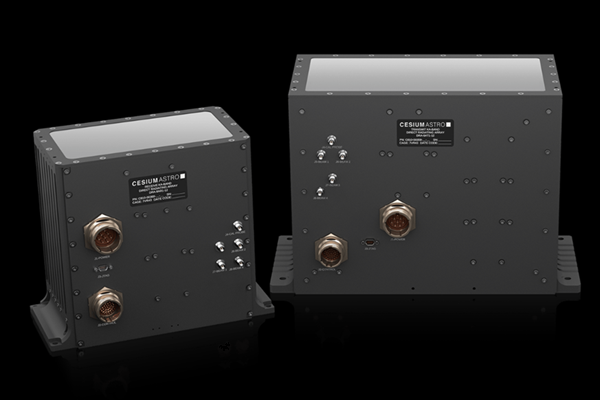
The Vireo payload line expands CesiumAstro’s phased-array capabilities into multi-beam operation delivering simultaneous communication links across multiple ground or space terminals. The Vireo family includes Ka-band and L-band variants, with the Ka-band version offering significantly higher throughput and beam agility. A representative Vireo Ka-band configuration incorporates 288 transmit elements supports up to four independent beams and achieves an aggregate EIRP of approximately 36 dBW at Bo1 dB. This architecture enables dynamic beam steering, adaptive beam shaping and interference mitigation, allowing the payload to allocate bandwidth based on user demand or mission priority. The design is optimized for repeated thermal cycling and long-duration space operations with built-in calibration routines and radiation-tolerant electronics to ensure consistent array performance. This makes Vireo suitable for multi-user broadband services, inter-satellite crosslinks, tactical communication scenarios and rapidly reconfigurable network architectures.
Transceiver – Full-Duplex, Multi-Channel SDR for Space
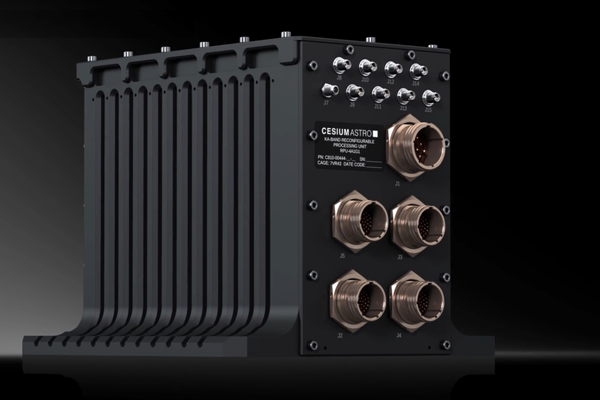
CesiumAstro’s Transceiver is a space-qualified, full-duplex, multi-channel satellite communications processor that forms the digital backend of the company’s active phased-array payloads. The system supports Ka-band reconfigurable communications, handling modulation, demodulation, channelization, waveform processing and beam-control interfaces. Designed as a software-defined unit, the Transceiver allows operators to modify waveforms, adjust channel allocations and implement new protocols in orbit without hardware changes. The unit’s architecture is built around high-throughput digital signal processing, enabling it to interface directly with CesiumAstro’s phased-array front-ends. Radiation-tolerant components and thermal-management accommodations ensure stable operation in the LEO environment. These capabilities allow the Transceiver to serve as a flexible digital payload processor for missions requiring multi-beam scheduling, dynamic bandwidth allocation or rapid reconfiguration of communication links.
Mechanical Features
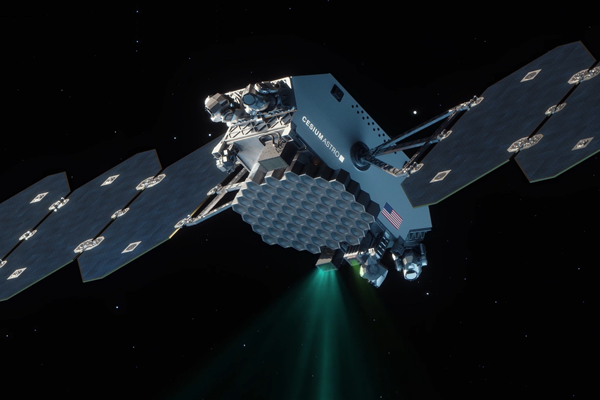
The Element platform incorporates a structural and mechanical architecture designed to balance launch compatibility, deployable performance and in-orbit robustness. The mechanical configuration is optimized for compact stowage during launch with a stowed envelope of 2.44 × 1.4 × 1.2 meters, allowing the spacecraft to fit within standard rideshare and dedicated launch interfaces. On orbit, the platform deploys the phased-array and structural appendages to reach a fully deployed length of approximately 12.93 meters, enabling proper field-of-view, gain and aperture geometry for high-throughput Ka-band phased-array operations. The spacecraft’s wet mass of around 700 kilograms positions Element in the mid-class LEO satellite category, providing sufficient mass margin for propulsion, payload electronics, thermal management and power generation subsystems. Propulsion is provided by a Hall-effect thruster, offering more than 400 m/s of available delta-v, supporting orbit maintenance, collision-avoidance maneuvers, phasing adjustments and mission-lifetime station-keeping. This propulsion capacity allows operation in LEO altitudes ranging from 500 to 1,020 kilometers, aligning with a designed operational life of approximately 5 years. The mechanical design integrates CesiumAstro’s phased-array payloads, digital processing units, deployable booms, and antenna structures into a rigid and thermally stable frame. The structure accommodates thermal management pathways, maintaining component temperatures within allowable limits despite LEO thermal cycling. Structural stiffness, hinge mechanisms, deployment actuators and mounting interfaces are engineered to maintain pointing accuracy, vibration tolerance and structural stability required for electronically steerable communication arrays. These mechanical features enable the platform to support continuous, high-dynamic-range communication links while maintaining structural and thermal integrity across the mission duration.
Bus Specifications
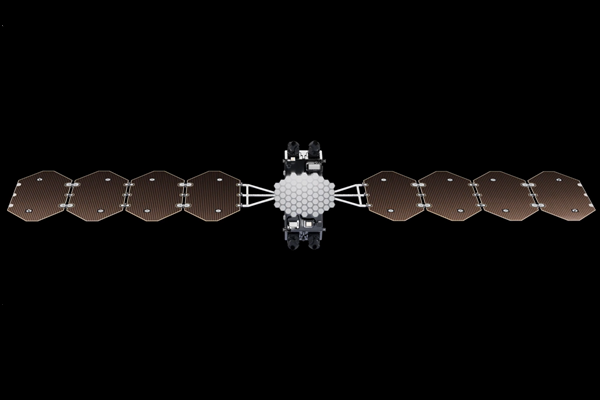
The Element satellite bus is designed as a fully integrated platform that supports commercial missions, government programs and defense-oriented applications. The architecture combines structural, thermal, power, propulsion, and avionics subsystems into a unified system capable of hosting CesiumAstro’s phased-array communications payloads. The platform is engineered for operation in low Earth orbit (LEO) with an expected mission lifespan of approximately five years, supporting orbital altitudes between 500 km and 1,020 km. This range allows Element to be adapted for communications constellations, data-relay missions, Earth-to-space connectivity, or tactical network layers. In launch configuration, Element occupies a stowed volume of 2.44 m × 1.4 m × 1.2 m, enabling compatibility with a broad range of deployers and launch interfaces. Once deployed on orbit, the spacecraft extends to a length of 12.93 meters, accommodating CesiumAstro’s large phased-array apertures and supporting the pointing geometry needed for multi-beam Ka-band operations. With a wet mass of roughly 700 kilograms, the satellite falls within the medium-class mass segment, providing sufficient margin for propulsion, power systems, payload electronics, and thermal hardware while remaining manageable for rideshare missions. The bus incorporates a Hall-effect propulsion system, delivering more than 400 m/s of delta-v, enabling orbit maintenance, formation adjustments, collision avoidance, and end-of-life maneuvering. This propulsion capacity supports its operational lifetime and provides flexibility in selecting orbital planes or modifying mission trajectories. Element is compatible with a variety of launch vehicles, including ESPA Grande carriers, Falcon 9 Full Plate XL and fully dedicated launch stacks, offering customers multiple deployment pathways for constellation builds or single-spacecraft missions.
The Element bus architecture is built for modular payload integration, allowing operators to configure the spacecraft for different communications roles, geographic coverage requirements and operational profiles. This combination of mass class, propulsion capability, structural design and launch flexibility positions Element as a practical and adaptable platform for high-performance LEO communications missions. The Element platform represents CesiumAstro’s integrated approach to pairing advanced phased-array communications payloads with a mission-ready satellite bus. By combining the Nightingale single-beam array, Vireo multi-beam phased-array systems, and the configurable Transceiver processor, Element supports high-throughput links, electronically steerable beams and software-defined operation designed to LEO communications missions. The mechanical design accommodates compact stowage for launch and a large deployed aperture for operational performance, while maintaining the structural and thermal stability required for continuous phased-array operation. The bus architecture including a mid-class wet mass, a Hall-effect propulsion system with over 400 m/s delta-v and compatibility with multiple launch interfaces provides flexibility for single-satellite missions and constellation deployments.
About CesiumAstro
CesiumAstro is an American aerospace company specializing in active phased-array communication payloads, satellite platforms and in-orbit communications systems. Founded in 2017, the company is headquartered in Austin, Texas, with additional facilities in Broomfield, Colorado; El Segundo, California; and the United Kingdom. CesiumAstro develops active phased-array antennas, software-defined radios, satellite processors and fully integrated satellite platforms, aimed at high-throughput communications, multi-beam beam-steering and reconfigurable mission capabilities. The company’s product suite includes the Element satellite platform designed as a mission-ready bus built around its own payload technology with modular architecture and flexibility for both commercial and defence missions. CesiumAstro has facilities in Austin for its manufacturing operations and a systems-engineering presence in Colorado and California. By focusing on communications payloads plus an integrated satellite stack, CesiumAstro positions itself to meet growing demand for software-defined, multi-beam, low-Earth-orbit satellite solutions across broadband, direct-to-device and national-security markets.