Long March-10B Rocket Makes Successful Maiden Flight and Booster Recovery
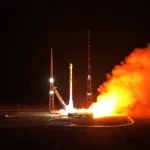
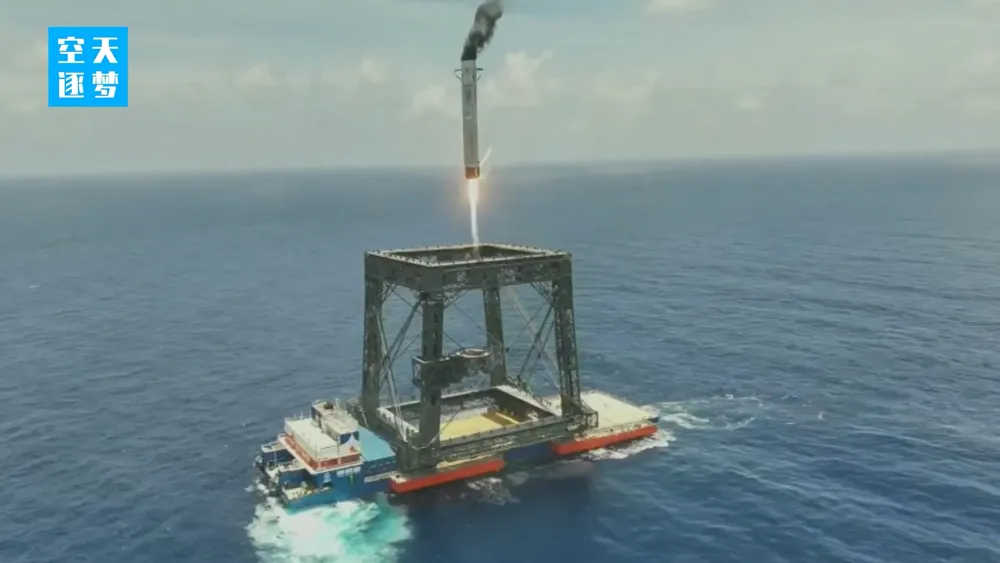
At 12:15 p.m. on July 10, 2026, the Long March-10B launch vehicle lifted off from the Hainan Commercial Space Launch Site. Approximately six minutes after first-stage and second-stage separation, the first-stage booster executed a controlled vertical return and was successfully recovered on an offshore recovery platform using a net-capture system. Both the launch mission and booster recovery operation were completed successfully.
According to the China Aerospace Science and Technology Corporation (CASC), the recovered first-stage booster is expected to undergo refurbishment and complete a reusable flight before the end of this year.
This mission marks China’s first successful controlled recovery of a launch vehicle first stage and also the world’s first successful net-based recovery of an orbital-class launch vehicle. It represents a historic breakthrough in China’s reusable rocket technology and lays a solid foundation for significantly enhancing the nation’s access-to-space capabilities. The Long March-10B has become China’s first reusable launch vehicle to successfully demonstrate booster recovery.
Long March-10B Overview
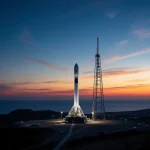
Developed by the First Academy of CASC, the Long March-10B is a large two-stage liquid-fueled launch vehicle featuring a 5-meter-diameter core stage configuration.
The rocket’s first stage adopts the same configuration as the booster stage of the Long March 10A and uses liquid oxygen (LOX) and kerosene propellants. The second stage is powered by liquid oxygen and methane. The vehicle generates approximately 890 metric tons of liftoff thrust and has a liftoff mass of about 760 metric tons.
The maiden-flight vehicle measured approximately 63 meters in length and is capable of delivering up to 16 metric tons to low Earth orbit in its reusable configuration.
The Long March-10B is designed to support a wide range of missions, including deployment of low-Earth-orbit satellite internet constellations and launches of large commercial satellites. Its reusable architecture is expected to significantly reduce launch costs while providing high payload capacity and strong economic efficiency.
This mission was the 657th flight of the Long March launch vehicle family. It also served as a further validation of reusable rocket recovery technologies following the earlier low-altitude demonstration flight of the Long March 10 series, which successfully concluded with a safe ocean splashdown.
Full Mission Profile: End-to-End Validation of Reusable Launch Technology
The mission consisted of two major phases: the ascent phase and the return-and-landing phase. Together, they provided a comprehensive verification of the complete reusable launch vehicle technology chain, from liftoff through recovery.
During ascent, seven LOX-kerosene engines on the first stage powered the rocket through acceleration and stage separation. Following separation, the second stage’s methane-fueled engine took over, completing a sequence that included powered flight, coast-phase attitude adjustments, and a second ignition to accurately place the payload into its designated orbit. The stage also completed post-mission passivation procedures.
The return-and-landing phase represented the core objective of this mission and consisted of four segments:
- Coast and attitude-control phase
- Powered deceleration phase
- Aerodynamic deceleration phase
- Landing phase
After stage separation, the first-stage booster entered the return trajectory at high velocity.
During the coast phase, the grid-fin system deployed and performed reentry attitude adjustments. At the same time, the propellant-settling management system directed remaining propellants toward the bottom of the tanks, ensuring optimal conditions for engine ignition during powered deceleration.
Following attitude adjustment, the booster entered the aerodynamic deceleration phase, using atmospheric drag to reduce velocity. During this stage, the base of the rocket experienced intense aerodynamic heating and aerodynamic loads, making it a critical validation point for the vehicle’s thermal protection system.
During the final landing phase, the booster employed a “quasi-hover” control strategy. Through real-time trajectory optimization and guidance algorithms, the rocket achieved a precise approach and was successfully captured by a net-recovery system mounted on an offshore platform.
Structural and Thermal Challenges Under Extreme Flight Conditions
The successful completion of the full mission profile required precise management of highly complex structural, thermal, and aerodynamic environments.
Throughout the mission, the rocket traversed the entire atmospheric and near-space flight regime—from sea level to orbital altitude—while experiencing numerous challenging conditions, including stage separation, transonic flight, maximum dynamic pressure, and atmospheric reentry.
The return phase represented the most demanding portion of the flight from a thermal and structural perspective.
As the booster reentered the dense atmosphere at several times the speed of sound, aerodynamic heating caused temperatures at the base of the vehicle to rise rapidly. The structure was subjected simultaneously to severe thermal loads and intense mechanical stresses.
To withstand these conditions, engineers equipped the booster with high-temperature thermal protection materials and optimized aerodynamic shaping to maintain structural integrity and system reliability throughout reentry.
Aerodynamic loads also posed a major challenge. Dynamic pressure increased and then decreased as a function of altitude and velocity, reaching peak levels near the point of maximum dynamic pressure. These forces imposed stringent requirements on the rocket’s structural design and mechanical systems.
Mechanical vibration environments persisted throughout the entire mission. Engine thrust oscillations, stage separation shocks, transonic aerodynamic forces, and reentry deceleration all generated complex vibration stimuli that could affect onboard electronics and precision instruments.
To address these challenges, the development team implemented refined frequency-management techniques and vibration-mitigation designs to ensure that all onboard systems met their mechanical-environment requirements.
These technological advances provided the foundation that enabled the Long March-10B to successfully withstand extreme structural and thermal conditions.
Key Technology Demonstrations and Reusability Milestones
The mission successfully demonstrated several critical technologies, including:
- Adaptation to complex structural and thermal flight environments
- High-precision navigation, guidance, and control systems
- Offshore net-capture booster recovery
- Reusable rocket recovery and refurbishment technologies
These achievements represent a major step forward for China’s reusable launch vehicle program and establish a foundation for future routine booster reuse operations.
Compared with the earlier Long March 10A low-altitude flight demonstration, the Long March-10B mission experienced significantly higher thermal flux during reentry and featured a far more complete flight profile, imposing substantially greater demands on thermal protection systems and flight-control technologies.
To ensure reliability, the development team conducted comprehensive reviews of aerodynamic characteristics, structural load analyses, and thermal environment assessments. Each design element was systematically verified to ensure adequate coverage of expected operating conditions and compliance with performance requirements.
Mission results confirmed that:
- The thermal protection system performed effectively.
- Guidance and control strategies functioned as designed.
- The recovery system operated successfully.
- All major performance objectives were achieved.
Following recovery, engineers will conduct detailed inspections, maintenance procedures, refurbishment work, and requalification testing to prepare the booster for a second flight.
“After recovery, we will carry out inspections, maintenance, servicing, and confirmation testing to ensure the vehicle meets all requirements for a second flight,” said Chen Muye of the China Aerospace Science and Technology Corporation.
Looking ahead, the development team will proceed with planned reusable-flight verification activities, continue optimizing vehicle performance, and accelerate the evolution of reusable launch technologies. The first reused flight of the recovered booster is expected to take place before the end of 2026.