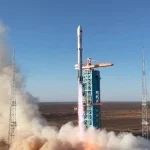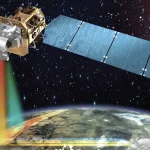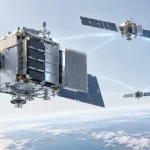
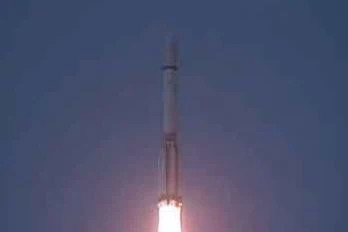
A Russian government Proton-M launch vehicle has successfully launched with three Glonass-M – the Russian Global Positioning System (GPS) – satellites on Friday. Launch was on schedule at 12:52 GMT from the Baikonur Cosmodrome in Kazakhstan, as the Russian fleet of vehicles continue their fight back from recent failures.
Glonass-M Launch:
Glonass is the Russian version to the US Global Positioning System (GPS), which several nations are building for the purpose of independence from the American-controlled system.
Like the US GPS system, Glonass can be used by both military and civilian entities, and is designed for both military and civilian uses.
See Also
- UPDATES Proton-M/Glonass
- 60 Launch Vehicle Manuals (L2)
- Click here to Join L2
The three satellites are numbers 43, 44, and 45 – following on from the recent launch of the number 42 Kosmos satellite – a Blok-45S design – which was successfully launched via a Soyuz 2-1B launch vehicle from the Plesetsk Cosmodrome in northern Russia.
The latest trio of satellites were individually delivered to Baikonur over a period of a few weeks, starting with number 43 in late September.
The launch was then delayed several times from its original October 30 target, with the latest – a one day delay – relating to an unspecified technical issue. However, lift off on Friday was successful, ahead of what was four planned burns of the Breeze-M upper stage, prior to the release of the new trio around 18:41 GMT.
The Proton booster tasked with the launch of the satellite trio was 4.1 m (13.5 ft) in diameter along its second and third stages, with a first stage diameter of 7.4 m (24.3 ft). Overall height of the three stages of the Proton booster is 42.3 m (138.8 ft).
SpaceX
(adsbygoogle = window.adsbygoogle || []).push({});
 The first stage consists of a central tank containing the oxidizer surrounded by six outboard fuel tanks. Each fuel tank also carries one of the six RD-276 engines that provide first stage power. Total first stage vacuum-rated level thrust is 11.0 MN (2,500,000 lbf).
Of conventional cylindrical design, the second stage is powered by three RD-0210 engines plus one RD-0211 engine and develops a vacuum thrust of 2.4 MN (540,000 lbf).
Powered by one RD-0213 engine, the third stage develops thrust of 583 kN (131,000 lbf), and a four-nozzle vernier engine that produces thrust of 31 kN (7,000 lbf). Guidance, navigation, and control of the Proton M during operation of the first three stages is carried out by a triple redundant closed-loop digital avionics system mounted in the Proton’s third stage.
The Breeze-M upper stage is the Phase III variant, a recent upgrade which utilizes two new high-pressure tanks (80 liters) to replace six smaller tanks, along with the relocation of command instruments towards the centre – in order to mitigate shock loads when the additional propellant tank is being jettisoned.
It was a problem with that upper stage which resulted in the loss of the Ekspress-AM4 communications satellite in August – another Russian government mission – when the stage, otherwise known as the Briz-M, failed to insert the satellite into the correct transfer orbit due to a problem with the last of the mission profile burns.
This failure led to a delay for the ViaSat-1 mission, which was initially scheduled for September, prior to its successful launch – conducted by International Launch Services – on October 19.
With this week’s successful launch and docking of the Progress M13M/45P via the Russian Soyuz launch vehicle, paving the way for the next crewed Soyuz TMA launch later this month, the Russian fleet are closing in on a full return to nominal operations.
(Images via Roscosmos).