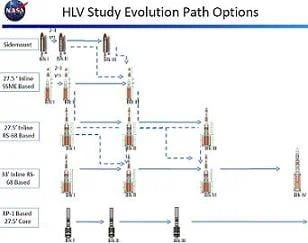
The Shuttle Derived Heavy-Lift Launch Vehicle (SD HLV) Assessment has been completed, the result of applying years of historical expertise from members of the Space Shuttle Program (SSP) and others into a follow-on vehicle. The focused effort over 15 months to create a post-shuttle masterplan has fostered HLV options that could be completed to a Block II Full Operational Capability for around $7.8 billion.
Background:
Numerous studies into a follow-on replacement for the Space Shuttle – which utilizes the hardware, infrastructure and skill set workforce – have been created and presented over recent years, mainly based around two concepts; an inline launch vehicle and a sidemount vehicle.
Such studies range back to before the Vision for Space Exploration (VSE) – which ultimately decided on the 1.5 architecture of Ares I and Ares V, via the 2005 ESAS (Exploration Systems Architecture Study).
See Also
- Fy2011 Forum Section
- L2 Ares/HLV/Orion Sections
- Click here to Join L2
Alternatives to the Ares approach included the unofficial, yet highly public Direct team effort on a Jupiter Inline family of launchers and architectures, and an official – but behind the scenes – Sidemount effort, which became a larger team effort in late 2008.
SSP manager John Shannon was able to publicly present the status of the preliminary Sidemount effort to the Augustine Committee’s review into Human Space Flight in 2009, covering a variety of disciplines, even as engineers continued to add and refine the Sidemount system.
In late 2009, Mr Shannon requested the Inline SD HLV to be included in the analysis to provide a comparison with the Sidemount system. Sources note the Inline systems were developed independently by Mr Shannon’s team, as opposed to directly using the Jupiter vehicle blueprints, despite meetings between NASA officials and the Direct team members, and the great similarity between the architecture.
 NASA also requested for a trade study (HLLV Study) to be carried out on the HLV options, notably between the RP-1 booster, Sidemount and Inline systems. The SSP Assessment effort, however, ran independent of that study, but provided input.
Rocket building kits
(adsbygoogle = window.adsbygoogle || []).push({});
Work continued in earnest until President Obama’s 2011 budget was unveiled in February, which proposed the cancellation of the Constellation Program (CxP), but also the use of Shuttle-derived systems, with SSP given notice to shut down their HLV study activities by completing the documentation of their findings.
The documented effort on the SD HLV was completed this month, resulting in an impressive – and highly extensive – 726 page presentation, which was acquired by L2.
“This document describes the pre-Phase A concept definition, studies, and analysis results generated by the Space Shuttle Program on various Shuttle-derived Heavy-lift Launch Vehicle (HLV) concepts over a 15-month timeframe from December, 2008 through February, 2010,” noted Mr Shannon in the foreword of the presentation, dated June 8.”
 “The work was performed in response to questions from the 2008 Presidential Transition Team, the Augustine Committee’s ‘Review of United States Human Space Flight Plans,’ and a 2009 internal NASA assessment of Heavy-lift Vehicles. Subsequent to the release of the President’s proposed FY2011 budget in February 2010, HLV assessment activity was halted and effort began to document the preliminary results.
“This document reflects the hard work and dedication of individuals representing the Space Shuttle Program and its contractor community. The contributions of this team have contributed to the Agency’s understanding of Heavy-lift Vehicles and are greatly appreciated.”
“When the HLV assessment was stopped, some work was left unfinished, as noted by the inconsistency in detail found in the various sections. Results documented in this document should be considered similar to a Pre-Phase A collection of concept studies. A sound project formulation activity would be required to add necessary detail.”
“This document is under configuration control of the Space Shuttle Program… to preserve the knowledge developed by the subject activity.”
*Click here for NASASpaceflight.com HLV Articles*
A Smooth Transition:
The focus of the assessment – which concentrates on the Sidemount option – is based around a block transition of existing Shuttle hardware, for early flights using remaining assets left over after Shuttle, prior to the upgrading via new hardware and software.
“Shuttle derived is the dominating factor that sets these studies apart from other similar assessments. This objective was to maximize the use of existing Space Shuttle skills and assets for developing and operating the HLV. This includes using the flight hardware, the flight software, the facilities, the processes and the skilled contractor and civil servant personnel that have been used successfully on the Space Shuttle,” noted the Executive Summary.
 “A block development approach was adopted to provide the earliest possible capability at the lowest cost and risk, and then evolve that capability over time. Block I uses the residual Shuttle flight hardware with little or no modifications, while Block II would replace the Shuttle subsystems and elements with new hardware and software when the existing assets ran out.”
As previously noted in memos on the ongoing studies, hardware availability allowed for the potential for around three flights of the Block I SD HLV. Extensive outlines on the actual stock count of SD hardware is provided later in the presentation.
“The existing inventory of the certified flight hardware is sufficient to support three or more flights after the Shuttle’s planned retirement. The only major new development for Block I would be the Payload Carrier (PLC) that replaces the Orbiter on the side of the External Tank (ET),” the summary continued.
“Block III upgrades could be done later to increase performance and reduce launch costs to support NASA’s future needs.”
Also key to the findings, the proposed HLV is part of a larger mission architecture, one which could provide additional support for the International Space Station (ISS) if required, mainly via cargo capability, but also via crewed versions of the vehicle, and on to Lunar mission support and beyond.
The presentation also noted that the crewed HLV version would utilize the Orion in its original role of transporting astronauts into orbit and back, as opposed to the FY2011 proposal of an interim role only as a Crew Rescue Vehicle (CRV) on the ISS.
“The HLV is primarily for cargo and provides an excellent foundational capability for heavy-lift. It can deliver 80 metric tons (mt) of gross cargo to Low Earth Orbit (LEO), 45 mt to the International Space Station (ISS), 30 mt to Geosynchronous Orbit (GEO) and 8-10mt to the lunar surface.
“A capsule such as the Orion Crew Exploration Vehicle (CEV) can be added to the top of the PLC to carry crew to the ISS or do manned lunar or other crewed missions. A Launch Abort System (LAS) can be added to this crewed configuration which would significantly improve the estimated loss of crew (LOC) rate by a factor of 5 to 10 compared to the current Space Shuttle.”
“The goal was to have the HLV ready and tested prior to the planned Orion completion so it could be used as a crewed launch vehicle or as a backup for a commercial crewed launch vehicle.”
The Executive Summary also reported the findings that the Inline version of a SD HLV is at a disadvantage to the Sidemount, based on schedule and cost and degree of infrastructure changes. However, while the presentation focuses mainly on the Sidemount, due to the late start to the Inline study, both versions – along with the potential to start with Sidemount, before merging into an Inline vehicle – are deemed to be feasible.
“Late in the HLV concept definition studies, the HLV team was asked to evaluate an inline Shuttle derived HLV development with same approach and strategy to use existing Shuttle assets and compare those results to the side mount HLV,” continued the Executive Study.
“The in-line HLV performance results were very similar to the side mount HLV since using the same number of Solid Rocket Booster (SRB) segments, the same number of Space Shuttle Main Engines (SSME) and propellant loads were basically the same. Block I development would take about two years or longer than the side mount.
“Building the PLC for the side mount and adding a new thrust structure to house the SSME’s on the bottom of the ET for the in-line core stage would be a wash. The largest difference would be that the launch pad and the mobile launch platform (MLP) would require a launch tower for the taller in-line vehicle and considerable changes to the MLP and the Tail Service Mast (TSM) configuration.
 “These additional changes for the in-line HLV could take longer and would cost more than the side mount. This document contains more information for the side mount than the in-line HLV due to the late start on the inline.”
“Both are feasible and could provide a heavy-lift capability much sooner than a new heavy-lift launch vehicle. A viable option (no cost analysis yet) could be to start with the side mount first then evolve to an in-line HLV if and when needed.”
The summary also noted what is arguably the most attractive elements of a SD HLV-based transition; schedule, cost, and skillsets. Operational proficiency , a key aspect in flying safely and minimizing the gap in the current SSP operations team, is a critical driver and very perishable. Loosing the critical skills only to hire and train a new team seven years in the future could be very disruptive.
“These studies identified some major advantages in pursuing a Shuttle derived HLV capability as soon as possible. First, it retains the Shuttle infrastructure and critical skills needed to fill the gap in our nation’s human launch capability, and maintaining the United States’ leadership in space exploration.
“Second, it would provide a foundational heavy-lift launch capability that could support maintenance and growth for the ISS, it could be used to develop a propellant resupply depot in space, and it could be used to demonstrate critical subsystems and elements that would expand or raise the technology readiness level for future deep space operations. It could also support flexible path missions beyond LEO that would be building blocks and validate the systems needed to eventually go to Mars.”
“The primary advantage is that the Shuttle derived HLV provides a foundational heavy-lift capability soon, at affordable costs and relatively low risk, thus enabling meaningful development and space operations missions while providing the time and resources to develop the technologies and systems to meet our future space exploration needs.”
Interestingly, while the study team’s primary goal is to document the findings of the extensive studies, as opposed to enacting an effort that is currently opposed by the FY2011 proposal, an element of hope is noted for the documentation to become the basis of a commercial proposal for a HLV that would fit into President Obama’s outline for NASA’s future.
“The intent in documenting the results of these HLV concept definition studies and analyses is to make this wealth of information available to the Shuttle contractors and the commercial space systems development and operations community to meet our country’s space exploration needs,” the summary added.
“We encourage the use of this data to support a commercial venture that would own and operate a Shuttle derived HLV system. Commercial ownership and operation of such a Shuttle derived HLV system may be a practical way to significantly reduce the operating costs to fly the current Space Shuttle while providing a near term, low risk heavy-lift capability for our national space program.”
Sidemount SD HLV:
With history back as far as the Shuttle-C concept, the Sidemount HLV is the most natural of the transitions from the STS design.
“The side mount HLV make extensive use of legacy Space Shuttle assets. The primary ascent elements of the SSP [ET, RSRB, SSME] are unchanged from their current configuration,” outlined the presentation.
 “The main propulsion module is connected to the ET in the same manner as the Shuttle except there is no requirement for disconnects as the module remains attached to the ET after main engine cutoff. The avionics and software of the Orbiter will be virtually unchanged from their current configuration and functions, and are to be mounted in either the HLV aft propulsion module or distributed on the Payload Carrier (PLC).”
The first flight of the Sidemount HLV would have utilized the spare ET-94 tank, currently housed at the Michoud Assembly Facility (MAF) in New Orleans. This tank is a LWT (Light Weight Tank) as opposed to the SLWT (Super Light Weight Tanks) currently used by the Shuttle to achieve larger masses to be carried uphill.
“The earliest flight configuration of the side mount HLV could use an existing Lightweight External Tank (ET-94) and a propulsion module boat tail based on the existing Shuttle design. Later versions of side mount HLV would use Super Lightweight Tanks (SLWT) and a new design boat tail housing the SSMEs.”
“The primary new element is the Payload Carrier with a payload envelope of 7.5-m x 30-m. The selection of a 7.5-m diameter was picked as the latest practical diameter that support future missions. Further analysis has shifted the focus to smaller lander designs for lunar orbit rendezvous missions and EDS designs based on a cluster of RL-10 class engines.
 “While such later designs could be accommodated using a 6.5-m diameter Payload Carrier, it was decided to retain the larger diameter for future mission growth. Fairing elements of the Payload Carrier are jettisoned during the ascent to increase payload capabilities.”
Analysis of the use of a propulsion/avionics module was also conducted to provide a future option to recover “high value assets” following launch of the HLV – namely the SSME engine systems and avionics.
“Because the staging point of the SSME propulsion is around Mach 17 for a J-2X upper stage or Mach 24 for an RL-10 upper stage, the module would reenter and land in the Atlantic Ocean.
Inline SD HLV:
 As referenced by the Direct Team’s Jupiter Inline vehicle concepts, this design also has a history reaching back as far as the Marshall Space Flight Center (MSFC) studies (1990s) to design a shuttle-based heavy lift cargo vehicle to compliment the Space Shuttle. Known as the National Launch System (NLS), the concept was deemed to have significant merit – before being deleted due to budgetary concerns.
“The SSMEs and RSRBs are used unchanged. The propulsion module is positioned at the aft end of the in-line tank and the payload carrier is placed in-line above the tank,” noted the presentation on both commonality and changes. “Because of the axial and bending loads the in-line tank requires strengthening beyond that of a standard External Tank design.
“In addition the forward LOX tank is redesigned from the ogive shape of the External Tank to a cylindrical tank section with elliptical domes.
“There are more extensive changes to the Mobile Launch Platform, Fixed and Rotating Service Structures, and tail service masts to accommodate the taller in-line configuration. There are also significant changes in the Vehicle Assembly Building (VAB) to assembly and servicing platforms. Payload fairings are jettisoned on the way to orbit to increase payload capabilities.”
 A fascinating mitigation of numerous infrastructure challenges would be to place the SSMEs/MPS on the side of the Inline vehicle, which would mirror the STS aft end on the current MLP and Pad.
“An alternative HLV configuration was also examined late in the study period. This hybrid concept uses an in-line mounting of the payload at the upper end of the in-line Shuttle derived tank, but retains the SSME engine placement in the side mount position as on the Shuttle.
“The intent was to define a low-cost, interim flight demonstration vehicle that allowed use of an existing External Tank and minimized infrastructure changes especially at the MLP.
However, this concept also has challenges of its own, such as offloading propellants during a pad abort, and axial and bending loads on the intertank region.
“A notional extensibility approach for operational vehicles using this hybrid concept is shown (in the graphic – left). The advantages include reducing the number of changes to the launch pad and also providing for easier detachment of the propulsion modules when used in conjunction with the recovery module concept presented (see reference in Sidemount overview).”
Upper Stages:
Suborbital staging to increase payload capabilities is a charge that has sometimes been cited in opposition to the ESAS findings, which – mainly due to the restrictive timeline of the study – was deemed to have only made a cursory examination of the SD HLV options, notably Sidemount.
The design of the Upper Stage is a key element to the ability of the HLV, to conduct the mission of interest.
“The HLV has the capability of taking large cargo to an orbital or suborbital stage point. For a useful mission this cargo must contain the propulsion necessary to carry payloads to a final destination. This propulsion element may be integrated with the payload, but usually takes the form of an upper stage. Examples of upper stages include existing and new designs.
 “Early deployment of payloads to LEO or beyond LEO using Block I HLV could utilize existing stages such as the Delta IV or Atlas V upper stages. Such stages could support demonstration missions such as a lunar swing-by Orion test mission or GEO deployment of a Space-based Solar Power Satellite demonstrator.”
“Block II and Block III HLV would also use new design upper stages based on various rocket engines including J-2X and the RL-10 family.”
Engineers went back further into the history of the program for the Upper Stage evaluations, referencing the engine used during the Apollo era.
“Existing systems were compared against mission needs and the original Apollo upper stage, the S-IVB, to highlight attributes of a successful configuration.
“By taking this approach, the development of a fully integrated HLV flight system is possible that maximizes the application, with minimal redesign, of the Shuttle elements which remain in near-term production while replacing those elements – with the exception of the Payload Carrier – that are not in production with those derived from existing Evolved Expendable Launch Vehicle (EELV) systems.”
“This creates an overall vehicle capable of high performance, but with minimal development time and cost. A smaller and simpler upper stage derived from commercial experience also eliminates a large measure of the upper stage propulsion, avionics and systemic development efforts and refocuses those efforts on tailoring a stage uniquely suited to the requirements of a Shuttle derived Heavy-lift Launch Vehicle.”
The Block I, II, III approach:
The three block approach would apply to both the Sidemount and Inline vehicles, a building block design approach that was determined as the best way to minimize cost and utilize Shuttle assets. There are three blocks in total, with Block I including a Proto Demo Test Flight for the in-line configuration.
 “The Block I HLV utilizes existing Shuttle assets wherever practical. The first flights are based on a large inventory of existing assets including RSRB, ET, SSMEs, avionics and software and other subsystems. The RSRBs are used unchanged,” the presentation outlined.
“For side mount HLV the External Tank is unchanged except for minor modifications to ET bipod and thermal protection in targeted areas. Block I inline HLV will require a development effort for the in-line tank. Legacy SSMEs are housed in the propulsion module structure based on the existing Shuttle boat tail for the side mount HLV or on a new design for the in-line configurations.”
“Shuttle avionics and software and other applicable subsystems (e.g. APU, RCS) are modified or used unchanged. A new payload carrier with jettisonable fairings is developed. Existing upper stages may be used for various mission types.”
“Block II HLV: New production expendable SSMEs are used. These SSME are routinely run at 109 percent power level during ascent which will necessitate several minor modifications to the MPS (e.g. LH2 feedline flowliners, GO2/GH2 flow control valve orifices, etc.). The side mount ET has further strengthening in localized ring frame areas. A new design side mount propulsion module replaces the Shuttle boat tail design.”
“The payload carrier design for cargo is modified for crew. Improved subsystems (non-toxic propellants, electromechanical actuators, etc) are used. Crew capability is provided using the Orion spacecraft with Launch Abort System. Provided are new avionics computers with emulation of current Shuttle computer architecture allowing current flight software to be used with little modification and low risk.”
 “For larger payload flights beyond LEO a new Earth Departure Stage (EDS) is developed. Initially the J-2X engine from the Constellation program was baselined. However, later trade studies showed that an EDS based on RL-10 engines provided a lower mass and higher payload solution for missions beyond LEO.”
“Block III HLV: To maximize payload to orbit, the Block III HLV uses four SSMEs housed in a reconfigured propulsion module design. These expendable SSMEs are routinely run at 111 percent power level during ascent. Significant modifications to the MPS will be needed to accommodate this configuration. The 4-segment RSRBs are replaced by 5-segment RSRBs for higher thrust.”
“The External Tank or in-line tanks are lengthened to accommodate a higher propellant load. The EDS from Block II also has increased propellant capacity tanks. This results in a 33 percent increase in payload capability over Block II.”
Available Assets from STS:
A large effort was placed into inventory analysis of existing and required systems for – at the very least – the Block I flights, along with ground rules and associated costs and procedures on contract awards. Key areas – such as available ET, SSME and SRB hardware – provided an interesting status review of overflow STS assets.
“SSMEs: The SSME Project Office presented to the Shuttle derived Heavy-lift Launch Vehicle (SD HLV) team on two occasions. The Pratt & Whitney designation for the current configuration SSME is RS-25D,” noted the presentation.”
“The first SSME Project Office presentation to the HLV team occurred on August 21, 2009. This briefing was in response to questions from the HLV team attempting to validate a cost analysis performed at the request of the HLV team. The SSME Project was asked to assess the reasonableness of the cost estimate as well as its associated assumptions.”
“The SSME Project determined the cost estimate to be reasonable with the following two exceptions: a. The estimate lacked sufficient funds to provide for tooling and infrastructure investments necessary to meet 15 engine per-year production goals. The SSME Project recommended adding 125 million dollars for capital investments. b. The estimate lacked sufficient funds to provide for design, development and certification costs. The SSME Project office recommended adding funds.”
“The SSME project recommended maintaining the current concept of operations for RS-25 fabrication, assembly, test and delivery. In this process, line replaceable units (LRUs) are completed by PWR and shipped to Kennedy Space Center (KSC) for engine assembly. Assembled engines are then shipped to Stennis Space Center (SSC) for acceptance testing, after which they are shipped back to KSC for installation and flight processing.”
A reference is also made to a decision that was noted by the all-powerful Program Requirements Control Board (PRCB) meeting in January of this year, where a proposal was put forward to delay the disposal of SSME assets, pending ‘future launch vehicle architecture’ decisions, which – as per the SD HLV presentation – now appears to have been an extension to the ‘feasibility’ of SSME production restart.
“At the time of the briefing, SSME production restart was feasible. The assessment determined that in-house tooling and critical skills were still available to enable restart. Further, the majority of vendors were still available. However, some vendor restart funds would be required. It was determined that the Space Shuttle Transition and Retirement activity posed a significant risk to potential future RS-25 production,” the SD HLV presentation added, before noting flight rate demands.”
“Two potential design changes were presented as necessary. The current RS-25 main combustion chamber would likely be replaced with a Hot Isostatic Pressing (Hip) Bonded MCC to help meet production rate goals. The current engine controller would be replaced after the current inventory was depleted. The current controller is made of electronic parts which are not currently available. Therefore a new design would be required.”
“The HLV team proposed a flight rate which would require up to 15 RS-25 engines per year. Heritage RS-25 production has not emphasized delivery schedule for many years. Rather, production was driven by funding and other resources demands. This brings into question the use of historical production actuals as the basis for estimates in a high-production rate environment. This further illustrates that caution should be used when doing so to ensure valid estimates.”
In total, 15 SSMEs are expected to be available at the end of the current Shuttle manifest, along with two development engines.
“Projections at the time of the briefing indicated that 15 current configuration (Block II) RS-25D flight engines would be available at the end of the current SSP manifest which included flights through STS-134. Additionally, 2 development engines would also be available. This projection included completion and acceptance testing of engine 2062 and 4 high-pressure turbopump recycles which were unfunded at the time of the briefing.”
 A reference is also made to a new version of the SSME, called the RS-25E, which aids the HLV benefits via lower costs.
“The RS-25E design consists of design and process changes necessary to lower the per-unit cost as well as decrease the required production cycle time. An attempt was made to strike a balance between retaining current RS-25D reliability, while sufficiently improving cost and fabrication time with minimal design, development and certification requirements.”
“The previous end of program forecast indicated that 15 legacy flight RS-25Ds and 2 development RS-25Ds would be available. The recommendation to the HLV team was to assume 12 HLV flight ready RS-25D assets. This would provide 3 flight and 2 development engines for RS-25E development and certification testing, as well as stage/main propulsion test article (MPTA) testing.”