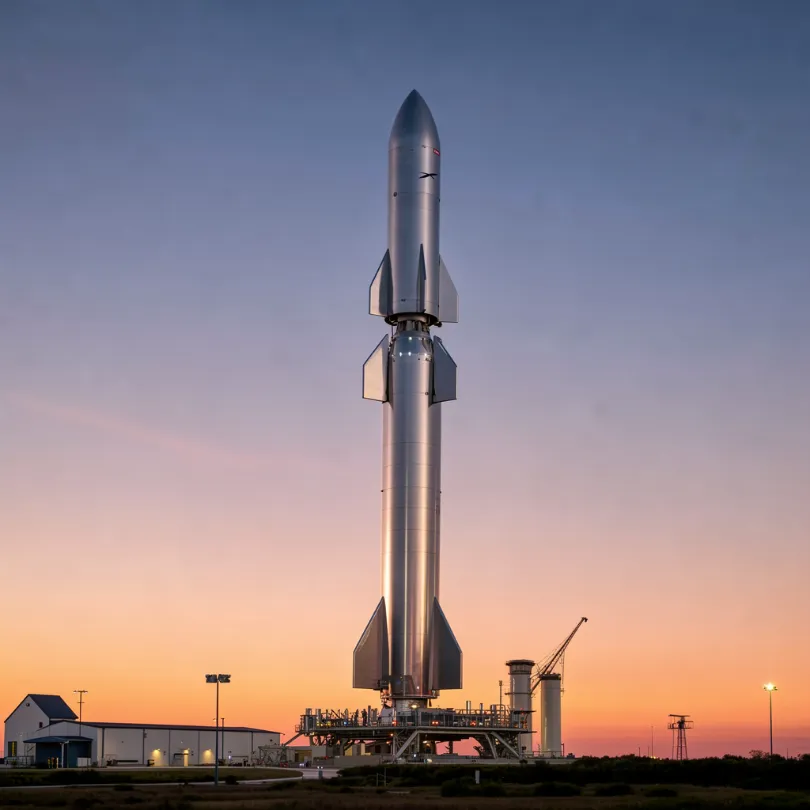
The 90-minute launch window opens at 6:45 p.m. EDT from Starbase, Texas. During the July 16 attempt, four of the Super Heavy booster’s 33 Raptor 3 engines failed to ignite as the countdown reached zero, triggering an automatic abort seconds before liftoff. Flight 13 will repeat most of the objectives of Flight 12 while adding a first: the deployment of 20 next-generation Starlink V3 satellites from Starship’s payload bay.
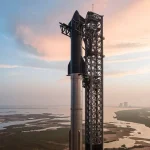
V3 is Starship’s largest rocket yet at 408 feet (124 meters) tall, making it the tallest rocket ever flown. Each of Super Heavy’s 33 Raptor 3 engines produces 551,156 pounds (250 metric tons) of thrust, giving the booster over 18 million pounds (8,160 metric tons) of combined thrust at liftoff. Justin Styer, a senior director at SpaceX, compared that power to “11 Ford F-150 trucks per second zipping out of the bottom of the rocket.” V3 also has three larger steering fins in place of V2’s four, redesigned fuel lines so all 33 engines can fire together more reliably, and hardware that will let two Starships dock and transfer fuel in space.
On Flight 12 in May, the upper stage reached its planned suborbital trajectory, deployed dummy satellites, and survived reentry with its heat shield largely intact, though it lost one of its three vacuum-optimized Raptor engines about 40 seconds after separation. The booster fared worse. Differences in engine startup timing threw off its flip maneuver by roughly 90 degrees, and five engines failed to relight during the boostback burn, causing it to hit the water at high speed. The FAA classified the flight a mishap and grounded Starship until SpaceX completed an investigation, which closed July 13 with the agency clearing Flight 13.
For Flight 13, SpaceX reworked the booster’s startup sequence, made hardware changes to Super Heavy’s engines, and updated the boostback relight system. Starship’s propulsion system also received fixes after Flight 12’s engine loss. If the launch proceeds, Super Heavy will lift off and separate about two minutes later, then attempt a landing burn and splashdown in the Gulf of Mexico. Starship will continue on its suborbital trajectory before deploying 20 Starlink V3 satellites, which will extend their solar arrays and antennas and attempt to link with the broader Starlink constellation via lasers before burning up about 20 minutes after deployment. Six of the satellites carry cameras aimed at Starship’s belly to gather imagery of the heat shield. Starship will also attempt an in-space relight of one Raptor engine, a test skipped on Flight 12, before a guided reentry and splashdown in the Indian Ocean roughly an hour after liftoff.
Flight 13’s success is crucial for NASA’s Artemis program. NASA selected Starship as the human landing system for Artemis 4, the first lunar landing since Apollo 17. Before that, SpaceX must prove it can refuel one Starship using another in orbit, a maneuver that depends on the version of the rocket being tested this week.
SpaceX has not announced a date for the orbital refueling demonstration. A successful Flight 13 would move the company one step closer to it.