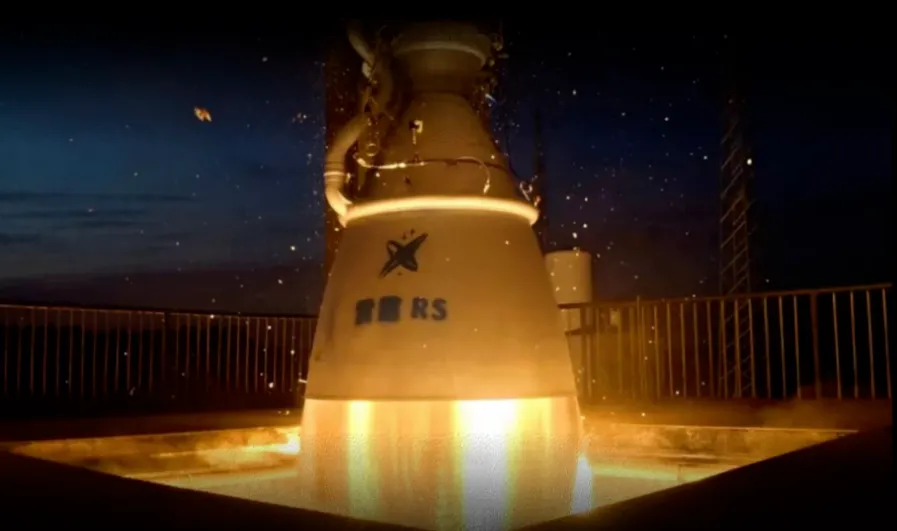
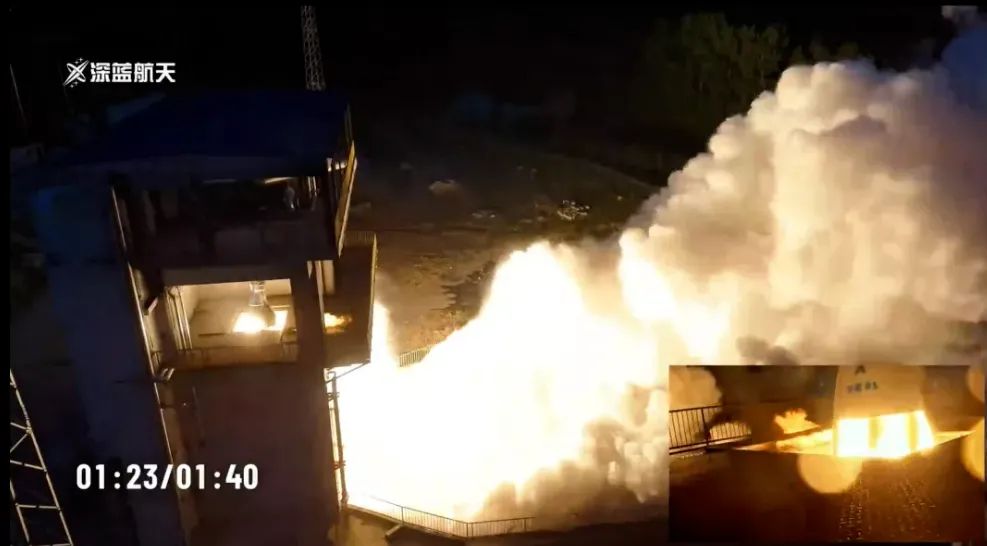
August 21 — Deep Blue Aerospace has successfully completed a 100-second, long-duration steady-state hot-fire test of its 130-tonne-class THUNDER-RS liquid oxygen/kerosene engine at the company’s liquid rocket engine and propulsion-system test facility.
The engine operated steadily and without faults throughout the test, achieving all test objectives. The milestone marks a key engineering breakthrough for high-thrust reusable propulsion in China’s commercial space sector.
Test data showed that the THUNDER-RS generated 1,297.5 kilonewtons of thrust, equivalent to approximately 132.3 tonnes-force. All operating parameters closely matched their design targets. The test fully validated the reliability of the complete engine while assessing the thrust chamber’s thermal-protection capabilities under prolonged exposure to high temperatures and pressures. The control system and other core hardware were also subjected to realistic, sustained operating conditions.
The THUNDER-RS is China’s most powerful gas-generator-cycle, pintle-injector liquid oxygen/kerosene engine. The 100-second test represents a significant step in scaling this technological approach from smaller engines to a high-thrust, 100-tonne-class propulsion system.
Designed as the primary propulsion system for the large reusable NEBULA-2 launch vehicle, the THUNDER-RS incorporates independently developed core technologies. It uses a gas-generator-cycle architecture and a pintle injector developed in-house by Deep Blue Aerospace, while extensively employing integrated metal 3D-printing processes.
Pintle injection is one of Deep Blue Aerospace’s signature technologies. It has already undergone multiple rounds of validation on smaller engines and has now been applied to a 100-tonne-class high-thrust model. Metal 3D printing simplifies the engine’s structure, shortens development cycles and further improves its reliability and potential for repeated use.
Why does the space industry attach such importance to a 100-second long-duration test?
A short-duration firing can verify whether an engine starts and shuts down properly, but 100 seconds of steady-state operation broadly covers the principal powered phase of a rocket flight. It is therefore a critical threshold that an engine must cross before progressing from a prototype to an engineering-ready system.
Such a test comprehensively evaluates the engine’s structural strength, thermal-protection system and coordination among its various components while simulating sustained operation under actual flight conditions. By passing the 100-second steady-state threshold, the THUNDER-RS has moved beyond the laboratory-prototype stage and laid a solid foundation for subsequent tests involving an 11-engine cluster, rocket recovery and reusability.
Propulsion is the lifeblood of a reusable launch vehicle, and engine maturity directly determines the pace of the overall rocket development program. With the THUNDER-RS completing its long-duration test, development of Deep Blue Aerospace’s large reusable NEBULA-2 rocket is now accelerating.
Work is proceeding simultaneously on the vehicle structure, avionics and control system, recovery-navigation system, servo mechanisms and other major subsystems. Deep Blue Aerospace follows a development strategy of achieving an engine breakthrough before beginning full rocket integration. By progressively accumulating ground-test data, the company aims to reduce the risks associated with subsequent integration and flight testing.
Competition in China’s commercial reusable-launch-vehicle market is intensifying. Companies are moving from conceptual designs to hardware validation, with high-thrust liquid engines and rocket-recovery technologies reaching milestone after milestone.
The principal value of reusable rockets lies in reducing launch costs per mission and supporting large-scale satellite constellation deployment, near-Earth space development and space-station resupply. Highly reliable reusable propulsion is an indispensable prerequisite for achieving commercial operations at scale.
The THUNDER-RS engine’s 100-second test represents an important building block in the industry’s continued progress. Deep Blue Aerospace plans to conduct further routine ground testing and technological iterations to refine the high-thrust engine, advance the reusable NEBULA-2 toward design finalization, and provide China’s commercial space industry with highly reliable, low-cost space transportation solutions.