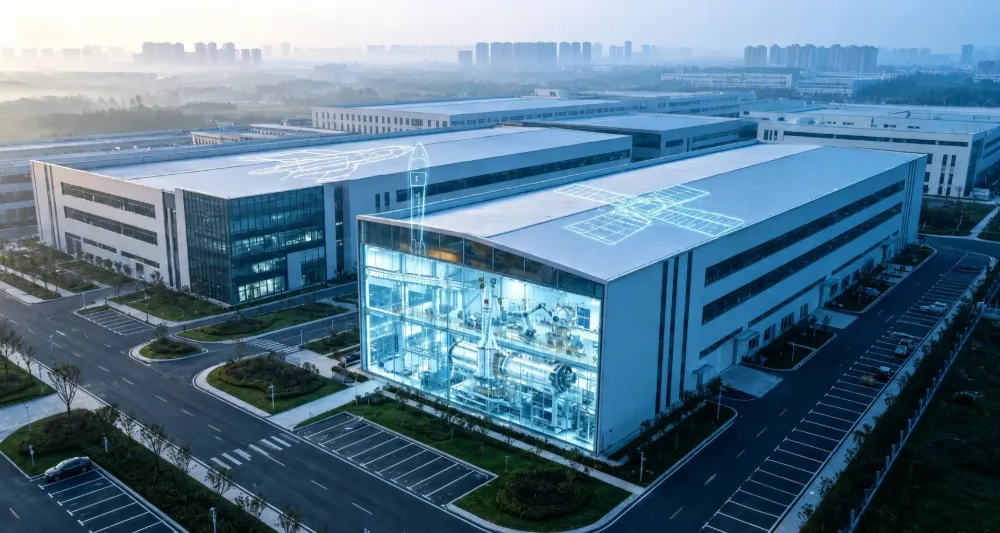
According to information released on August 24 by the Shaanxi Provincial Public Resources Trading Center, two wholly owned subsidiaries of Western Aerospace Technology (Shaanxi) Group — Western Satellite Technology (Shaanxi) Co., Ltd. and Western Launch Vehicle Technology (Shaanxi) Co., Ltd. — have disclosed construction tender plans for a satellite super factory and a rocket super factory, respectively.
The two projects carry a combined estimated investment of more than RMB 3.8 billion and are both expected to launch invitation tenders on September 20, 2026. The move marks a transition from the planning and feasibility stage into tender preparation, although further progress will still depend on formal tender announcements, land approvals, construction permits, and final contract awards.
Located in Xi’an High-Tech Zone, the project will cover a total of 725 mu (about 48.3 hectares) and be developed in two phases. Phase I will occupy 171 mu, while Phase II will cover 554 mu. The site is planned as an integrated manufacturing hub combining satellite and rocket assembly, testing, and inspection capabilities, while also attracting upstream and downstream suppliers to form one of western China’s few fully integrated satellite-and-launch-vehicle industrial clusters.
Shaanxi has long been one of China’s major aerospace centers, but its strengths have historically been concentrated in component manufacturing and supply-chain support. The province has lacked large-scale system integration capabilities for complete satellite and launch vehicle assembly and testing. If completed as planned, the two super factories could fill this gap and help transform the regional commercial space industry from a component supplier base into a full spacecraft and launch vehicle manufacturing center.
Under the company’s publicly announced long-term “Thousand Satellites, Hundred Rockets” strategy, Western Aerospace also plans to introduce two proprietary brands: the “Xiwei” satellite brand and the “Daqin Launch” rocket brand.
On the financing side, multiple banks have provided a combined RMB 50 billion comprehensive credit framework agreement for Western Aerospace. In parallel, provincial, municipal, and district-level authorities have jointly established a RMB 5 billion commercial space industry fund, with an initial RMB 1.5 billion tranche already deployed through direct investment. The fund is expected to focus on satellite and rocket manufacturing as well as related supply-chain development. Both the credit facilities and fund commitments remain framework arrangements, with capital expected to be released in phases according to project milestones.
In research and development, the company has partnered with Xi’an Jiaotong University, Northwestern Polytechnical University, and Xidian University to establish three innovation institutes focused on satellites, launch vehicles, and telemetry, tracking and control technologies. The collaboration also includes the launch of the Xi’an Commercial Space Industry Innovation Center to accelerate the transition of research achievements into engineering applications.
On the policy front, Xi’an High-Tech Zone has released its Three-Year Action Plan for High-Quality Development of Commercial Space (2026–2028), introducing measures covering enterprise cultivation, technology development, project implementation, and talent recruitment. The plan is intended to provide long-term support for the growth of the local commercial space ecosystem.
Across China, multiple regions are pursuing integrated satellite-and-rocket manufacturing bases as competition in the commercial space sector intensifies. Xi’an’s deep aerospace heritage has traditionally been centered on component production. With the satellite and rocket super factories advancing toward the tendering phase, the city could strengthen its capabilities in complete satellite and launch vehicle assembly, creating a dual-engine growth model built around both rockets and satellites and providing industrial support for the large-scale deployment of low-Earth-orbit satellite constellations.