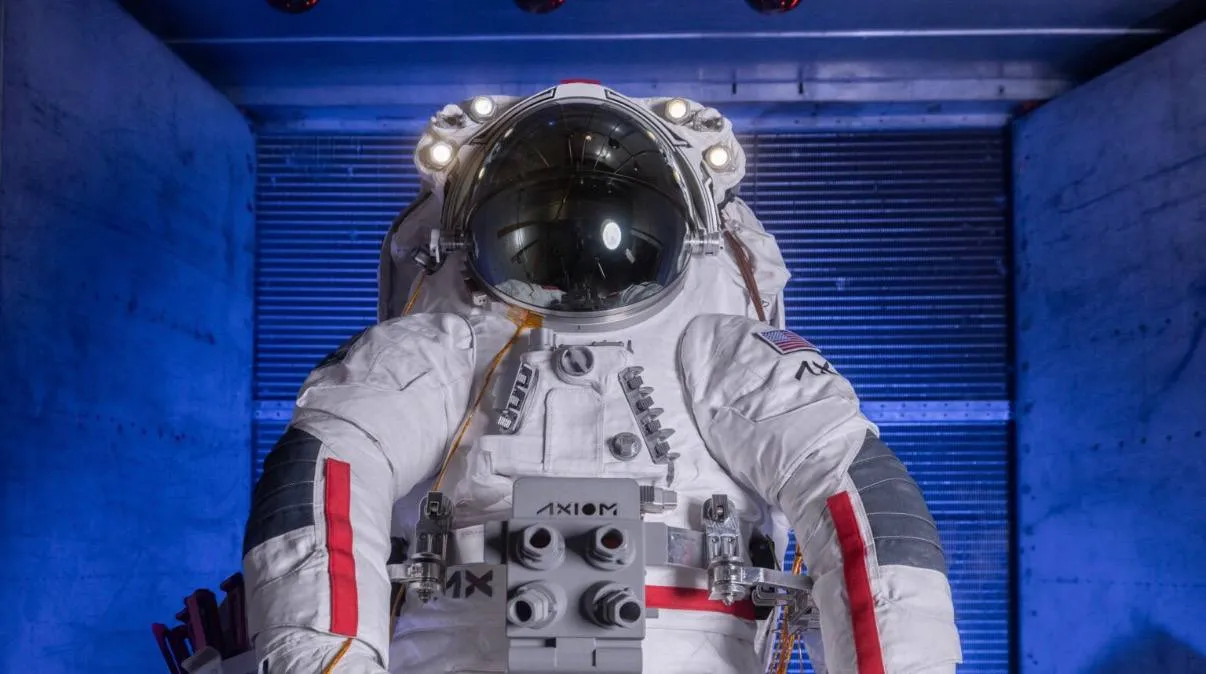
NASA is working with Axiom Space on a lighter and less complex version of its next-generation lunar spacesuit as the agency attempts to preserve a 2028 crewed Moon landing under Artemis IV.
The new configuration, referred to as the “Sortie Suit,” is intended for the first Artemis surface missions using lunar landers developed by SpaceX and Blue Origin. The effort is being directed by Artemis Program Manager Jeremy Parsons and was disclosed during an internal NASA meeting in the week of August 31.
The revised suit is expected to reduce mass, remove requirements that are not essential for the initial landings and simplify the physical and operational interfaces between the spacesuit and the two commercial Human Landing Systems.
NASA has not indicated that it is abandoning Axiom Space’s AxEMU architecture. The Sortie Suit instead represents a reduced-scope variant intended to support shorter early missions before more capable configurations are introduced as Artemis surface operations mature.
NASA Prioritizes Near-Term Lunar Operations
The redesign reflects a broader attempt to align individual Artemis systems with the actual demands of the first landing missions. Under NASA’s current architecture, Artemis III is scheduled to conduct crewed demonstrations in low Earth orbit in 2027, potentially involving Orion, one or both commercial lunar landers and the AxEMU.
Artemis IV would then attempt the first crewed lunar landing of the Artemis program in 2028. Four astronauts would travel aboard Orion to lunar orbit, where two would transfer to a lander, descend to the lunar South Pole and spend approximately one week conducting science and collecting samples.
Axiom’s original suit requirements extended well beyond the minimum capability needed for such an initial sortie. NASA required the suit to support six extravehicular activities during a 6.5-day surface mission. It also had to remain available for additional spacewalks for as long as 210 days after being placed in dormant storage.
The thermal-control system was additionally required to support at least two hours of nominal operations inside an exceptionally cold permanently shadowed region. Those areas are scientifically important because some may preserve water ice and other volatiles, but designing for them adds considerable thermal, power and life-support complexity.
NASA is now shortening some certification-duration requirements and adjusting other specifications around near-term missions. Aerospace Safety Advisory Panel member and former astronaut Charlie Precourt said in early September that NASA leadership had been meeting with Axiom six days a week, frequently in person, to address schedule and performance concerns.
Mass Reduction Could Ease Multiple Integration Problems
A lunar spacesuit is effectively an independent spacecraft incorporating pressure containment, oxygen supply, carbon-dioxide removal, thermal regulation, communications, avionics and micrometeoroid protection. Additional endurance and environmental requirements tend to propagate throughout the design rather than affect only one subsystem.
Longer dormant-storage capability, for example, can require additional protection against material degradation, leakage and contamination. Operations in extreme cold can demand more insulation, thermal-management capacity and qualification testing. Added layers and hardware increase mass and may also make the pressure garment stiffer, reducing astronaut mobility.
These effects are particularly consequential on the Moon. Although lunar gravity is only one-sixth of Earth’s, astronauts must repeatedly kneel, recover from falls, collect samples and manipulate tools while carrying the suit’s full inertia. Excess mass can therefore increase fatigue and complicate emergency recovery even when its static weight is comparatively low.
A lighter suit would also reduce demands on the landers. Both SpaceX’s Starship HLS and Blue Origin’s Blue Moon must accommodate suit storage, charging, consumables, maintenance and crew donning and doffing. Simplifying the suit-to-lander interface could limit redesign work in airlocks and crew compartments while reducing the amount of specialized ground and flight hardware each provider must develop.
Interoperability has already emerged as a program concern. Axiom selected a suit connection arrangement different from the NASA reference interface used in Blue Origin’s lander planning, potentially requiring changes to the Blue Moon crew-module airlock or dedicated donning and doffing equipment. A common, less complicated interface would reduce the risk that suit development becomes a separate integration path for each lander.
AxEMU Development Has Advanced, but Certification Work Remains
NASA selected Axiom Space and Collins Aerospace in June 2022 under the Exploration Extravehicular Activity Services program. Rather than buying and owning the suits, NASA planned to purchase spacewalking services from commercial providers through firm-fixed-price task orders.
Collins withdrew from its assignments in 2024 after the company and NASA determined that it could not meet the agreed schedule. That left Axiom as NASA’s only active provider for both lunar-surface and International Space Station replacement suits, reducing the competitive redundancy envisioned when the program began.
Axiom nevertheless passed a contractor-led technical review of the AxEMU by February 2026. At that point, components for the first flight unit were beginning to arrive ahead of assembly. NASA and Axiom had also completed more than 850 hours of human-in-the-loop pressurized testing, including underwater evaluations and reduced-gravity exercises focused on mobility, geology tasks and emergency rescue.
Those accomplishments do not complete flight certification. The suit must still pass NASA design reviews and an extensive verification campaign covering life support, structural integrity, thermal-vacuum performance, electromagnetic compatibility, human factors, fault tolerance and integration with the selected lander.
NASA’s Office of Inspector General warned in April 2026 that, if Axiom experienced delays comparable with recent spaceflight development programs, lunar and ISS demonstrations might slip to 2031. The watchdog concluded that NASA’s original demonstration dates were overly optimistic and that significant testing and certification remained.
An Incremental Development Strategy
The Sortie Suit approach effectively separates the capability required to land astronauts soon from the broader performance NASA ultimately wants for sustained lunar exploration. Early missions can validate mobility, life-support reliability, dust exposure and surface-maintenance procedures under operational conditions. Those results can then inform later upgrades for longer stays, more frequent spacewalks and excursions into permanently shadowed terrain.
That strategy may reduce near-term development pressure, but requirements cannot be relaxed indiscriminately. Emergency life support, pressure integrity, thermal safety and compatibility with the landers remain mission-critical. Changes introduced late in development must also be controlled carefully to avoid invalidating completed tests or creating new certification work.
NASA is therefore trading some long-duration and extreme-environment capability for schedule margin, lower mass and simpler integration. If the agency and Axiom can contain the resulting redesign, the Sortie Suit could remove one constraint from Artemis IV. The mission’s 2028 target, however, still depends on the readiness of Orion, the Space Launch System, a commercially developed lunar lander and the full chain of surface-support systems—not the spacesuit alone.