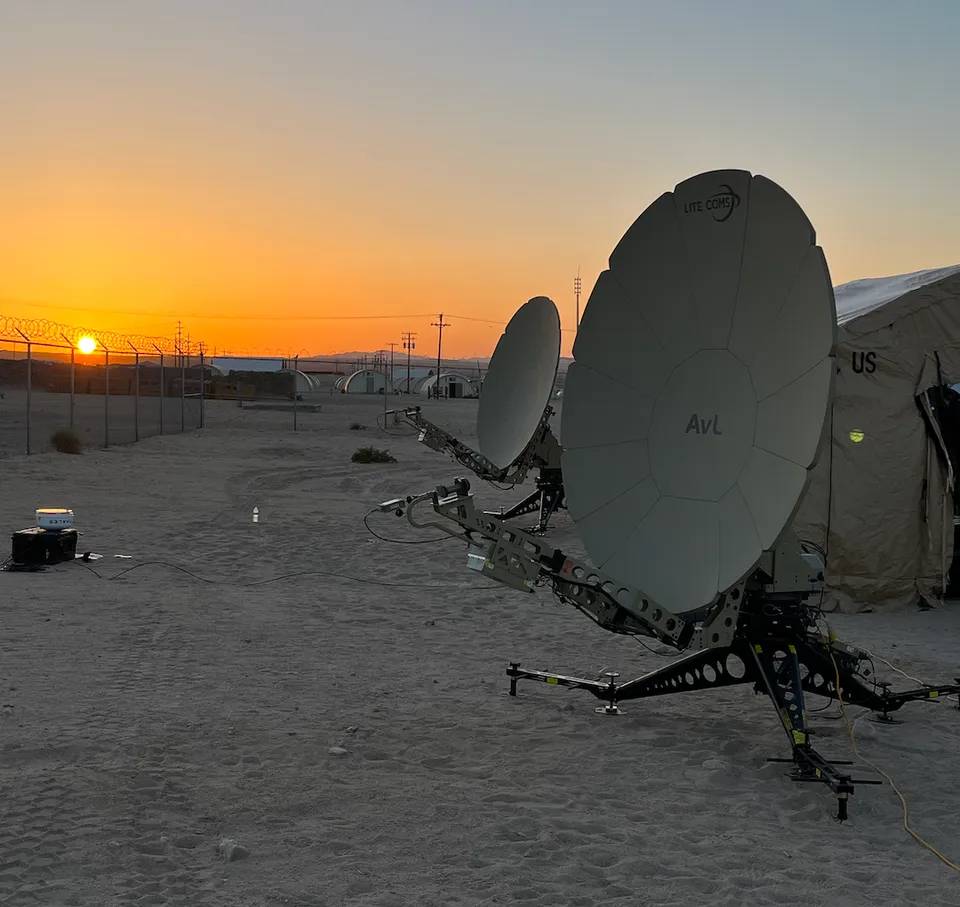
AvL Technologies has signed a $31 million contract with Polish defense supplier GISS Sp. z o.o. to provide 2.4-meter, trailer-mounted satellite communications terminals for Poland’s Ministry of National Defence, the companies announced September 8, 2026. The WGS-certified systems will give deployed Polish units field terminals compatible with the U.S.-led Wideband Global SATCOM network.
The companies did not disclose the number of terminals covered by the agreement, delivery dates or whether the procurement will draw on European Union defense financing.
AvL’s driveaway terminal uses a carbon-fiber reflector and automated antenna-positioning technology intended to shorten deployment and satellite-acquisition times in field conditions. The transportable system is certified for X-band and military Ka-band communications.
The two frequency bands offer complementary capabilities. X-band is widely used for military satellite communications and is generally less susceptible to rain attenuation than higher-frequency Ka-band links. Military Ka-band provides greater bandwidth for applications such as intelligence data transfer, full-motion video, command-and-control traffic and other data-intensive services, although its performance requires careful link planning during heavy precipitation.
WGS certification indicates that the terminal has completed the technical approval process required to operate over the Wideband Global SATCOM system. Certification addresses factors including antenna performance and the risk of interference to other users; it does not by itself provide network access or guarantee the security of communications, which also depends on modems, waveforms, encryption, network management and operational procedures.
Poland separately joined the WGS program through a memorandum signed with the United States in Warsaw on December 4, 2025. That agreement gave the Polish Armed Forces access to capacity across the constellation, which provides X-band and military Ka-band communications from geostationary orbit. The new terminals therefore supply part of the ground infrastructure needed to use capacity Poland had already secured.
WGS supports the United States and participating allied governments, allowing forces to share a common satellite communications architecture during national and multinational operations. For Poland, deployable WGS-compatible terminals can extend broadband connectivity to command posts and other units operating away from fixed communications infrastructure while improving interoperability with U.S. and NATO forces.
AvL Chief Executive David Bowne said the contract reflected the confidence placed in the company by GISS and the Polish defense sector. He said the award would expand AvL’s position in the international defense market and support Poland’s efforts to strengthen resilient communications.
GISS Chief Executive Andrzej Puścian described the agreement as a milestone for the Polish company. He said combining AvL’s certified terminal technology with GISS’s domestic market experience would establish a basis for longer-term cooperation.
The contract expands Asheville, North Carolina-based AvL’s presence in Europe through a Polish supplier that already works with the country’s defense establishment. GISS previously supplied satellite terminals to the Polish Armed Forces and provides local integration and support capabilities, while AvL contributes antenna engineering, manufacturing and WGS-qualified hardware.
The award comes amid a broader Polish effort to expand military satellite communications across both ground and space segments. In addition to accessing WGS, Poland is pursuing national secure communications capabilities and procuring several classes of transportable terminals for military users.
Poland has also received the EU’s largest allocation under the Security Action for Europe, or SAFE, instrument: up to €43.7 billion in long-term loans for defense investment. The country received an initial €6.6 billion payment in May 2026. SAFE supports areas including air and missile defense, counter-drone systems, military mobility and enabling capabilities, although AvL and GISS did not state that the $31 million terminal award is financed through the program.
The procurement addresses a practical requirement created by Poland’s entry into WGS: satellite capacity must be matched with certified, rapidly deployable ground equipment before operational units can use the network effectively. The undisclosed delivery schedule and quantity of terminals remain the next details needed to assess the program’s deployment scale.