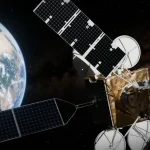
China’s Ministry of Industry and Information Technology has called for deeper integration between satellite networks and terrestrial communications systems, including satellite-to-phone connectivity, satellite Internet of Things services and the coordinated development of an integrated space network.
The requirements are part of China’s Information and Communications Industry Development Plan for the 15th Five-Year Plan period, issued Sept. 7. The plan calls for China to build a globally advanced communications infrastructure by 2030 while strengthening domestic capabilities in 6G, satellite communications, computing and network equipment.
Among the plan’s infrastructure priorities is the coordinated construction of space-ground interconnection centers. These facilities are expected to support the integration of satellite systems with terrestrial networks and enable services such as direct-to-device satellite communications and satellite IoT connectivity.
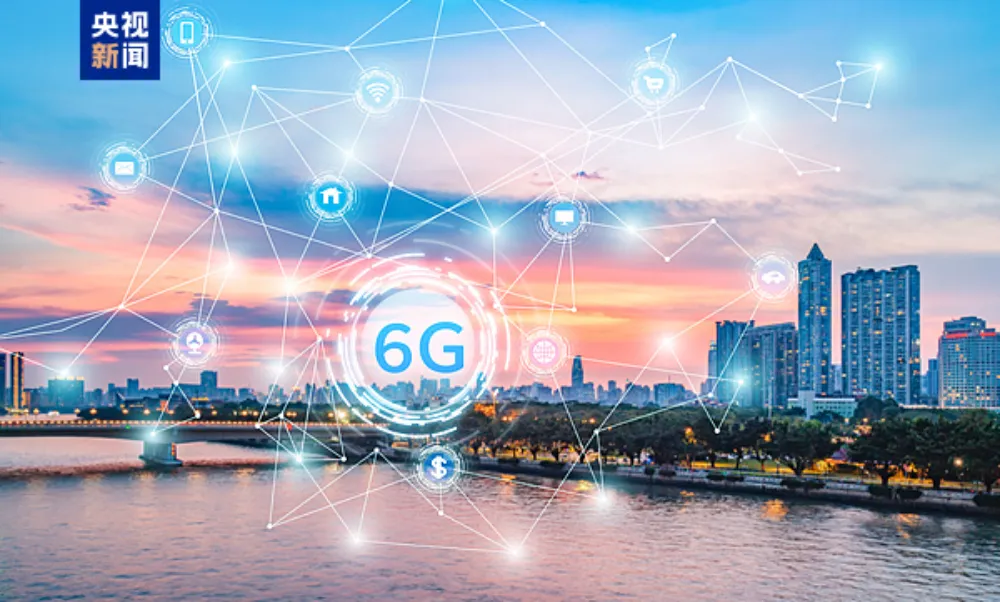
The plan also calls for the timely launch of 6G commercial services, continued 6G technology trials, and the development of 6G base stations, core network equipment and 6G smartphones.
Space Networks Become a Core Infrastructure Priority
China’s plan treats satellite networks as a major component of next-generation communications infrastructure rather than as a separate communications sector. It calls for closer coordination among satellite, terrestrial, navigation, remote-sensing and computing systems to form an integrated space network.
The objective is to extend network coverage beyond the reach of conventional ground infrastructure, particularly in remote areas, maritime regions, aviation corridors and other locations where terrestrial base stations are difficult or uneconomical to deploy.
Direct satellite connectivity for mobile phones is expected to become one of the most visible applications. Satellite IoT services could support large-scale monitoring of vehicles, industrial assets, agricultural equipment, energy infrastructure and environmental conditions.
The plan also identifies several technical areas for further research, including satellite communications equipment, coordination between high-, medium- and low-Earth-orbit systems, and spectrum sharing between satellite and terrestrial networks.
These capabilities will be important for managing a communications environment in which satellites and terrestrial systems use overlapping frequency resources and must operate as a coordinated network. Efficient spectrum management, interoperability and seamless handover will be central to maintaining service continuity between orbital and ground segments.
6G Development Extends Beyond Faster Mobile Broadband
The plan calls for systematic research into wireless, network and cybersecurity technologies for 6G. Priorities include network-native artificial intelligence, integrated communications and sensing, computing-enabled communications, token-based communications, data services, extremely large antenna arrays, energy-efficient networking and the integration of satellite and terrestrial systems.
China has accumulated more than 300 6G technology reserves, according to industry officials cited in the report. The envisioned 6G network would combine communications, sensing, computing and artificial intelligence across terrestrial and space-based infrastructure.

That architecture would allow networks not only to transmit data but also to support environmental sensing, intelligent decision-making and coordination among large numbers of autonomous software and physical agents. Satellite systems would provide wide-area coverage and resilience, while terrestrial networks would supply capacity and low-latency access in populated areas.
Chinese telecommunications companies have already begun testing related technologies. China Telecom’s research institute and partners have conducted trials involving coordinated networking among high- and medium-Earth-orbit satellites and terrestrial systems. China Mobile is exploring intelligent-agent communications and other 6G-enabled services.
Satellite Industry Shifts Toward Integrated Services
The plan reflects a broader change in the satellite industry, where communications, navigation, Earth observation and onboard computing are increasingly being combined into integrated service architectures.
According to GalaxySpace Research Institute President Zhang Shijie, the deeper integration of communications, navigation, remote sensing and computing will be a major direction for the satellite sector. Advances in onboard processing, power generation, high-capacity communications and sensing could accelerate the development of space-ground integrated services.
The reference to satellite communications equipment also indicates an emphasis on strengthening domestic manufacturing capabilities. The plan calls for breakthroughs in spaceborne communications systems as part of a broader effort to improve the resilience of China’s information and communications supply chains.
Satellite manufacturers and network operators could benefit from demand for higher-throughput payloads, inter-satellite links, onboard processing, multi-orbit network management and user terminals capable of switching between terrestrial and satellite connections.
The plan’s wider targets include information and communications industry revenue of 4.1 trillion yuan by 2030 and cumulative investment of 3.8 trillion yuan in information infrastructure. It also sets a goal of 50 5G or 5G-Advanced base stations per 10,000 people and a 95% 5G user penetration rate.
For the satellite sector, the most important implication is that space infrastructure is being incorporated into China’s national communications planning alongside base stations, fiber networks, data centers and artificial intelligence infrastructure. That approach could support the gradual development of a unified network spanning low-, medium- and geostationary orbits, terrestrial systems and intelligent terminals.
For international customers, the significance of this plan extends beyond China’s domestic 6G rollout. China’s increasingly industrialized space supply chain now offers access to satellites, communications payloads, launch services, ground systems and integrated space-network solutions at highly competitive costs. If you are planning a satellite constellation or source space products and services from China, contact STARPATH GLOBAL to discuss your project requirements and potential solutions.