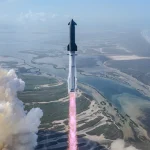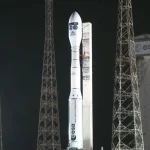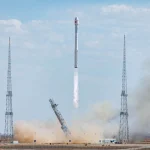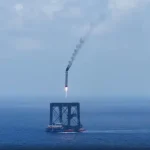

At 2:26 p.m. on September 15, 2026, the ZhuQue-2E Y7 launch vehicle lifted off from the Dongfeng Commercial Space Innovation Pilot Zone at the Jiuquan Satellite Launch Center, successfully deploying 10 SpaceSail Polar Orbit Group 19 satellites operated by Shanghai Spacesail Technologies into their designated orbits.
Unlike previous missions, this launch warrants particular attention for two main reasons.
1. China Now Has Another Operational Rocket Capable of Supporting Large-Scale Satellite Internet Deployment
As of September 15, 2026, China SatNet had conducted 27 constellation deployment launches, all using rockets developed by state-owned organizations: the Long March 5B, Long March 8A, Long March 6A and Long March 12.
SpaceSail had completed 14 constellation launches, likewise relying exclusively on state-developed vehicles: the Long March 6A, Long March 8, Long March 8A and Long March 12B.
With this latest mission, China finally has a privately developed commercial rocket capable of conducting large-scale satellite internet constellation deployment missions.
2. A Rocket Not Originally Built for a Megaconstellation Has Completed Its Commercial “Rebirth”
For today’s commercial launch companies, deployment missions for the China SatNet and SpaceSail constellations represent the largest source of market demand by far—and the core contracts they must compete aggressively to secure.
However, comparing the emergence of the GW and G60 constellation programs with the development timeline of ZhuQue-2 reveals a significant mismatch in timing.
The GW constellation first entered the public eye after overseas media reported that China had submitted orbital and frequency filings for a low-Earth-orbit internet constellation under the code name “GW” to the International Telecommunication Union in September 2020. The filings covered two broadband constellation plans, GW-A59 and GW-A2, comprising a combined 12,992 satellites.
Public ITU records show that the submission was formally received on November 9, 2020, marking the GW constellation’s first appearance in the international public domain. Its preliminary feasibility studies and research had begun only in 2019.
The G60 constellation emerged even later. It made its first public appearance in November 2021 at a high-quality development matchmaking event for the Yangtze River Delta G60 Science and Technology Innovation Corridor, held during the fourth China International Import Expo.
ZhuQue-2, by contrast, was initiated in September 2017. Its preliminary design review was completed by the end of December that year, after which the program entered the detailed design phase. Prototype development began in June 2019.
In January 2022, the first flight vehicle completed its final pre-delivery inspection and was cleared to leave the factory. Its maiden flight took place at 4:30 p.m. on December 14, 2022, but failed to reach orbit. ZhuQue-2 achieved its first successful orbital launch on July 12, 2023.
In other words, when ZhuQue-2 was initiated in 2017, neither of China’s two major low-Earth-orbit satellite internet programs—the GW and G60 constellations—had yet emerged.
The rocket’s original design was therefore not driven by the deployment requirements of any particular constellation, nor was it intended to meet the launch capacity targets of GW or G60, which did not yet exist.
When China’s demand for low-Earth-orbit satellite internet launch capacity became much clearer after 2020, ZhuQue-2 found itself facing a challenge it had never originally been designed to address. Launch vehicles initiated during or after that period could incorporate constellation deployment requirements from the outset. They were purpose-built for large-scale satellite deployment.
From this perspective, the timing placed ZhuQue-2 at a disadvantage in the constellation launch market. It was not designed around megaconstellation requirements, yet it had to secure constellation contracts through subsequent upgrades.
Nevertheless, a rocket that was not originally created for satellite constellation deployment gradually acquired that capability through successive engineering iterations. On September 15, 2026, it ultimately deployed 10 SpaceSail satellites in a single mission.
That initial disadvantage—and the engineering work required to overcome it—is precisely what makes this milestone worth documenting.
How ZhuQue-2 Evolved Into ZhuQue-2E
The original ZhuQue-2 used a two-stage configuration with a diameter of 3.35 meters and a total height of 49.5 meters.
Its first stage was powered by four parallel TQ-12 liquid oxygen-methane engines. The second stage used one vacuum-optimized TQ-12 main engine and one TQ-11 vernier engine. The rocket had a liftoff mass of 219 metric tons and liftoff thrust of 268 metric tons-force, with the capacity to deliver 1.5 metric tons to a 500-kilometer sun-synchronous orbit.
For the first ZhuQue-2E vehicle, the rocket’s total length was adjusted to 47.3 meters. The first stage retained four parallel TQ-12 liquid oxygen-methane engines, while the second stage was upgraded to a single vacuum-optimized TQ-15A methalox engine.
The TQ-15A produced 85 metric tons-force, or approximately 836 kilonewtons, of vacuum thrust and was paired with a YQ-10 auxiliary power system. The rocket also adopted a common-bulkhead tank and tunnel feedline design, shortening the stage and reducing structural mass.
The vehicle maintained a liftoff mass of 219 metric tons, while liftoff thrust increased to 282 metric tons-force.
Simplifying and upgrading the second-stage propulsion system reduced the number of engines and lowered system complexity. The use of a single high-performance vacuum engine also improved reliability and launch efficiency, raising payload capacity to a 500-kilometer sun-synchronous orbit to 4 metric tons.
Beginning with the second ZhuQue-2E vehicle, the first-stage propulsion system was changed to four parallel TQ-12A liquid oxygen-methane engines.
Development of the TQ-12A, an upgraded version of the TQ-12, began in February 2021. Design improvements increased thrust by 9%, raised specific impulse by 40 meters per second and reduced engine mass by 100 kilograms.
Each TQ-12A initially produced 720 kilonewtons of sea-level thrust, with a sea-level specific impulse of 2,818 meters per second.
Beginning with the fifth vehicle, the ZhuQue-2E was lengthened to approximately 55.9 meters. The thrust of each first-stage TQ-12A engine increased by 108 kilonewtons, bringing sea-level thrust to 828 kilonewtons. The vacuum thrust of the second-stage TQ-15A was further increased to 858 kilonewtons.
The maximum payload fairing diameter expanded from 3.35 meters on the original ZhuQue-2 to 4.2 meters. Liftoff mass rose to 267 metric tons, while liftoff thrust increased to 338 metric tons-force.
The first-stage tanks were also lengthened beginning with the fifth vehicle. Combined with fully subcooled propellant loading, this increased propellant capacity by approximately 15%.
Fully subcooled loading reduces propellant temperatures below their normal boiling points, increasing density and allowing more propellant mass to be carried within the same tank volume. It also improves engine inlet conditions. This change was one of the main contributors to the rocket’s increased payload capacity.
Other modifications included removing portions of the first-stage tank insulation and the first-stage fins, as well as optimizing the layout of the external cable raceway. Together, these changes produced systematic structural mass reductions.
In its stretched configuration, ZhuQue-2E can deliver 4 metric tons to a 500-kilometer sun-synchronous orbit or 6 metric tons to low-Earth orbit.
Beginning with the sixth vehicle, the ZhuQue-2E second-stage engine mount adopted an integrated 3D-printed structure. The mount uses a hollow truncated-cone configuration and Y-shaped primary beams to transfer engine thrust efficiently.
The design increases overall structural stiffness and load-bearing capacity while reducing weight and cost and shortening manufacturing and assembly cycles.
From the original ZhuQue-2 to ZhuQue-2E Y7, LandSpace carried out multiple systematic iterations focused on increasing payload capacity.
Those successive rounds of engineering upgrades and optimization ultimately enabled ZhuQue-2E Y7 to place the 10 SpaceSail Polar Orbit Group 19 satellites into their designated orbits on September 15, 2026—marking the first time a privately developed Chinese commercial rocket had conducted a large-scale satellite internet constellation deployment mission.