If chips are the bricks and data centers are the buildings, power is one of the essential utilities that makes them work. Computing ultimately comes down to watts: keeping a 700-watt GPU running in orbit requires an entire engineering system, from solar-array orientation and battery chemistry to bus voltage. Moving from watts to megawatts means climbing a power ladder, with a different set of principles and costs at every step.
1. Start with the Power Budget
Express different computing applications in watts, and a clear progression emerges:
The gap between the final two rows is striking: a hundred-kilowatt orbital platform and a hundred-megawatt terrestrial facility are separated by roughly three orders of magnitude. Any proposal to scale computing in space must explain how it will bridge that gap.
2. Generation: The Evolution of Space Solar Power
Beyond efficiency, two engineering factors deserve attention.
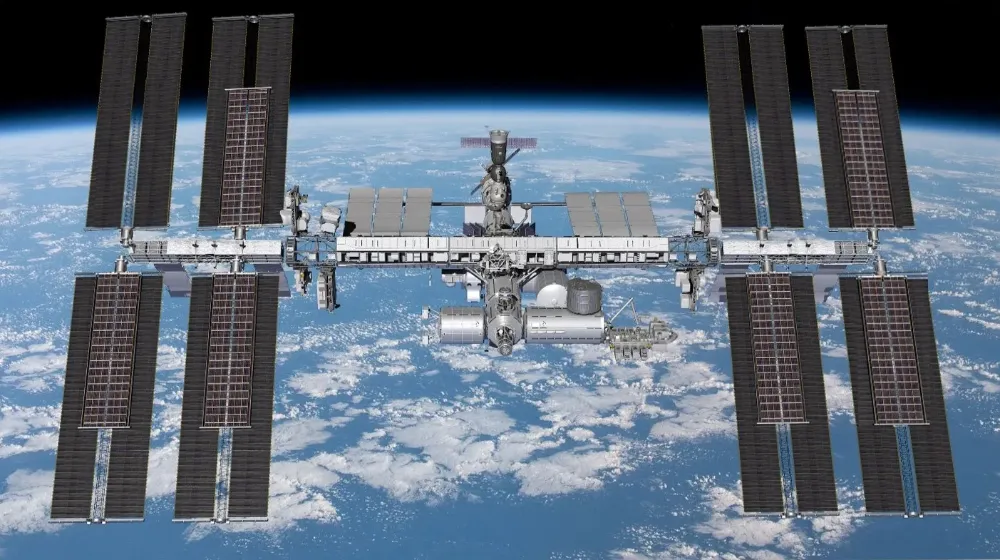
Sun tracking. Articulated arrays use rotating mechanisms to keep their surfaces oriented toward the Sun as the spacecraft moves through its orbit. The ISS uses separate joints for orbital tracking and seasonal adjustments. Pointing errors reduce the sunlight reaching the cells and therefore reduce output.
Radiation degradation. Years of exposure to energetic particles gradually reduce solar-cell performance. The aging of the ISS arrays provides a practical example of why spacecraft power budgets must account for output at the end of the mission, rather than only at launch.
Space solar power has a major advantage: no clouds or atmospheric weather, with the possibility of long periods of uninterrupted sunlight in suitably chosen orbits. Ground-based solar installations often have capacity factors around 20%, although the figure varies by location and design. An orbital system can achieve much greater solar availability, but approaching 90% is an orbit-specific possibility, not a general property of low Earth orbit. Eclipse duration, pointing, temperature and degradation all affect usable output.
That access to sunlight is part of the physical case for orbital computing. Whether it produces cheaper electricity also depends on the cost of building, launching and operating the power system.
3. Storage and Distribution: Battery Chemistry and Bus Voltage
Storage. A spacecraft in low Earth orbit may spend tens of minutes in Earth’s shadow on each revolution, depending on its altitude, orbital geometry and the season. If computing must continue through an eclipse, batteries have to carry the load.
Nickel-hydrogen batteries were a longstanding choice for spacecraft, including the ISS, because of their durability under repeated cycling. Their size and mass, however, encouraged a transition to lithium-ion technology. The ISS replaced its nickel-hydrogen batteries with lithium-ion units through a series of upgrades from 2017 to 2021.
For a computing satellite in an orbit with an eclipse on nearly every revolution, batteries may face roughly 16 charge-discharge cycles a day. Cycle life therefore becomes a major constraint on mission duration. Depth of discharge, operating temperature and calendar aging all matter: battery life can set the useful life of the spacecraft’s power system.
Distribution. Voltage is another crucial design choice. The U.S. segment of the ISS uses a nominal 160-volt DC primary power system, with power converted to approximately 124 volts for users. At a given power level, higher voltage reduces current, allowing designers to reduce conductor mass and resistive losses. The trade-off is more demanding insulation, switching and protection, including measures to control arcing in the space environment.
As power demand rises, higher distribution voltages become increasingly attractive. On Earth, the data-center industry is developing 800-volt DC architectures to support megawatt-class racks. Orbital platforms face the same underlying electrical trade-off, although their operating environment will shape the voltage levels they can use.
Nuclear power: a longer-term option. At megawatt scale, solar-array area, deployment and structural demands become major design considerations. On the Moon, prolonged darkness can add a different challenge. These constraints make fission power a candidate for some future systems, although they do not automatically rule out solar power.
NASA demonstrated a kilowatt-class fission power concept in the 2018 Kilopower Reactor Using Stirling Technology, or KRUSTY, test. In 2022, NASA and the U.S. Department of Energy selected three design concepts for a 40-kilowatt-class lunar surface fission power system. Such work could support a future step up the power ladder, but deploying a reactor for orbital computing would require substantial additional engineering and regulatory work. It remains a long-term possibility.
4. How Fast Can Orbital Power Scale?
The pace of progress will depend on advances in solar-cell efficiency and battery performance, lower launch costs, and thermal systems capable of rejecting the resulting heat. Increasing generation alone is not enough: nearly all the electricity used by computing hardware ultimately has to leave the spacecraft as heat.
Our working assessment is that near-term orbital computing will center on kilowatt-class systems, with larger demonstrations aiming toward the hundred-kilowatt range. Demonstrations at megawatt scale may have to wait until the 2030s, although the schedule remains uncertain. A mature, high-capacity launch system such as Starship could accelerate deployment, but power generation, assembly and heat rejection would still need to advance alongside it. Gigawatt-scale orbital computing should therefore be understood as a long-term ambition.
For Earth-observation users, the practical question is how these power constraints affect the data and analysis a mission can reliably deliver. STARPATH GLOBAL helps customers match satellite resources and analytical workflows to their monitoring needs, including where onboard processing can add value. To discuss a specific application, contact our team.