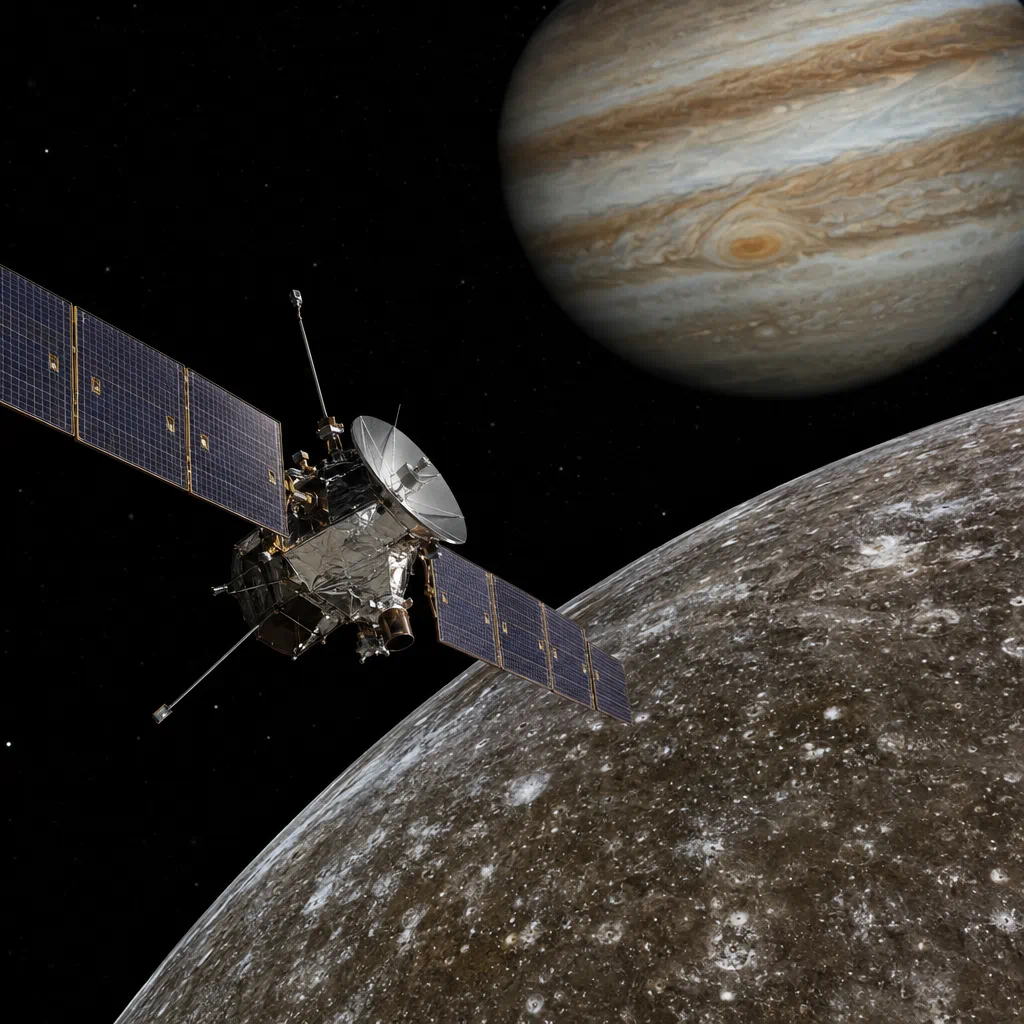
CNSA has discussed a mission to the Jovian system since 2018. The agency now states that the primary objectives of Tianwen-4 are to achieve Jovian orbiting, as well as orbiting and landing exploration of Callisto, and to advance scientific research on the Jovian system. To improve the mission’s performance and success, CNSA is seeking instrument proposals from within China and from outside partners.
The orbiter will carry 10 instruments, including multiple cameras, imagers, spectrometers, a particle detector, and a magnetometer. The Callisto lander is planned to carry two scientific payloads: a Callisto Surface Composition Analyzer and a Callisto Lander Magnetometer. The surface composition analyzer will be a Raman spectrometer, which analyzes rock composition using light from a laser. Callisto’s surface is heterogeneous on a small scale, with bright patches that appear to be pure water ice, patches that seem to mix rock and ice, and larger darker areas that are not ice. The spectrometer should be able to determine these compositions and identify whether surface carbon is primordial or altered.
The lander’s magnetometer will work alongside the orbiter’s magnetometer. By combining the data, ionospheric signals and signals from the moon’s surface can be separated, revealing more about Callisto’s interior and its potential subsurface ocean. The mission plan calls for Tianwen-4 to orbit Callisto at an altitude of 300 km. Tianwen-4 will carry a pair of visible light imaging cameras, including a wide-angle camera, known as JWAC, dedicated to mapping Callisto’s surface and topography. From the 300 km mapping orbit, the JWAC operates at about 90 meters per pixel. By comparison, the Galileo spacecraft imaged most of Callisto at poor resolution 25 years ago, with only some small areas captured at tens of meters per pixel.
Callisto is considered the most accessible of the Galilean moons for a surface mission. It lies outside Jupiter’s powerful radiation belts, where radiation can degrade sensitive instruments after short exposure. As the moon furthest from Jupiter, its gravity well is shallower, requiring less propellant to land, and Tianwen-4 can use Callisto gravity assists to prepare for orbital insertion. Its ancient, heavily cratered surface is geologically quiet, which makes hazard avoidance easier, since orbital images are unlikely to change between capture and arrival. Still, the mission faces challenges. Callisto is airless, so atmospheric braking is not an option, and the communication time delay ranges from about 35 to 50 minutes one way, meaning the landing must be autonomous.
CNSA outlined a timeline in 2020 that would see Tianwen-4 launch in September 2029. To preserve propellant, the spacecraft will perform a slingshot flyby of Venus in April 2030, then two gravity assists with Earth in 2031 and 2033. It will reach Jupiter and enter orbit in 2035, making flybys of irregular moons during phase one. Phase two begins with two gravity assists at Callisto, leading toward the landing in February 2038.