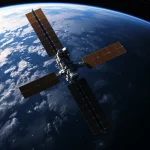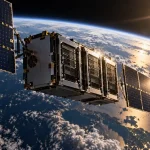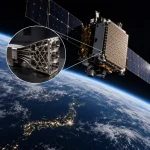
An atmosphere-breathing plasma propulsion system developed at the University of Stuttgart could allow satellites to operate for extended periods in very low Earth orbit by collecting atmospheric particles and using them as propellant. Created by Francesco Romano as part of his doctoral research, the experimental system combines a high-efficiency intake with a contactless radio-frequency helicon plasma thruster designed to withstand the chemically aggressive environment of the upper atmosphere.
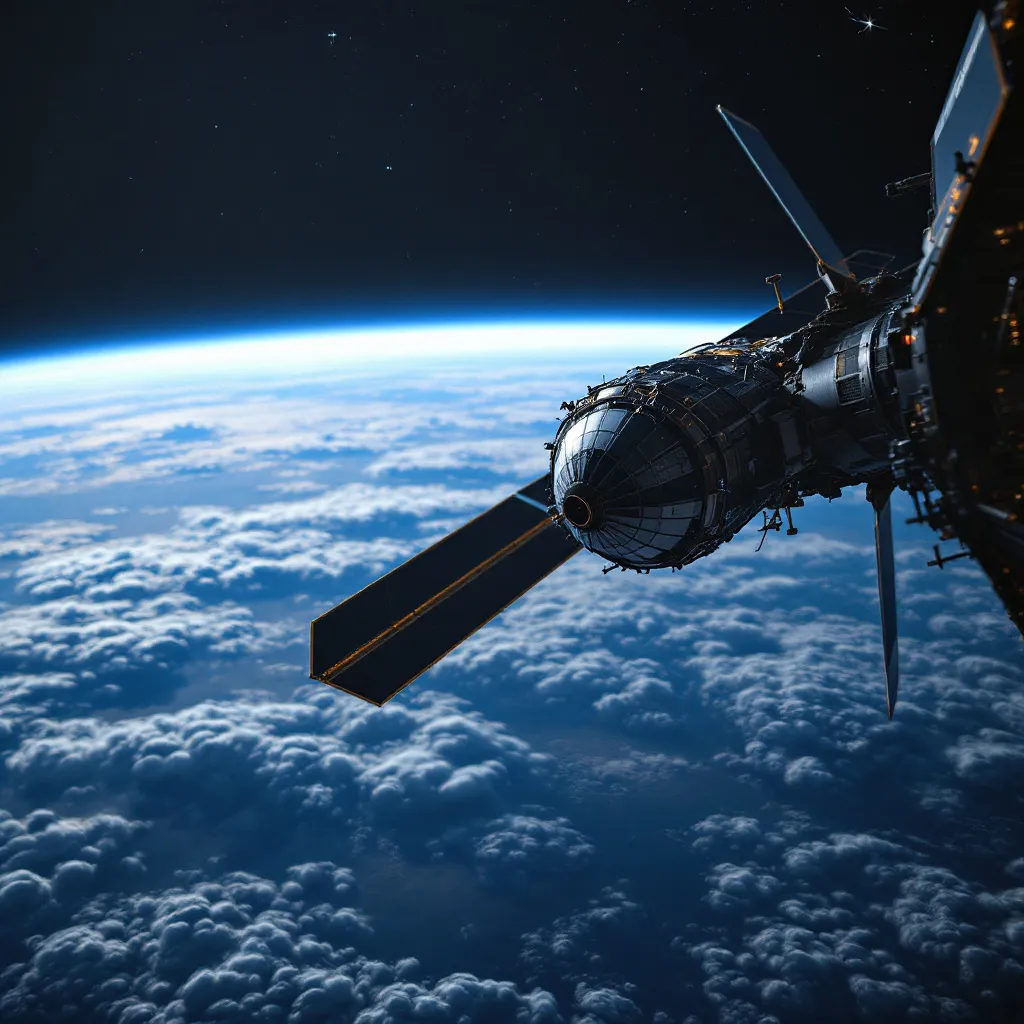
Very low Earth orbit, commonly defined as altitudes between roughly 100 and 450 kilometers, can improve the performance of Earth observation, communications and radar satellites. Operating closer to Earth allows imaging systems to achieve higher ground resolution with comparable optics, while communications and active sensing payloads can require less transmission power.
The region also presents a major operational constraint. Residual atmospheric particles create substantially more drag than at higher orbital altitudes, continuously reducing a spacecraft’s speed and orbital energy. Satellites must therefore generate frequent or nearly continuous thrust to maintain altitude. Conventional electric propulsion systems can compensate for that drag, but their operational life is limited by the amount of xenon, krypton or another stored propellant carried at launch.
Atmosphere-breathing electric propulsion seeks to remove that limitation. Instead of relying entirely on onboard propellant, the spacecraft collects atmospheric particles along its direction of travel, ionizes them and accelerates the resulting plasma to generate thrust. If the propulsion system can produce enough force to offset aerodynamic drag, the satellite’s lifetime would no longer be directly constrained by its initial propellant supply.
Atomic oxygen drives a different engine architecture
Romano’s design addresses two persistent challenges for atmosphere-breathing propulsion: the corrosive composition of the upper atmosphere and large variations in atmospheric density.
At very low orbital altitudes, ultraviolet radiation breaks molecular oxygen into atomic oxygen. The resulting particles are highly reactive and can degrade exposed spacecraft materials, including metal electrodes, ion-acceleration grids and cathodes used by conventional electric thrusters.
Cathode degradation is particularly important because many ion engines require an external neutralizer to inject electrons into the exhaust. Without charge neutralization, the spacecraft can accumulate an electrical potential that attracts expelled ions back toward it, reducing or eliminating useful thrust.
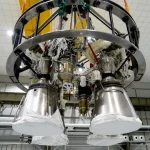
The proposed Radio-Frequency Helicon Plasma Thruster avoids direct electrode contact with the working gas and does not require a separate neutralizer. A radio-frequency antenna transfers energy into the collected atmospheric gas, creating plasma without placing vulnerable electrodes inside the discharge chamber. A solenoid around the thruster generates a magnetic field that helps accelerate and direct the plasma into a quasi-neutral exhaust containing both positively and negatively charged particles.
The contactless architecture could reduce erosion and corrosion, although a flight system would still need to demonstrate long-duration material compatibility, stable plasma production and adequate thrust efficiency under realistic orbital conditions.
Atmospheric density and composition vary with altitude, latitude, local time and solar activity. Those fluctuations affect the amount of gas entering the propulsion system and make it difficult to maintain a stable discharge and consistent thrust. An operational engine would need to adjust to these changes while continuously balancing drag.
Specular intake achieves 94.3% collection efficiency
Romano evaluated three intake configurations intended to capture the widely dispersed particles encountered in very low Earth orbit. The concepts included an enhanced funnel, a diffuse hexagonal intake manufactured from coated titanium alloy, and a specular intake using a parabolic reflecting surface coated with graphite or silicon dioxide.
Testing with atomic oxygen, argon and nitrogen indicated that the specular intake delivered the strongest performance. It captured approximately 94.3% of incident particles and was comparatively tolerant of imperfect alignment. Collection efficiency declined by about 8% when the intake was tilted 15 degrees relative to the incoming flow.
That tolerance is operationally relevant because a satellite’s attitude, atmospheric winds and pointing requirements can prevent the intake from remaining perfectly aligned with the spacecraft’s velocity vector. The intake must also compress the collected particles sufficiently for the thruster to ignite and operate despite the extremely low ambient density.
For plasma generation, Romano adapted a birdcage antenna architecture similar to those used in magnetic resonance imaging systems. The antenna reportedly coupled 99% of the supplied electrical power into the thruster, reducing the reactive losses associated with conventional wire coils.
Vacuum-chamber experiments simulating very low Earth orbit gas concentrations produced stable plasma streams with 50 to 60 watts of radio-frequency power. That figure represents the power required for the experimental plasma discharge rather than the complete power demand of an operational propulsion system, which would also include magnetic coils, power-processing electronics and spacecraft subsystems.
Models examine Earth and Mars applications
Romano applied propulsion models to representative missions, including the European Space Agency’s Gravity Field and Steady-State Ocean Circulation Explorer. GOCE operated at unusually low altitudes using a xenon ion propulsion system to compensate for drag, but its mission ended after its stored propellant was depleted.
The modeling indicated that an atmosphere-breathing system based on the new design could theoretically maintain an Earth satellite between approximately 190 and 250 kilometers while consuming less than 1.6 kilowatts. Such operation could be compatible with spacecraft solar arrays, although actual feasibility would depend on vehicle size, aerodynamic drag, intake orientation, conversion efficiency and atmospheric conditions.
The research also considered Mars, where carbon dioxide would replace oxygen and nitrogen as the primary collected propellant. The calculations suggest that a spacecraft could potentially maintain an orbit between 120 and 160 kilometers above Mars, substantially closer to the surface than conventional long-duration Mars orbiters.
The technology remains at the experimental validation stage. No orbital demonstration has been announced, and laboratory plasma production does not yet establish that the system can generate sufficient net thrust after accounting for the drag created by the intake and spacecraft body. Further development would require integrated thrust measurements, endurance testing with reactive gases, variable-density operation and an in-orbit demonstration before indefinite VLEO operations could be considered practical.