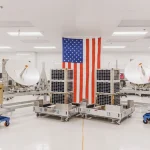
NASA’s TROPICS-1 mission was the first of three flights awarded to Astra with the goal of launching six spacecraft into a 30-degree inclination orbit around Earth. Astra’s Rocket LV0010 rocket, based on the Rocket 3.3 design, was supposed to be today’s star. However, the rocket’s second stage engine failed to finish the burn, resulting in NASA’s payloads not reaching orbit.
The countdown had a rocky start with two holds, one for a ship entering the exclusion zone and the second for “final LOX conditioning.” LOX stands for Liquid Oxygen which is used alongside RP-1 (highly refined kerosene) to power its Delphine engines. This combination of LOX and RP-1 is used on many commercial launchers. Finally, at 1:43 p.m. EDT Astra launched its LV0010 rocket with the TROPICS-1 mission for what seemed to be a clean and beautiful launch. While the first stage was hugging the southern edge of the launch corridor, as seen by the map on the stream, it successfully completed its mission.
After the first stage engines cut off, LV0010’s payload fairings successfully deployed, then the second stage separated and ignited its engine. This burn should last about five minutes, but it was cut short with only a minute left in the burn. This early shutdown was followed by the second stage tumbling as the vehicle has little ability to control itself without the engine providing thrust. A few minutes later, Astra’s Amanda Frye, a senior manager of the first stage and engine production, read a statement that said they experienced an anomaly during the second stage flight, and the payloads were lost.
We had a nominal first stage flight. The upper stage shut down early and we did not deliver the payloads to orbit. We have shared our regrets with @NASA and the payload team. More information will be provided after we complete a full data review.
— Astra (@Astra) June 12, 2022
Jonathan McDowell, an Astronomer for the Center for Astrophysics, estimates TROPICS-1 was at a -1,250 x 545 km orbit when the second-stage engine failed. The rocket was far from being orbital at the time of the shutdown and would have crashed back into the Atlantic Ocean probably less than 15 minutes later.
Second Astra launch failure from Florida and for NASA
This is Astra’s second launch attempt from SLC-46 at Cape Canaveral Space Force Station. Both missions have been for NASA, and both so far have failed. Astra has now attempted to launch eight Rocket 3 vehicles, with only two being successful. The very first Rocket 3 that was slated to launch was destroyed in prelaunch testing, but it was apparently an “unfortunate mistake.”
This is more troubling news for the up-and-coming launch provider. While failure should be accepted in the launch industry to push innovative technologies, this many shows there could be a bigger problem at hand.