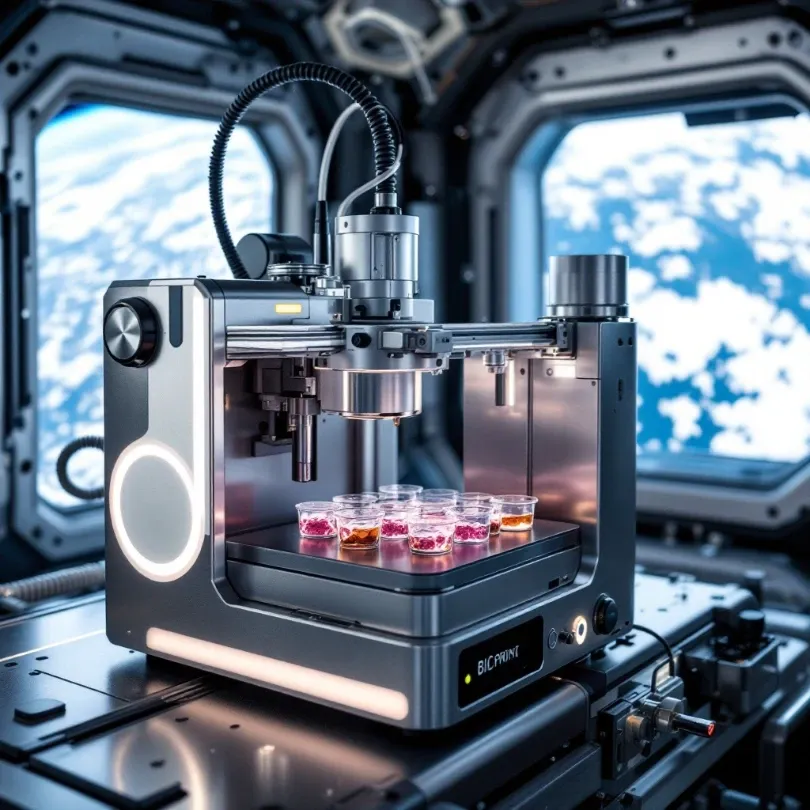
The work comes from Auxilium Biotechnologies, whose AMP-1 orbital bioprinter carried out the experiments in June. The bioprinter used cell and tissue designs supplied by the Wake Forest Institute for Regenerative Medicine in North Carolina.
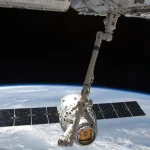
In addition to kidney and liver tissue, the AMP-1 machine bioprinted cartilage tissue and created 28 nerve repair implants during the mission. The bioprinted materials returned to Earth on a SpaceX Dragon cargo capsule that splashed down in the Pacific Ocean on June 17.
“The ability to manufacture multiple tissue types alongside clinically relevant medical products highlights both the versatility and scalability of our technology,” Auxilium CEO Jacob Koffler said in a statement on July 9. WFIRM director Anthony Atala added that the result “marks an important step forward for regenerative medicine,” noting that “the uniform cell distribution achieved aboard the space station points to real possibilities for manufacturing medical devices and tissues in space.”
The mission was not the first bioprinting experiment conducted on the ISS. In 2018, Russian cosmonaut Oleg Kononenko tested a machine called the Bioprinter Organ.Aut, which assembled cartilage cells using a magnetic field. Auxilium’s AMP-1, however, is the first tool to produce multiple types of tissue in space and the first to make kidney and liver tissue in orbit.
According to Auxilium, that flexibility will be important as commercial interests expand manufacturing hubs in space for biotech, healthcare, and advanced materials development. “This mission marks an exciting step forward for in-space biomanufacturing and demonstrates what can be achieved when innovative technology is paired with strong collaboration,” said Isac Lazarovits, the company’s engineering vice president. He described the demonstration of “multiple product classes and meaningful production volume within a single mission” as an important milestone toward routine manufacturing operations in orbit.
Auxilium and its collaborators frame the results as advancing toward routine in-orbit manufacturing, with the company continuing to develop the capabilities demonstrated on this flight.