
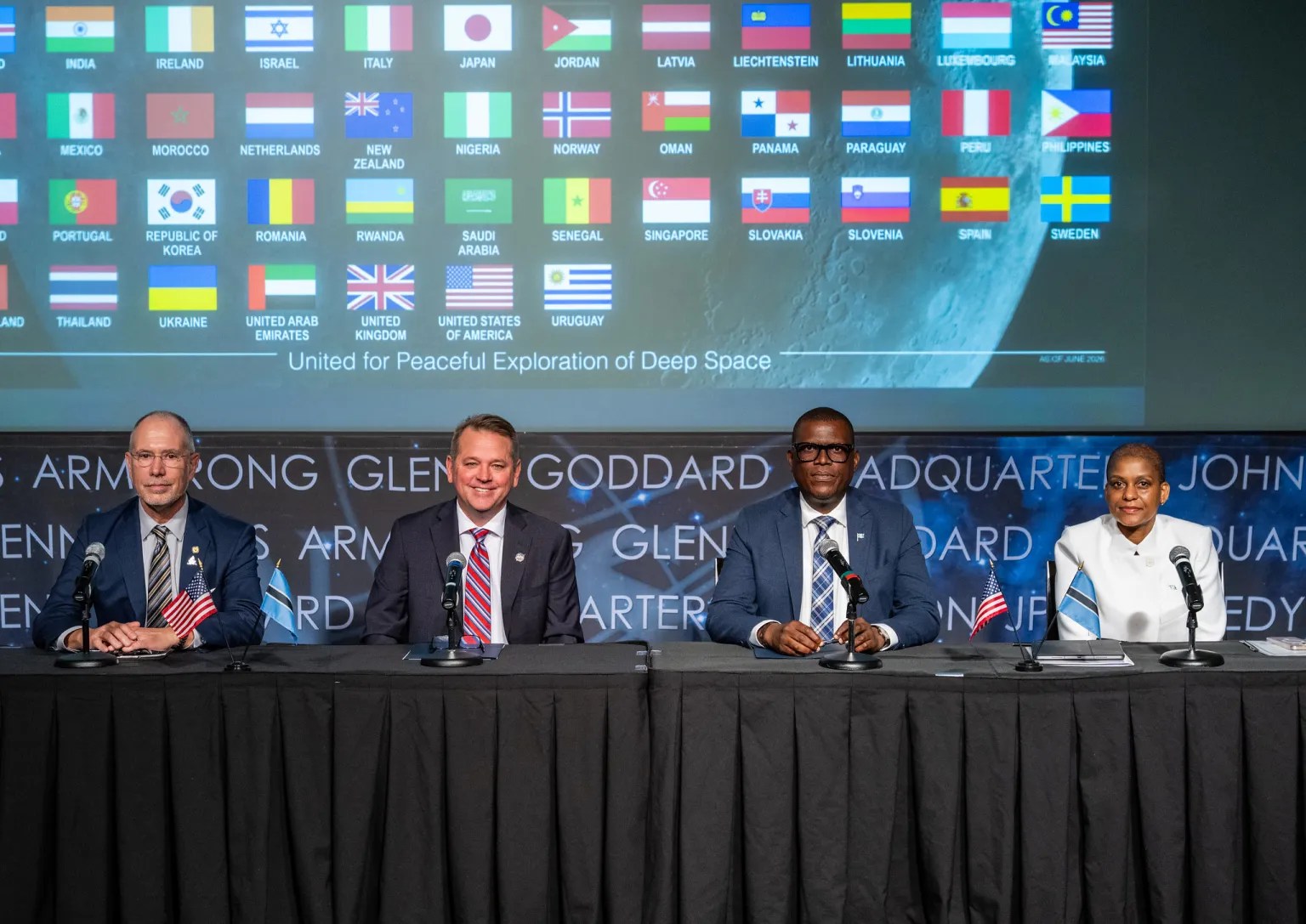
Botswana is set to become the 68th country to sign the Artemis Accords, joining the U.S.-led international framework that promotes peaceful and responsible civil space exploration.
The signing ceremony will take place at NASA Headquarters in Washington, D.C., with Botswana’s Minister of Communications and Innovation, David Tshere, joining NASA Deputy Administrator Matt Anderson and U.S. Department of State Senior Advisor for Space Gregory Autry.
Expanding International Space Cooperation
The Artemis Accords were established in 2020 by NASA and the U.S. Department of State together with eight founding signatories: Australia, Canada, Italy, Japan, Luxembourg, the United Arab Emirates, the United Kingdom and the United States.
The non-binding framework supports international cooperation in civil space activities and is associated with NASA’s Artemis program, which aims to return astronauts to the Moon and support future human missions to Mars.
The principles outlined in the Accords include the peaceful use of space, transparency, scientific data sharing, emergency assistance, registration of space objects, protection of historic sites and the responsible management of orbital debris.
Participation in the Artemis Accords does not require countries to operate their own space programs or participate directly in Artemis missions.
Africa’s Growing Role in Space Governance
Botswana’s accession continues the expansion of African participation in the Artemis Accords.
Nigeria and Rwanda became the first African countries to join the framework in December 2022 during the inaugural U.S.-Africa Space Forum in Washington. Angola signed in December 2023, followed by Senegal in July 2025 and Morocco in April 2026.
Botswana will become the sixth African nation to join the Accords, reflecting growing interest across the continent in international space cooperation and space governance.
Supporting Future Space Diplomacy
The signing comes as governments and commercial organizations increase investments in lunar exploration and space technologies, making international cooperation an increasingly important element of space policy.
The Artemis Accords are intended to establish common principles for future civil exploration activities as participation in lunar and planetary missions continues to expand.