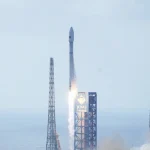
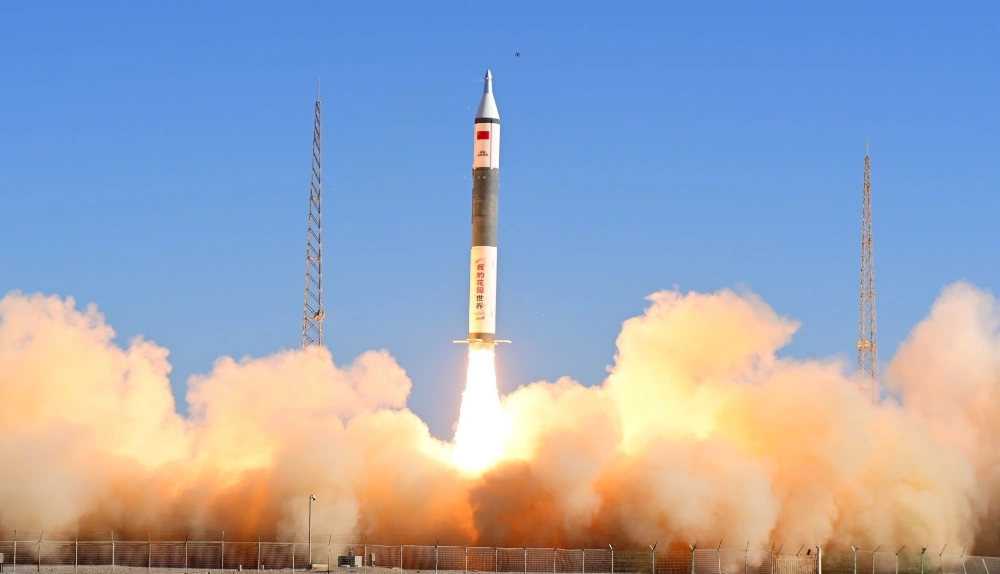
At 10:40 a.m. Beijing time on September 17, 2026, China launched the Tianyi-51 and Tianyi-52 satellites aboard a Kuaizhou-11 Y3 rocket from the Jiuquan Satellite Launch Center. Both satellites entered their planned orbits, completing the mission successfully.
The satellites form a commercial, mid-inclination interferometric synthetic aperture radar (InSAR) pair designed to monitor changes in the Earth’s surface. Tianyi-51, also called Caiyun SAR01, was jointly developed by the Yunnan provincial geological exploration authority, Yunnan Geology and Mining Group, and Spacety. Tianyi-52, also called Xinglianti Tianyuan YG01, was jointly developed by Wuxi-based Xinglianti Aerospace Technology and Spacety. Chinese media described them as the first commercial mid-inclination InSAR satellite pair to reach orbit.
Spacety said the satellites use a 55-degree-inclination orbit and its second-generation C-band radar system. InSAR compares radar observations of the same area taken at different times to detect small changes in the ground. According to the company, the orbital design could reduce repeat observations of target areas from several days to one day. It also expects observations from multiple viewing angles to improve monitoring in dense cities and steep terrain. Those operational capabilities remain to be demonstrated in orbit.
Potential applications include landslide monitoring, identifying risks to buildings, inspecting hydropower facilities and tracking deformation along transport routes. The satellites also carry onboard AI processing payloads and high-speed laser links for returning observation data, according to Hubei Daily. Spacety says it is working toward a global network of 120 SAR satellites.
The solid-fueled Kuaizhou-11 was developed by Kuaizhou Aerospace Space Technology. It has a stated capacity of one metric ton to a 700-kilometer sun-synchronous orbit; that figure describes the rocket’s capability, not the orbit or mass of the two satellites launched on this mission. This was Kuaizhou-11’s seventh flight and the 40th flight across the Kuaizhou rocket family.
China’s expanding space industry is bringing more satellite manufacturing capacity to the global market, creating competitively priced options for satellite imagery, payloads, and assembly, integration and testing (AIT) services. For international customers planning satellite missions, STARPATH GLOBAL can help identify spacecraft, payload, and AIT options suited to their needs. Teams can discuss your mission requirements with STARPATH GLOBAL to assess technical requirements and budgets.