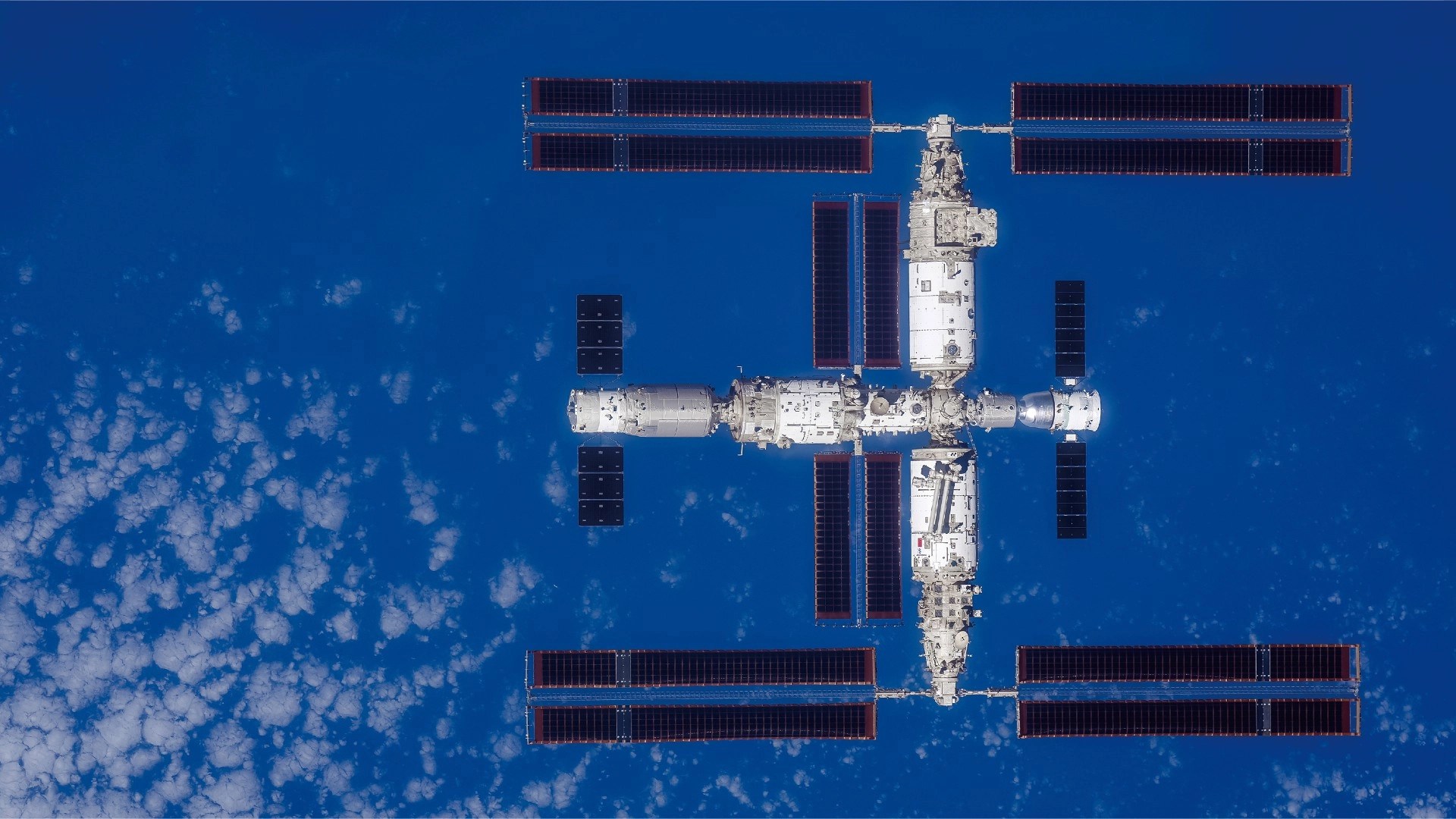
China is preparing to expand its Tiangong space station by adding a new multifunctional module that will transform the orbital outpost from its current T-shaped configuration into a cross-shaped structure.
The expansion represents the next phase of the station’s long-term development plan and is intended to increase scientific research capacity, support more frequent missions and prepare the station for future international cooperation.
First Expansion Phase
Tiangong currently consists of the Tianhe core module and the Wentian and Mengtian laboratory modules.
Under the first expansion phase, a new 20-tonne-class multifunctional module will dock with the Tianhe core module, creating a cross-shaped configuration.
According to Qian Hang, a researcher at the China Academy of Launch Vehicle Technology (CALT), the expansion has always formed part of the station’s original design.
The additional module will provide more docking ports for visiting spacecraft, an extra hatch for spacewalks, and expanded storage and laboratory space.
Growing Scientific Demand
Chinese officials said the expansion is driven by increasing demand for orbital research.
Since entering operation, Tiangong has hosted 267 scientific and application projects. Over the past year alone, 86 new experiments were added, with approximately 1,179 kilograms of research materials delivered to the station and 105 kilograms of scientific samples returned to Earth. These activities have generated more than 150 terabytes of scientific data.
Qian said the increasing pace of crewed and cargo missions also requires additional docking capacity to avoid scheduling conflicts and improve operational flexibility.
Future upgrades will also enhance living quarters, exercise facilities and emergency support systems as China prepares for longer-duration missions and potentially larger astronaut crews.
Long-Term Development
The new module has been designed with standardised interfaces, allowing additional modules to be integrated without major modifications to the existing station.
According to Pang Zhihao, two more laboratory modules could eventually be attached to the expansion module, while Yang Hong, chief designer of the space station system, said long-term plans envision a six-module station.
Under that concept, Tiangong’s total mass would increase from approximately 90 tonnes to as much as 180 tonnes, enabling dedicated research modules for different scientific disciplines and significantly expanding crew capacity.
Supporting Future Missions
The expanded station will also support more complex orbital operations, including spacecraft servicing and maintenance.
One of the most significant future missions will be the Xuntian Space Telescope, scheduled for launch in 2027. Rather than remaining permanently attached to Tiangong, the telescope will operate independently in a similar orbit and dock with the station when maintenance is required.
This co-orbital approach is designed to minimise vibration during astronomical observations while allowing astronauts to service the telescope when necessary.
Chinese officials said the expansion will transform Tiangong into a more capable orbital complex, combining human spaceflight, scientific research, technology demonstrations and astronomical observation within a single long-term space infrastructure.
Source: Xinhua