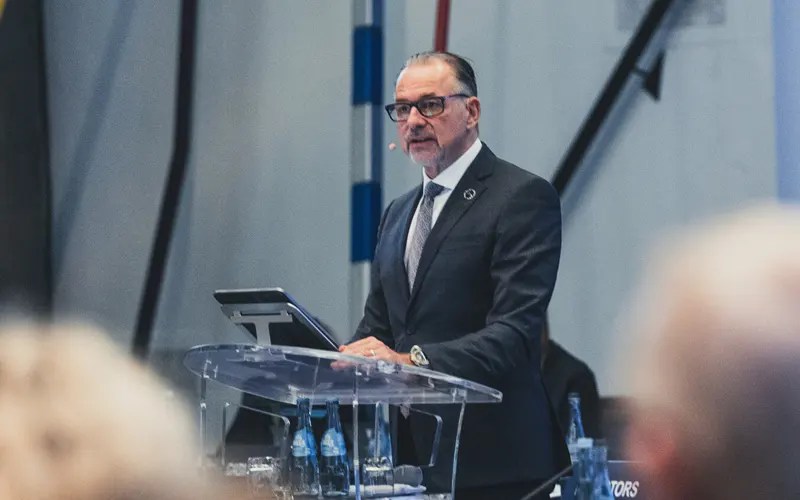
European Space Agency Director General Josef Aschbacher has called for Europe to establish its own independent human spaceflight capability, arguing that the continent has become overly dependent on decisions made by foreign partners.
In an opinion article published on May 18, Aschbacher said recent changes to the United States’ Artemis programme architecture and Europe’s reduced cooperation with Russia highlighted the need for greater autonomy in human space exploration.
Before 2022, ESA astronauts traveled to the International Space Station aboard Russian Soyuz spacecraft and U.S.-built Dragon capsules operated through partnerships with NASA.
However, ESA suspended cooperation with Russia following Moscow’s invasion of Ukraine, leaving the agency dependent on seat-sharing arrangements with NASA for astronaut access to orbit.
Aschbacher said developments in the global space sector underscored the strategic importance of sovereign European capabilities.
“Europe has become too exposed to decisions beyond its control,” Aschbacher wrote.
“Autonomous human spaceflight is not a luxury” but “a necessary anchor for Europe to secure its freedom to unlock the scientific, economic, strategic and geopolitical benefits of space,” he added.
The ESA chief identified political commitment as one of the main obstacles to achieving independent European crewed spaceflight capabilities.
According to Aschbacher, ESA member states have previously supported foundational programmes but stopped short of fully committing to autonomous human exploration systems.
“Political decisions have always fallen short of pursuing full autonomy in human exploration,” he said, adding that the approach had produced “lasting consequences.”
ESA has already launched several programmes intended to lay the groundwork for future European crew transportation capabilities.
In 2023, the agency introduced its LEO Cargo Return Service initiative, aimed at supporting development of European cargo spacecraft that could later be adapted for crew transportation.
In November 2025, ESA also launched a Crew Launch Abort Demonstrator programme intended to support development of a human-rated launch system potentially compatible with the Ariane 6 rocket.
Separately, ESA began studies earlier this year exploring the feasibility of a future European-led space station as part of planning for a post-ISS environment.
The agency launched a call in February 2026 for parallel studies examining technology requirements and operational concepts for a possible European orbital station.
ESA expects those studies to support future strategic decisions before the end of 2026.
Aschbacher outlined several upcoming political and funding milestones that he said could shape Europe’s future human spaceflight ambitions, including ESA Council meetings, the International Space Summit and negotiations over the European Union’s 2028–2034 Multiannual Financial Framework.
He also urged European nations to maintain collective cooperation while avoiding excessive strategic dependence on external partners.
“No single Member State can achieve on their own what we can achieve together,” Aschbacher wrote.
Europe should also be careful to “not let cooperation slip into dependency,” he added.
The comments come as global competition in human spaceflight intensifies, with governments and private companies increasingly investing in lunar missions, orbital infrastructure and long-term space transportation systems.