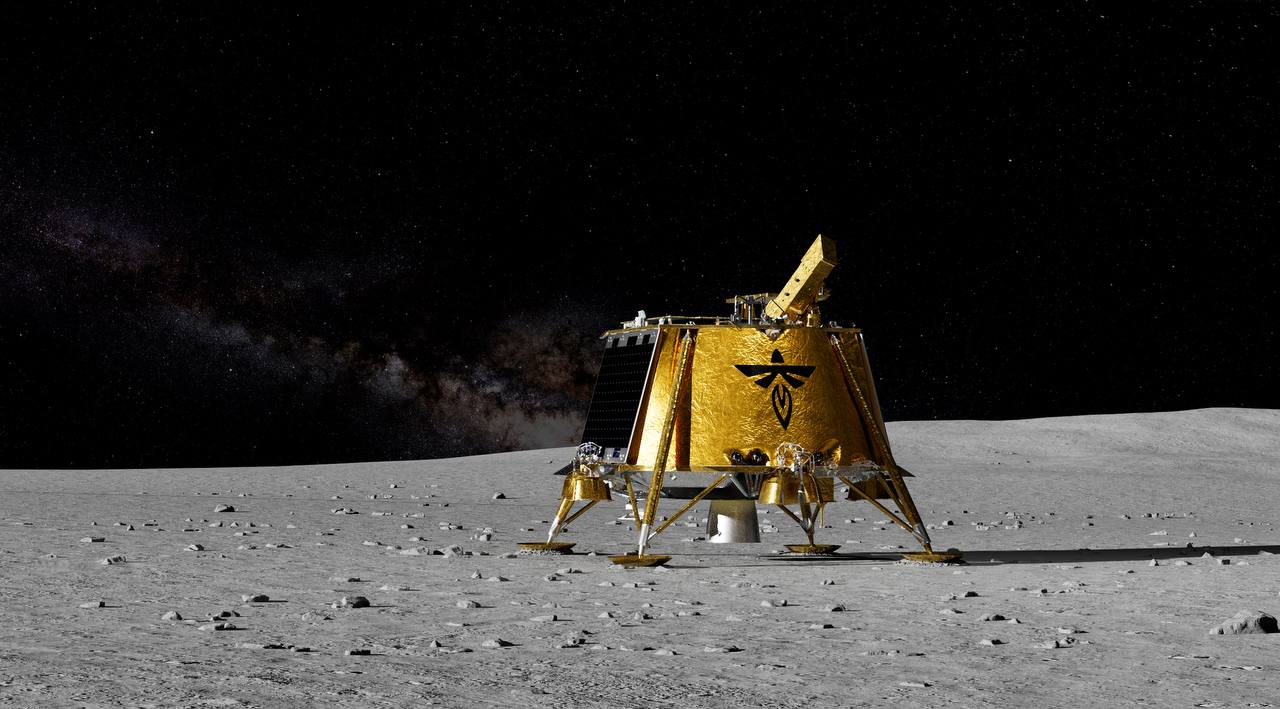
Financial terms were not disclosed. Space-ng will be fully integrated into Firefly, with Rublee overseeing the company’s spacecraft software suite. The two companies were already closely linked, since Space-ng’s vision navigation software handled autonomous hazard detection and real-time terrain avoidance during Blue Ghost Mission 1’s lunar descent.
Space-ng also brings high-resolution spacecraft cameras and AI compute hardware, both of which Firefly identifies as critical for upcoming missions. Blue Ghost Missions 2, 3, and 4, all part of NASA’s CLPS effort, will require precise autonomous landing on the lunar surface, with Space-ng’s software guiding those touchdowns. For NASA’s MoonFall mission, one of the first missions of NASA’s Moon Base, Firefly’s Elytra OTV will deliver four drones to the lunar south pole, where Space-ng’s optical navigation and AI compute hardware enable precise positioning where GPS is unreliable. Elytra will also conduct space domain awareness operations in low Earth orbit for DIU’s Sinequone Project, with Space-ng’s cameras and processing serving as the system’s eyes for tracking orbital objects.
Firefly CEO Jason Kim framed the deal around overlapping mission needs. “There’s a lot of synergies here,” Kim told Payload Space. “Not only can Space-ng’s capabilities help us with landing on the Moon, they can help us with all the other missions that need that kind of real-time navigation and hazard avoidance.” He stressed the centrality of reliable landing to lunar operations. “This is a very crucial, critical part of the Moon mission,” Kim said. “You’ve got to successfully, repeatedly, reliably land, and that’s what Space-ng’s vision navigation system does for us.”
The acquisition is Firefly’s second major software purchase in the past year, following its October 2025 acquisition of AI defense software company SciTec. Kim said the choice to buy rather than continue working with Space-ng as a vendor was a strategic one, allowing Firefly to offer Space-ng’s capabilities to government and commercial customers and create new revenue streams while expanding the company’s addressable market for more diverse mission capabilities.
Kim tied the move to Firefly’s vertical integration strategy. “We build our own rocket engines. We build our own rockets, and our lunar landers, and our spacecraft. Then, we acquired another software company last October. In terms of additional navigation software, we really saw a one-plus-one-equals-four kind of moment.” He said Space-ng is unlikely to be Firefly’s last acquisition, noting the company has a “robust M&A pipeline” focused on firms that fit its culture and strategy.
Firefly’s coming missions point to where the acquired technology will be tested. Blue Ghost Missions 2, 3, and 4 will rely on Space-ng’s vision navigation and hazard avoidance software for their lunar touchdowns, while the MoonFall and Sinequone projects will draw on its optical navigation, cameras, and AI compute hardware. Kim’s stated intent to sell Space-ng’s capabilities to government and commercial customers signals a planned expansion beyond Firefly’s own missions, and his reference to an active M&A pipeline points to further deals ahead.