
A project to upgrade the smart factory for precision optical, mechanical and electronic space products at the Shanghai Institute of Spaceflight Control Technology, part of the Shanghai Academy of Spaceflight Technology under China Aerospace Science and Technology Corporation, recently passed the final review of Shanghai’s special program for intelligent manufacturing development.
The project has established a series of representative application scenarios covering the entire chain of research and development, production and management. It has connected data throughout the process—from R&D and design to manufacturing and delivery—while accelerating the factory’s transition from conventional manufacturing to intelligent manufacturing. The upgraded facility now provides stronger support for the high-quality delivery of space equipment.
Breaking Down Data Barriers to Build a Fully Collaborative Ecosystem
“The ultimate goal of digital transformation is the systematic restructuring of all production factors and processes,” project leader Cai Xiaojiang said. “As an institute integrating research, production and testing, our objective is to intelligently reconstruct the full lifecycle and manufacturing process of complex optical, mechanical and electronic products used in space control systems.”
To address poor information flows during space product development, the institute established an integrated technical process management platform and a unified data center. By adopting common data standards and standardized interface protocols, it has consolidated and governed heterogeneous data previously scattered across different stages, breaking down information barriers between departments.
Building on this foundation, the project developed 12 representative application scenarios, including multidisciplinary collaborative simulation and design, flexible unmanned production, smart warehousing and logistics, and digital supply chain management.
“These scenarios do not operate independently,” Cai said. “They are closely interconnected through data links, forming a complete value chain extending from product development to final delivery.”
This factory-wide collaboration has shifted management decisions from experience-based judgment to data-driven analysis. Production scheduling has also moved from reactive responses to proactive forecasting, creating a solid digital foundation for efficient smart factory operations.
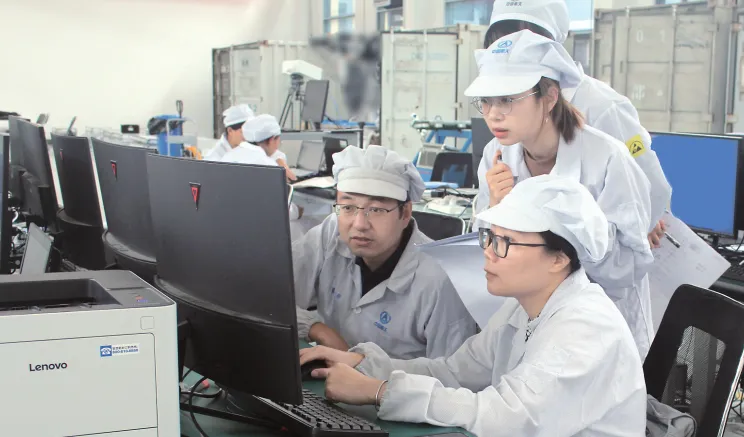
The rocket test, launch and control system development team at SAST’s 804th Research Institute discusses issues encountered while implementing the system’s layered architecture. Photo by Yang Zhen.
Deepening Scenario-Based Applications to Accelerate Operations Across the Factory
At the earliest stage of product development, complex systems often face rapid design iterations and difficult verification processes. Drawing on years of R&D experience, the institute has therefore expanded its use of digital twins, enabling digital prototypes to be developed and tested ahead of their physical counterparts.
Through multidisciplinary collaborative simulation and optimization, the institute reconstructed a comprehensive model of satellite control systems operating during in-orbit missions. Simulation results are used directly to improve control-system algorithms, raising optimization efficiency by 50%.
The institute has also standardized and consolidated big data covering the entire product lifecycle. Data envelope analysis has been introduced into the development of flight-control products, substantially increasing confidence in digital prototypes while enabling earlier assessment of product-quality risks and faster design iterations.
These measures have significantly reduced the cost of physical testing and shortened development cycles.
Inside the production workshop, employees and automated systems work side by side as products move efficiently between processes. To accommodate the customized, high-mix and low-volume production requirements of space products, the institute has established a flexible unmanned production line for metal components.
Automated guided vehicles and mobile robotic arms enable the line to switch rapidly between different product models. Equipment utilization has increased by 50%, while production efficiency has risen by more than 40%.
The institute has also introduced model-based definition, or MBD, to integrate design, process planning and manufacturing from the product design stage. This has greatly improved the early identification of process defects, reduced downstream production problems involving complex products, and created a tighter closed loop between design, process planning and manufacturing.
During quality inspection, traditional visual checks and manual measurements have been replaced by AI-powered machine vision and microfocus X-ray technology.
“Inspection of component solder joints now covers 100% of critical processes, while the first-pass yield has risen to more than 99.5%,” said Cao Bing, deputy director of a research office at the Electrical Assembly Center.
Strengthening Integrated Control Across the Management Chain
“After connecting factory-wide data and expanding scenario-based applications, we also began using production-line digital twins and automated scheduling for batch production,” said Sun Shixu, the project’s technical lead. “These tools allow us to promptly optimize production scheduling and resource allocation, making line operations more transparent and efficient.”
Through a digital operations and centralized control platform, production instructions are transmitted downward to manufacturing lines, while production and quality information is collected and reported upward.
This data flow connects every stage of manufacturing, eliminates data silos between production assignments and actual workshop operations, and provides valuable data services for managerial supervision and decision-making.
According to Tian Sumei, deputy director of the Information Center, 95% of equipment on core production lines and manufacturing cells is now connected to the network. Major process data can be collected automatically without manual intervention.
The centralized control platform also enables real-time collection, monitoring, analysis, processing, sharing and traceability of data relating to equipment, products, environmental conditions and personnel. The institute has established equipment health assessment models and fault-warning mechanisms, shifting maintenance from reactive repairs to predictive maintenance.
The institute has also extended intelligent management to both ends of its supply chain through two application scenarios: smart warehousing and logistics distribution, and digital supply chain management.
The newly completed smart warehousing system has doubled storage-space utilization, raised material-issuing accuracy to more than 99%, and reduced warehouse staffing requirements by 50%.
On the supply side, a mechanism that evaluates every individual order now covers 100% of procurement activities. Supplier assessments have moved from subjective scoring to data-based profiles, helping eliminate inefficient capacity and strengthen supply chain resilience.
Following the smart factory upgrade, the institute’s intelligent manufacturing maturity level rose from L3-1 to L3-3. Overall equipment and resource utilization increased by 20%, average production efficiency across manufacturing lines and cells rose by 30%, and manufacturing costs per unit of output fell by 16% to 20%.
The project has delivered multidimensional improvements in manufacturing capacity, product quality and operational efficiency.
As China’s increasingly efficient space manufacturing system brings more satellite capacity to the global market, international customers can gain access to competitively priced satellites, payloads and related space solutions. To identify the right Chinese products, customize them for your mission and support implementation, apply for STARPATH GLOBAL’s limited-availability Pioneer Partner Program.