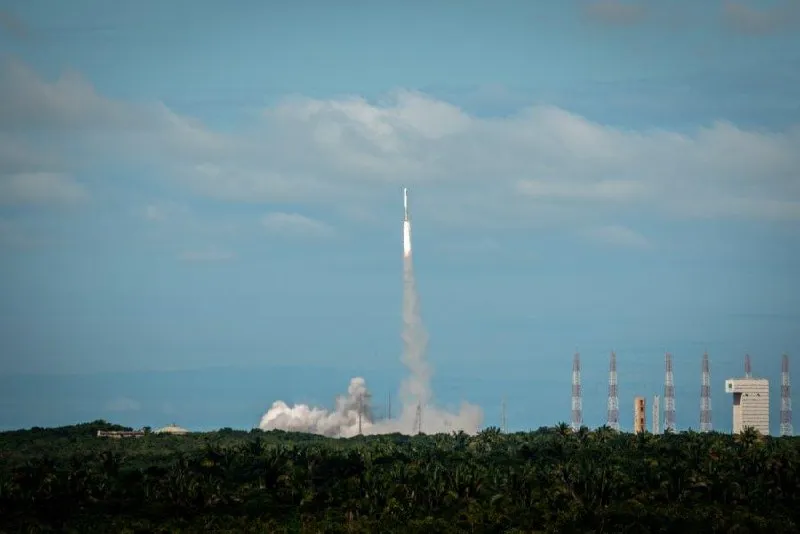
INNOSPACE’s multipurpose suborbital rocket SEBIT veered away from its planned trajectory during its debut test flight from Brazil on Aug. 19, prompting the Brazilian Air Force to activate the vehicle’s flight termination system and end the mission prematurely.
SEBIT lifted off from its launch platform at the Alcântara Space Center at 16:30 BRT on Aug. 19. After detecting an unexpected deviation from the planned flight path, Brazilian launch authorities terminated the flight in accordance with range safety procedures.
SEBIT subsequently fell within a designated maritime safety zone off Brazil. INNOSPACE reported no casualties or damage to launch facilities.
The company is now analyzing flight data to determine the precise cause of the trajectory deviation and the circumstances surrounding the early termination. It plans to incorporate corrective measures into the vehicle and conduct a follow-up test flight.
A Normal Liftoff Was Followed by a Rapid Trajectory Deviation
SEBIT is a single-stage suborbital vehicle powered by a 3-ton-class hybrid rocket engine. Unlike an orbital launch vehicle, it is designed to carry payloads to an altitude below 100 kilometers before following a ballistic trajectory back toward Earth.
The Aug. 19 flight was intended primarily as a development test rather than an operational commercial mission. INNOSPACE planned to use the flight to verify the rocket’s propulsion, flight characteristics, guidance, navigation and control systems, tracking performance, flight-safety procedures and ground operations.
The company had completed a wet dress rehearsal on Aug. 14 at Alcântara, conducting a final integrated check of propellant loading, the launch control system, ground infrastructure, the vehicle and safety procedures. The successful rehearsal allowed the company to proceed into final launch preparations.
The planned launch window extended from Aug. 19 through Aug. 28, with the launch scheduled for 16:30 BRT on Aug. 19.
Video of the flight showed SEBIT climbing after liftoff before its trajectory changed sharply. The vehicle subsequently lost its expected flight path, after which the rocket’s exhaust plume disappeared and the vehicle broke apart.
INNOSPACE has not yet identified a specific hardware or software failure as the cause. The company is examining flight data from the propulsion, guidance, navigation and control, tracking and ground systems to reconstruct the sequence of events.
That distinction is important. A trajectory deviation during an early flight test does not by itself establish whether the initiating problem originated in propulsion, flight-control software, sensors, structural systems or another subsystem. Determining the sequence of events from telemetry will be central to the investigation.
Why the Flight Termination System Matters
The activation of the flight termination system was a range-safety measure rather than a separate failure of the launch site.
Once a rocket begins deviating significantly from its authorized trajectory, a range authority may determine that allowing it to continue could create a risk to people, infrastructure or other protected areas. A flight termination system provides a controlled way to stop such a vehicle before it can travel outside the designated safety corridor.
In SEBIT’s case, the Brazilian Air Force activated the system after the rocket deviated from its planned trajectory. The vehicle then came down within a predefined maritime safety area, with no reported casualties or facility damage.
For commercial launch companies, demonstrating reliable range-safety procedures is an important part of establishing an operational launch capability. A test that ends early can therefore still generate useful information about the interaction between the rocket, launch site and safety infrastructure, even when the primary flight objective is not achieved.
INNOSPACE said the test produced data from several major systems, giving engineers information that can be used to determine what happened and identify improvements for the next flight.
SEBIT Targets a Different Market From Conventional Orbital Launchers
SEBIT is being developed for a market that sits between laboratory testing and conventional satellite launch.
Its suborbital trajectory allows payloads to experience portions of the space environment without requiring the vehicle to achieve orbital velocity. That makes the concept potentially useful for scientific experiments, materials research, biotechnology and medical research, as well as qualification testing for electronics and other hardware intended for space.
The approach can also reduce the complexity associated with orbital missions. A customer does not necessarily need a satellite bus, orbital insertion, long-term spacecraft operations or an extended mission to expose an experiment to relevant flight conditions.
For INNOSPACE, the commercial objective is to turn that capability into a repeatable test and verification service. The company has described SEBIT as a future space-transport platform for customers that need access to the suborbital environment.
That business model depends heavily on repeatability. A single successful flight can demonstrate technical feasibility, but a commercial service requires predictable launch preparation, stable flight performance, reliable payload accommodation and sufficiently high flight frequency.
The Aug. 19 test therefore represents the beginning of that validation process rather than its conclusion.
The Result Comes After INNOSPACE’s Earlier HANBIT-Nano Setback
SEBIT is not INNOSPACE’s only active launch-vehicle program. The company is also developing the HANBIT-Nano small satellite launcher for orbital missions.
HANBIT-Nano’s first commercial launch, conducted on Dec. 22, 2025, ended prematurely after a combustion-chamber rupture. INNOSPACE subsequently investigated that incident and released its final investigation results on June 11, 2026.
The company has been preparing a follow-up HANBIT-Nano launch for November 2026, with the schedule dependent on vehicle preparations, regulatory approvals and weather conditions. INNOSPACE plans to use the mission to verify improvements made following the earlier failure and to carry its own INNOSAT-0 test satellite.
That means the company is simultaneously working through two different phases of launch-vehicle development: analyzing an early SEBIT flight anomaly while preparing an upgraded HANBIT-Nano for another orbital attempt.
The two programs are technically distinct, but both place a premium on the same fundamental capability: converting test data into engineering changes and then demonstrating those changes through repeated flights.
Alcântara Gives INNOSPACE an International Launch Base
The SEBIT test also highlights the importance of Alcântara to INNOSPACE’s development strategy.
Located near the equator in Brazil, the Alcântara Space Center is operated under Brazilian government and military oversight and provides an established launch environment for international customers. INNOSPACE has been working with Brazilian authorities, including the Brazilian Air Force and aerospace organizations, as it develops its launch operations there.
The company adjusted its 2026 SEBIT schedule after changes to the operating structure at the launch center and the establishment of ALADA, a Brazilian state-owned aerospace company.
For a South Korean commercial launcher, conducting the flight from Brazil provides access to an international launch site while also requiring the company to demonstrate that its vehicle and operational procedures can work within another country’s range-safety and regulatory framework.
The successful avoidance of casualties or infrastructure damage during the early termination is significant in that context. The flight did not meet its intended technical objectives, but the range-safety system performed its intended function when the vehicle departed from its authorized trajectory.
The Next Flight Will Be More Important Than the First Failure
The immediate priority for INNOSPACE is to establish the cause of the anomaly.
The company has said it will analyze the collected flight data and implement necessary corrective measures before pursuing another SEBIT test flight. The quality of that investigation will determine how much value can ultimately be extracted from the Aug. 19 mission.
Early launch failures are not unusual in the development of new rockets. What distinguishes a commercially viable launch provider is its ability to identify failure mechanisms, modify the vehicle and demonstrate that the changes work in subsequent flights.
For SEBIT, the next test will therefore carry a different objective from the debut. Engineers will need to show not only that the rocket can leave the pad, but that its propulsion, navigation and control systems can maintain the intended trajectory throughout the critical portion of powered flight.
The company will also need to demonstrate increasing operational consistency if it wants to transition from development testing to customer missions.
INNOSPACE founder and CEO Soojong Kim said the data and operational experience from the first flight would be important assets for advancing SEBIT’s suborbital testing and verification service. He said the company intends to improve reliability and stability through repeated flights and develop SEBIT into a mission-focused suborbital transportation platform that customers can use with confidence.
That strategy makes the follow-up test particularly important. The Aug. 19 flight ended before reaching its intended objectives, but it produced real flight data from the vehicle and its supporting systems. The value of that data will ultimately be measured by whether INNOSPACE can translate it into a safer and more reliable SEBIT.
INNOSPACE Faces a Familiar Commercial Launch Challenge
The broader challenge is one faced by emerging launch companies worldwide: moving from an engineering prototype to a repeatable transportation service.
Suborbital launch systems can offer customers a relatively accessible route to microgravity and near-space testing, but the market remains sensitive to price, reliability, launch cadence and regulatory constraints. Customers conducting experiments or qualifying hardware need confidence that missions will occur on schedule and that the flight environment will be sufficiently predictable.
SEBIT’s hybrid propulsion architecture and relatively compact suborbital mission profile are intended to support that commercial proposition. But technology alone will not determine the outcome. INNOSPACE must build a record of successful flights and demonstrate that its launch operations can be repeated efficiently.
The company’s next SEBIT test will therefore be closely watched as a measure of how quickly it can turn the lessons of its debut into engineering improvements.
For now, the Aug. 19 mission is best characterized as an early flight test that ended prematurely after a trajectory anomaly, not as the end of the SEBIT program. INNOSPACE has retained flight data from the vehicle’s propulsion, guidance and tracking systems, and it intends to use that information to prepare for another attempt.
The immediate objective is to determine why SEBIT left its planned trajectory. The longer-term objective is more demanding: proving that the rocket can repeatedly and safely provide the suborbital test and research services for which it was designed.