A Rocket Lab spacecraft used a monolithic telescope and onboard navigation software developed by Lawrence Livermore National Laboratory to acquire and track another satellite during the U.S. Space Force’s Victus Haze exercise, demonstrating how quickly an inspection spacecraft can be launched, commissioned and directed toward an object already in orbit.
The exercise tested more than responsive launch. It evaluated an end-to-end chain that included launch preparation, spacecraft commissioning, target acquisition, navigation and rendezvous and proximity operations in low Earth orbit.
Victus Haze paired Rocket Lab’s Puma spacecraft, based on the company’s Pioneer platform, with True Anomaly’s Jackal-0004. The two maneuverable spacecraft participated in a series of space domain awareness scenarios resembling an orbital cat-and-mouse exercise, with each vehicle able to operate as an inspector or target.
Jackal-0004 launched May 3, 2026, aboard a SpaceX Falcon 9 rideshare mission. It was already in orbit when the Space Force issued Rocket Lab its notice to launch Puma.
Rocket Lab launched Puma aboard an Electron rocket from Launch Complex 1 in Mahia, New Zealand, at 10:19 p.m. local time June 19. Liftoff occurred 16 hours and 42 minutes after the company received the order, beating the previous tactically responsive space launch record set during the 2023 Victus Nox mission by more than 10 hours.
Rocket Lab calculated the final trajectory, updated the launch vehicle’s flight software and coordinated its ground-station network in approximately four hours. The company then commissioned Puma in 37 hours and 36 minutes, completing the process more than 34 hours before the Space Force’s 72-hour deadline.
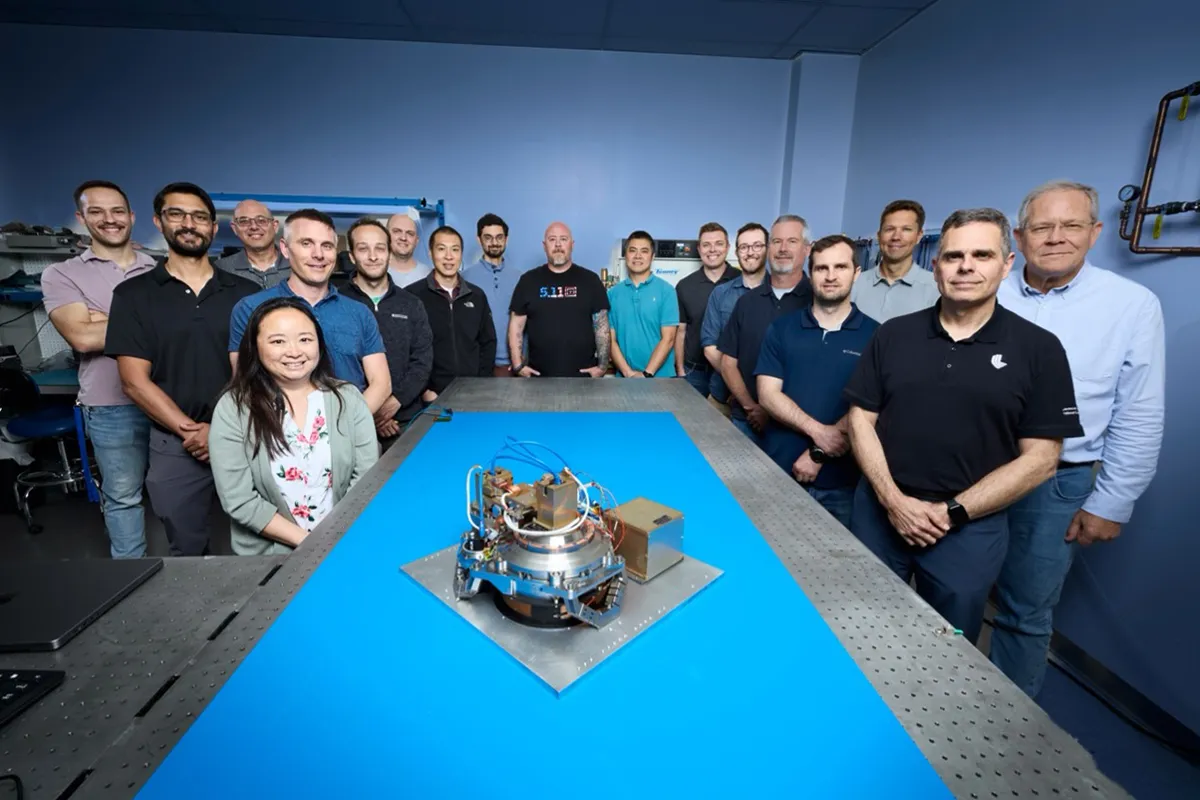
The LLNL optical payload was commissioned within 24 hours of launch. During the early mission phases, it acquired Jackal and supplied observations to onboard software that helped Puma determine the direction of the target and point toward it.
Angles-Only Navigation Closes the Guidance Loop
The payload demonstrated angles-only navigation using a live stream of telescope images and an algorithm running in its electronics. The system established a closed control loop between the optical payload and the spacecraft, allowing observations from the telescope to generate pointing information for Puma.
Unlike active sensors such as radar or lidar, a passive optical telescope does not directly measure the distance to another spacecraft. Angles-only navigation instead records the target’s direction across a sequence of images. Navigation software combines those changing lines of sight with the inspector spacecraft’s own orbital motion to estimate the target’s relative trajectory.
This approach is relevant to inspections of non-cooperative spacecraft, which may not transmit precise navigation information or carry equipment designed to assist an approaching vehicle. The inspector must use its own sensors and processing to locate the object, refine its relative position and plan a safe approach.
The LLNL system therefore contributed to both imaging and navigation. Its ability to process observations onboard reduced dependence on sending every image to the ground before the spacecraft could update its attitude or maneuver plan.
The telescope is manufactured from a single fused-silica substrate rather than assembled from several independently mounted optical elements. This monolithic construction provides high mechanical stability and reduces the risk that launch vibration or thermal changes will disturb the alignment between optical surfaces.
Because the telescope’s optical geometry is established during fabrication, it does not require the same type of post-assembly alignment and calibration associated with conventional multi-element systems. That robustness supports rapid integration and commissioning, both of which are important for spacecraft maintained in readiness for short-notice missions.
Victus Haze was LLNL’s second optical payload for a tactically responsive Space Force mission. In 2021, the laboratory supplied a three-mirror reflective telescope and sensor for Tactically Responsive Launch-2, which demonstrated the rapid preparation and deployment of an experimental space domain awareness payload.
Responsive Space Extends Beyond Launch Speed
Victus Haze is managed by Space Systems Command’s Space Safari Program Office in partnership with the Defense Innovation Unit. The program uses commercial spacecraft, launch services and mission operations to test how the Space Force could respond to unexpected or potentially threatening activity in orbit.
Rocket Lab provided an integrated mission package covering the Electron launch vehicle, Puma spacecraft, mission and ground software, launch services, commissioning and on-orbit operations. LLNL supplied the optical payload as government-furnished equipment, while True Anomaly operated Jackal-0004 with its own sensor and propulsion systems.
After commissioning, Puma completed a series of maneuvers to pursue, monitor, approach and image its target. Rocket Lab completed the initial rendezvous and proximity operations in less than 59 hours, approximately 25 hours ahead of the Space Force’s 84-hour deadline.
True Anomaly subsequently used Jackal to locate, approach, circumnavigate and image Puma during another phase of the exercise. Later scenarios allowed the spacecraft to exchange roles, testing how operators and autonomous systems respond when a target maneuvers rather than following a predictable trajectory.
These operations distinguish Victus Haze from earlier tactically responsive launch demonstrations. Rapidly placing a satellite in orbit addresses only the first stage of a response. The spacecraft must also activate its systems, establish communications, determine its orbit, locate the target and begin useful operations on a militarily relevant timeline.
Data from the continuing exercise will help the Space Force refine tactics, navigation methods and operational procedures for future inspection missions. Victus Haze also provides a framework for evaluating how commercial launch vehicles and maneuverable spacecraft can be combined with government-developed sensors to field space domain awareness capabilities on short notice.