NASA Administrator Jared Isaacman has endorsed placing artificial intelligence data centers in Earth orbit, arguing that space-based computing could draw directly on abundant solar energy while reducing pressure on terrestrial power grids, water supplies and land.
Isaacman outlined the concept in an August 26, 2026, interview with Nexstar DC. He described the sun as a “free fusion reactor” and linked orbital computing infrastructure to U.S. leadership in both space and artificial intelligence.
The remarks represent an endorsement of an emerging commercial technology rather than the announcement of a funded NASA program. NASA has not disclosed an orbital data-center architecture, procurement plan, budget or deployment schedule associated with Isaacman’s proposal.
The distinction is important because an orbital data center would be a large spacecraft system combining power generation, high-performance computing, thermal control, optical communications and autonomous operations. Although each underlying technology already exists in some form, integrating them at data-center scale remains an unresolved engineering and economic challenge.
Terrestrial energy constraints are pushing AI infrastructure toward space
Isaacman’s proposal comes as the expansion of terrestrial AI infrastructure faces growing resistance over electricity consumption, grid connections, water use, noise and land requirements. Data centers designed for training and operating large AI models can require hundreds of megawatts of continuous power, while the largest planned campuses are moving toward gigawatt-scale demand.
Placing computing hardware in orbit would eliminate competition for terrestrial land and could reduce dependence on local electricity and cooling-water infrastructure. Satellites in carefully selected orbits can receive sunlight for a larger portion of each day than ground-based solar installations, without atmospheric attenuation or weather interruptions.
That advantage does not translate into free electricity, however. Solar arrays, deployment structures, power-conditioning electronics and energy storage must all be manufactured, qualified and launched. Satellites in low Earth orbit also pass through eclipses unless they operate in specialized high-sunlight trajectories, requiring batteries or other provisions for periods without solar generation.
An orbital system would therefore exchange terrestrial grid and water constraints for launch mass, spacecraft reliability and thermal-management constraints.
Rejecting heat is harder than generating power
Thermal control is likely to be one of the defining limitations of orbital AI infrastructure. Advanced processors convert most of their electrical input into heat. Terrestrial data centers transfer that heat through air- or liquid-cooling systems and ultimately into the surrounding environment. A spacecraft operates in a vacuum, where convection is unavailable and waste heat must be transported to external radiators and emitted as infrared radiation.
A high-power computing satellite would need extensive radiator area, coolant loops, pumps, heat exchangers and fault-tolerant fluid connections. Radiator operating temperature would affect both the area required and the permissible temperature of the computing hardware. Large deployable radiators would also add mass and create structural, attitude-control and micrometeoroid-protection requirements.
Radiation presents a separate challenge. Commercial GPUs and AI accelerators are optimized for performance and energy efficiency rather than long-duration exposure to trapped particles, solar events and cosmic radiation. Shielding can reduce cumulative dose but adds mass and cannot eliminate all single-event effects.
Early orbital data centers may therefore use commercial processors with shielding, redundancy, error correction and frequent replacement instead of relying exclusively on slower and more expensive radiation-hardened chips. That approach could work only if launch and spacecraft-production costs become low enough to support a shorter hardware-refresh cycle.
Communications will determine which workloads make sense
Orbital data centers would also need to move large volumes of information between satellites and users on Earth. AI training requires rapid data exchange among many processors, with latency and bandwidth demands that can exceed those of conventional satellite communications.
Laser intersatellite links could connect distributed computing nodes, but maintaining high-capacity optical links between moving spacecraft requires precise pointing, stable structures and sophisticated network control. Downlink capacity would remain a bottleneck for workloads that continuously exchange raw data with terrestrial customers.
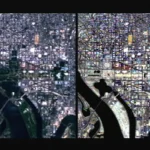
This makes space-native processing a more credible initial market than general-purpose cloud computing. Earth-observation satellites, space-domain-awareness platforms and scientific missions already generate data in orbit. Processing imagery or sensor measurements near the point of collection could reduce the amount of information that must be transmitted to Earth, lowering latency and conserving downlink capacity.
AI inference, data compression, image classification and event detection are consequently more practical early applications than training frontier-scale models using datasets stored primarily on the ground.
SpaceX, Google and Starcloud are moving toward demonstrations
Isaacman’s remarks align NASA’s leadership rhetorically with a commercial race already involving launch providers, cloud-computing companies and specialized startups.
SpaceX has asked the Federal Communications Commission for authority to deploy as many as 1 million orbital data-center satellites at altitudes between 500 and 2,000 kilometers. The proposed network would use optical links to communicate among satellites and with the Starlink system. The FCC has accepted the application for review but has not authorized the constellation.
The unusually large requested number should not be interpreted as a firm deployment commitment. Satellite operators often seek regulatory flexibility for multiple orbital configurations, and the economic and space-sustainability implications of anything approaching that scale would be substantial.
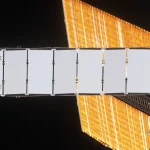
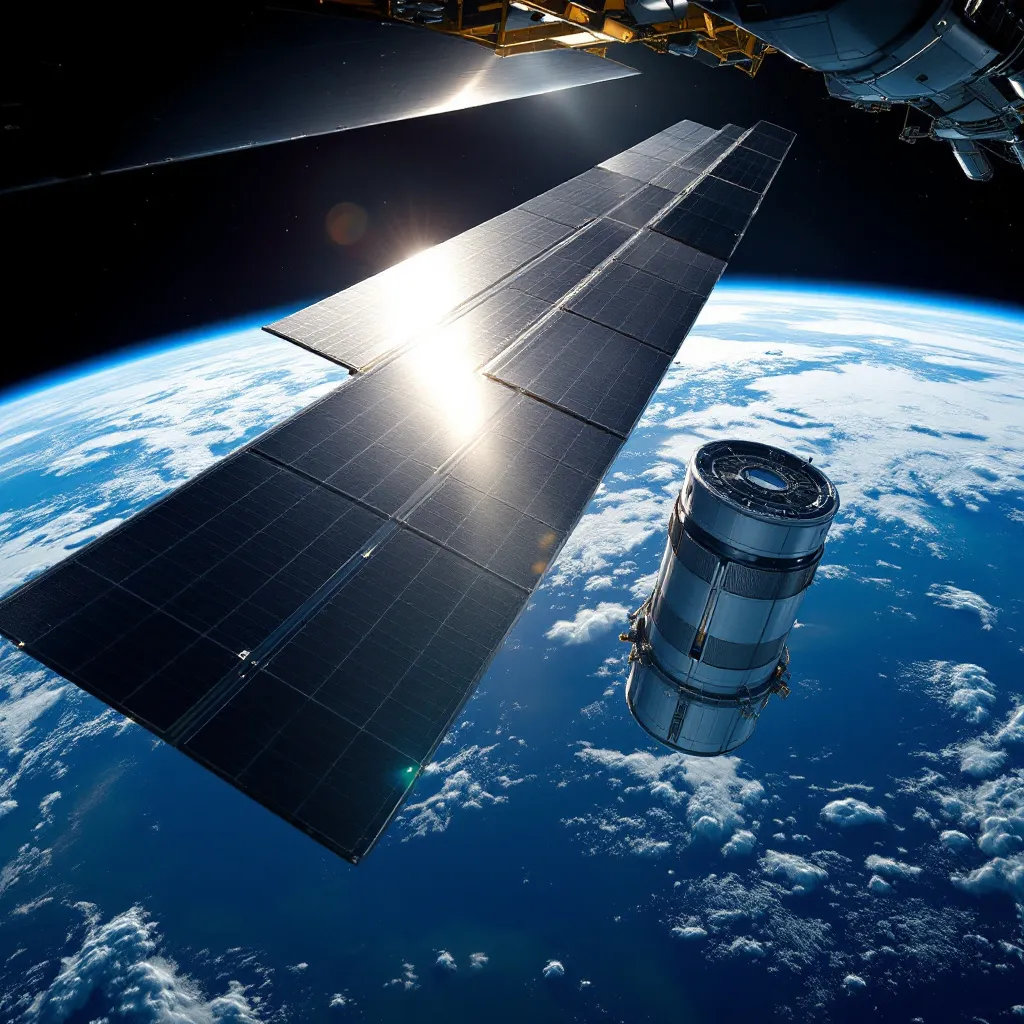
SpaceX’s proposed AI1 spacecraft illustrates the size of the hardware under consideration. The company has described a satellite approximately 30 meters tall, with a span of about 75 meters and up to 175 kilowatts of average AI computing capacity. It is also developing a Texas production facility intended to manufacture thousands of such spacecraft beginning as early as late 2027. The business case depends heavily on Starship achieving high flight rates, substantial payload delivery and much lower launch costs.
Google is following a more incremental path through Project Suncatcher. The company is studying clusters of solar-powered satellites carrying tensor processing units and linked by lasers. Two prototype spacecraft, being developed with Planet, are expected to launch in early 2027 to evaluate processor performance, radiation effects and high-speed intersatellite communications.
Startup Starcloud has already begun small-scale orbital demonstrations. It launched an Nvidia H100-equipped satellite in November 2025 and subsequently reported operating AI models in orbit. Its Starcloud-2 commercial mission is planned for 2027.
These projects collectively indicate that the sector is moving from architectural studies toward flight validation, but none has yet demonstrated the power, thermal rejection, networking or operating economics required for a commercial orbital data center at megawatt scale.
Mass production would reshape spacecraft AIT
Large computing constellations would require a manufacturing model closer to high-volume electronics production than traditional satellite assembly. Solar-array deployment systems, radiators, optical terminals and computing modules would need standardized interfaces and repeatable integration processes.
Thermal-vacuum testing would be especially important because thermal performance is central to mission viability. Radiation testing, electromagnetic compatibility verification, vibration qualification and optical-terminal alignment would also need to be incorporated without creating test bottlenecks that undermine production rates.
Manufacturers could reduce unit-level testing by qualifying common designs and using automated acceptance procedures, but the approach would demand tightly controlled suppliers, strong configuration management and extensive production data. High-volume deployment would also place pressure on semiconductor availability, solar-cell output, optical components and space-qualified power electronics.
Orbital debris mitigation and end-of-life disposal would be equally consequential. Thousands of large satellites with expansive solar arrays and radiators would increase collision cross-sections and complicate space traffic coordination. Regulators would likely demand credible maneuvering capability, reliable tracking and disposal plans before authorizing operational systems.
Isaacman’s endorsement gives orbital computing greater policy visibility, but it does not resolve those constraints. The next phase will be determined by prototype missions that can demonstrate sustained processor operation, heat rejection, optical networking and acceptable compute output per kilogram launched. Until those metrics are established, solar-powered AI data centers remain a potentially important new class of space infrastructure rather than a proven alternative to terrestrial facilities.