Roman is still traveling to its destination in space, with NASA gradually powering on and checking its instruments along the way.
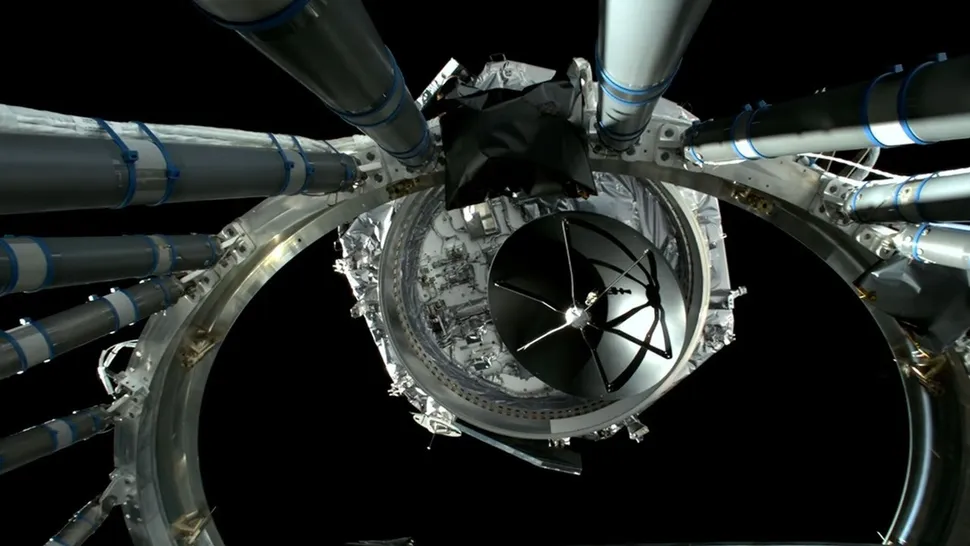
NASA has activated the Nancy Grace Roman Space Telescope’s 300-megapixel Wide Field Instrument and completed initial checks of its Coronagraph Instrument, the agency said Sept. 15. The observatory, launched Aug. 30 on a SpaceX Falcon Heavy, remains en route to its operating orbit near the second Sun–Earth Lagrange point, or L2. The staged activation is part of a months-long commissioning process; neither instrument is ready for routine science observations.
The Wide Field Instrument uses 18 infrared detectors to survey large areas of sky. Each image will cover a region larger than the apparent size of the full moon. Roman’s planned surveys will investigate dark energy, map the distribution of matter and search for planets beyond the solar system.
Before activating the detectors, engineers kept the instrument at minus 85 degrees Fahrenheit (minus 65 Celsius) for 10 days to allow moisture and other contaminants to dissipate. On Sept. 11, they switched off a heater and let it cool to about minus 225 F (minus 143 C), allowing the detectors to be turned on. The array continued cooling toward its operating temperature of approximately minus 300 F (minus 183 C).
Later on Sept. 11, the team activated the instrument’s calibration system. Engineers began sending test data through the instrument and down to Earth the next morning. They then tested its element wheel, which holds filters, prisms and other optics used to select wavelengths and separate incoming light. On Sept. 13, they confirmed that its focus mechanism was functioning as expected.
The instrument has also captured its first starlight. The initial test image shows out-of-focus stars because the detector array remains in its launch configuration and the telescope’s optics have yet to be aligned. It gives engineers a baseline for the remaining adjustments; it is not a science image. The team next plans to activate the fine-guidance system and bring the stars into sharp focus.
Roman’s Coronagraph Instrument has passed separate initial checks. Operators at Caltech/IPAC in Pasadena, California, confirmed they could communicate with its software, thermal controls, cameras, avionics and movable optical components. The instrument is designed to suppress a star’s glare so that much fainter planets nearby can be imaged directly.
The coronagraph checks included warming most of its hardware to about 72 F (22 C), near its intended operating temperature. Its detectors are now being kept warm for a roughly 30-day decontamination period, interrupted by occasional early calibration activities.
Roman’s destination near L2 is about 1 million miles (1.6 million kilometers) from Earth. NASA expects the spacecraft to enter its operating orbit in early December and plans to release its first science images by early 2027. Launch and trajectory fuel savings could leave enough propellant for at least 22 years of potential science operations, NASA estimates, although the telescope was designed for a five-year primary mission and a possible five-year extension.