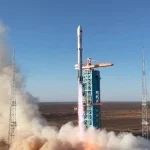
Russia’s Rokot/Briz-KM rocket has made its final launch Friday, with an early-morning liftoff from the Plesetsk Cosmodrome carrying three Gonets-M communications satellites. Rokot departed Plesetsk at 02:11 Moscow Time (23:11 UTC on Thursday), deploying its payloads into Low Earth orbit.
Rokot was developed as a low-cost, lightweight rocket, leveraging decommissioned missile hardware to place small payloads into orbit. Rokot used the first two stages of the UR-100NUTTKh ballistic missile, coupled with a Briz-KM upper stage, to perform this mission.
The UR-100NUTTKh – identified by NATO as the SS-19 Stiletto Mod. 3 – is the ultimate evolution of the UR-100 series of missiles. This was the smallest of the Universalnaya Raketa – or Universal Rocket (UR) – designs produced by Vladimir Chelomei’s OKB-52 bureau. UR-100, which was assigned the NATO reporting name SS-11 Sego, first flew in April 1965 and was accepted into military service two years later. Two upgraded versions of the design were tested in the late 1960s and early 1970s – the UR-100K and UR-100M – which replaced some of the deployed UR-100s. Some UR-100Ks remained in service until the early 1990s.
See Also
- Rokot Launch Coverage
- 75 Launch Vehicle Manuals (L2)
- L2 Russian Section
- Click here to Join L2
The 1970s also saw the Soviet Union commission a long-term replacement for the UR-100. This led to the UR-100N series, a significantly redesigned missile five and a half meters (18 feet) longer and 50 centimeters (1.6 feet) wider than its predecessor, which could be seen as a new vehicle. UR-100N first flew in September 1972 and entered service in 1975. As well as being enlarged, the UR-100N design introduced new engines and added a small third stage to serve as a post-boost vehicle for the precise delivery of multiple independent reentry vehicles (MIRVs) and enhanced countermeasures against anti-ballistic-missile systems.
UR-100NUTTKh represented a further upgrade over the UR-100N, with uprated engines, control systems and other modifications to increase survivability in the event of a first strike by the United States. UR-100NUTTKh made its first test flight in October 1977 and began to enter service in late 1979. By 1984 deployment of these missiles had reached 360, replacing the UR-100N. The Strategic Arms Reduction Treaty (START) was signed in 1991, limiting the number of missiles that the Soviet Union could field, and with the return of UR-100NUTTKh missiles deployed in Ukraine following the fall of the Soviet Union, Russia was left with a surplus.
Despite their age, a small number of UR-100NUTTKh missiles remain in front-line service with the Russian Strategic Missile Forces, including several that are being re-equipped with the new Avangard hypersonic glider reentry vehicles.
With a large stockpile of missiles, Russia began two programs to launch satellites on the UR-100NUTTKh: Rokot and Strela. The Strela rocket, which has flown three times – in 2003, 2013 and 2014 – was a refurbished but minimally-modified missile, which launched from a silo and used the UR-100’s own post-boost vehicle to complete insertion of its payloads into low Earth orbit. Rokot represented a more advanced version, using the more capable Briz upper stage. Unlike Strela, Rokot could fly from surface launch pads as well as silos.
The name Rokot comes from the Russian Рокот, meaning “rumble” or “boom”. In non-English speaking European countries, the alternative romanization “Rockot” is used instead, which has also come into use in English through organizations such as the German launch services company Eurockot, who marketed Rokot for commercial launches with western payloads. Rokot is built by the Khrunichev State Research and Production Centre, a successor to Chelomei’s design bureau.
Rokot was originally intended as a boost vehicle for an anti-satellite weapons program, Naryad, with the initial version of the Briz upper stage – Briz-K – designed to help maneuver a warhead that could intercept satellites up to 40,000 kilometers (25,000 miles, 22,000 nautical miles) above the Earth. Rokot made its first launch on 20 November 1990, a suborbital mission flown from a UR-100N silo at Site 131/29 of the Baikonur Cosmodrome to test the performance of the rocket and its new Briz-K upper stage as part of the Naryad program. A second suborbital Naryad test was conducted thirteen months later.
Astronomy
(adsbygoogle = window.adsbygoogle || []).push({});
On 26 December 1994 Rokot made its first orbital launch, carrying the Radio-ROSTO amateur radio satellite to low Earth orbit. Like the maiden flight, the second Naryad flight and Radio-ROSTO missions were also silo-launched from Baikonur, flying from Site 175/58. No further Naryad launches were made after the 1991 test flight.

Rokot on a launch for ESA
Despite the success of these initial launches, Rokot would not fly again for over five years. In this time a new surface launch pad was constructed at Site 133/3 of Russia’s northern Plesetsk Cosmodrome – a launch pad originally built for the Kosmos family of rockets. Site 133/3 has been used for all Rokot launches since, including Friday’s. Using a surface launch pad instead of a silo reduces the acoustic loads Rokot’s payloads are exposed to at liftoff, making the rocket more suitable for launching complex satellites.
Site 133 was originally built for the Kosmos-2I rocket, derived from the R-12 missile. Its single launch pad was designated 133/1, with the launcher equipment codenamed Raduga – meaning Rainbow. Ninety Kosmos-2I vehicles were launched from the pad from March 1967 until June 1977. Eight years later the pad was reactivated for use by the Kosmos-3M rocket, a derivative of the R-14 missile. As part of this process, the pad was renumbered 133/3 to reflect the presence of two pre-existing Kosmos-3M pads at the nearby Site 132. The first of thirty-eight Kosmos-3M launches from Site 133 took place in October 1985. After the last launch, in July 1994, work to convert the launch complex for Rokot began.
In late 1999, a Rokot/Briz-K was readied for the type’s first launch from Plesetsk with the experimental RVSN-40 satellite aboard. During pre-launch testing the rocket’s payload fairing was inadvertently separated, causing damage to the vehicle which led to the cancellation of its launch. RVSN-40 was later renamed Mozhayets 3 and launched aboard a Kosmos-3M rocket from Site 132.
Subsequent Rokot launches would use the upgraded Briz-KM upper stage in place of the earlier Briz-K. This version of Briz was enlarged and strengthened so it did not need to be encapsulated within Rokot’s payload fairing, allowing a larger fairing to be flown on top of the stage, with more room for the rocket’s payload. This also formed the basis for the successful Briz-M upper stage, used on larger Proton and Angara rockets, which incorporates additional propellant drop tanks to support geostationary satellite launches.

Briz-KM upper stage – via L2.
The Rokot/Briz-KM vehicle has only ever launched from the surface pad at Plesetsk. Its first flight, and the first Rokot mission to lift off from Plesetsk, took place on 16 May 2000 with SimSat-1 and SimSat-2. These payloads were mass simulators, mimicking a pair of Iridium communications satellites. Eurockot, one of a number of companies formed in the 1990s to market Russian rockets to western customers for commercial launches after the fall of the Soviet Union, had agreed a contract with Iridium for a number of launches to replenish the latter’s constellation of low-orbit communications satellites. Ultimately Iridium’s financial troubles meant that Rokot would only carry two operational Iridium satellites, on a single launch in 2002.
The first functional payload launched aboard a Rokot was the joint US-German Gravity and Recovery Climate Experiment (GRACE), which lifted off in March 2002. Three months later, Rokot flew its only Iridium mission which deployed the Iridium 97 and 98 satellites – the final pair of first-generation Iridium spacecraft and the last replenishment launch for the Iridium constellation until SpaceX began launching Iridium-NEXT satellites in January 2017.
Rokot’s next launch, in June 2003, carried another mass simulator, mocking up Monitor-E, a new type of Earth observation satellite that Khrunichev was developing. Leftover space aboard the rocket was also sold and eight small satellites were deployed into low Earth orbit by the Briz-KM. Among these were the first six examples of a new class of satellite, CubeSats. Built to a set of standard form factors, CubeSats were designed with common deployment mechanisms so specific equipment wouldn’t need to be built and validated for each individual spacecraft. This was intended to drive down the cost of access to space for small-scale experiments. Hundreds of CubeSats have since followed these first six spacecraft, now flying on a multitude of rockets worldwide.
Another 2003 Rokot launch saw Japan’s SERVIS-1 technology demonstrator deployed. In August 2005 a Rokot deployed Khrunichev’s first and only operational Monitor-E satellite. In October of the same year, while launching the European Space Agency’s CryoSat spacecraft, a scientific satellite intended to monitor Earth’s ice caps, Rokot failed to reach orbit. An investigation found that the vehicle’s onboard computer had not commanded the second stage to shut down at the end of its planned burn, preventing the Briz-KM third stage from separating and performing its own planned burn. This was the first of two launch failures that occurred during Rokot’s twenty-nine years of service, with the rocket also scoring one partial failure and thirty-one successes.
In July 2006, Rokot returned to service with the launch of the South Korean Arirang-2 (KOMPSAT-2) satellite. The type made its first military launch in May 2008 with three Strela-3 communications satellites. Over the next ten years, Rokot was used for a mixture of military and commercial missions. Military launches have largely carried Strela-3 satellites and their successors, Rodnik (Strela-3M). These satellites typically launch in groups of three, although civilian Gonets-M satellites can be substituted for their military counterparts. In addition to the May 2008 Strela-3 launch, Rokot flew one mission with one Strela-3, one Rodnik and one Gonets-M, one mission with one Strela-3 and two Gonets-Ms and five launches with three Rodnik spacecraft. Four dedicated launches with trios of Gonets-M satellites – including Friday’s launch – were also made.
On several of the Strela, Rodnik and Gonets launches a smaller fourth satellite has been included. These have included the Yubileiny and MiR technology demonstrators and three military satellites reported to be used for inspecting satellites in low Earth orbit. Rokot’s three other dedicated military launches each carried a single GEO-IK-2 geodesy satellite.
The first of Rokot’s GEO-IK-2 missions, launched on 1 February 2011, did not reach its planned orbit. The Briz-KM suffered a loss of control early in the second of two planned engine burns. An emergency cutoff was commanded, however, this left the payload in too low an orbit to complete its planned mission. Two years later, during the launch of three Rodnik satellites, a malfunction around the time of spacecraft separation left one of the spacecraft inoperable and the Briz-KM unable to perform its usual separation burn at the end of the mission.
Rokot’s commercial launches were dominated by European scientific satellites: these included the European Space Agency’s GOCE and SMOS ocean research missions and the PROBA technology demonstrator in 2009, the latter two of which shared a rocket. ESA’s Swarm mission, conducting research into Earth’s magnetic field, was launched by a Rokot in 2013 and three Sentinel satellites – operated by ESA on behalf of the European Commission under the Copernicus Earth science program – were deployed by the last three commercial Rokot missions in February 2016, October 2017 and April 2018. The only non-ESA commercial launch Rokot performed in this time was SERVIS-2, a followup to SERVIS-1, which flew in June 2010.
With the introduction of Europe’s own Vega rocket, increased competition in the small satellite launch market and the increased availability of rideshares on larger rockets, Rokot’s share of the commercial launch market has declined. Russia’s own Soyuz-2-1v rocket has taken over some payloads in Rokot’s class, and the Angara-1.2 rocket is also becoming available for similarly-sized payloads. As parts of Rokot’s guidance system were manufactured in Ukraine, declining relations between the two countries were enough to finish off the Rokot program and in 2018 it was announced that Rokot would be phased out.
Rokot made its last commercial launch last year, launched the last GEO-IK-2 military geodesy satellite in August and following Friday’s launches future Gonets satellites will launch on other rockets. The rocket that was used for Friday’s mission was initially prepared to launch a backup GEO-IK-2 satellite, if August’s launch had failed, however, once this launch proceeded successfully it was cleared for the Gonets mission instead.
Russia remains open to reviving Rokot at a later date, with a new Rokot-2 vehicle, incorporating only Russian hardware, under consideration. If this is developed, it will fly no earlier than 2021.
Unless and until Rokot-2 flies, Rokot retires after twenty-nine years of service and 34 launches – 31 of which have used the Briz-KM upper stage. Friday’s launch was the 159th to take place from Site 133/3 at Plesetsk, which is also expected to be retired unless Rokot-2 is developed.

Site 133/3 at Plesetsk
Owing to its heritage as a silo-launched missile, even when it flies from its surface launch pad the first two stages of the rocket are contained within a launch canister. Ahead of Friday’s launch, this was erected at the launch pad. The complex’s mobile service tower was then used to mate the Briz-KM, payload and fairing atop the vehicle. This tower shelters the rocket until a few minutes before liftoff, at which point it is pulled back to its parked position away from the vehicle.
The liquid-fuelled Rokot burned storable, hypergolic, propellants – unsymmetrical dimethylhydrazine and dinitrogen tetroxide – a fuel combination that arose from the need to keep the UR-100N missile fuelled and ready to launch for years at a time when it was on alert as part of Russia’s nuclear deterrent. The Briz-KM used the same combination of fuel and oxidizer, which is also convenient for upper stages that need to make multiple engine firings over the course of a complex mission.
An RD-0233 engine powered Rokot’s first stage. Igniting a few seconds before liftoff, this powered the rocket out of its launch canister and into the sky above Plesetsk. The first stage fired for about two minutes – after which the spent stage separated. Rokot’s first stage separation sequence involved first lighting the four second stage vernier engines – smaller thrusters which were used to assist attitude control – before detaching the spent first stage and firing retrorockets to push it away. Finally, Rokot’s second stage main engine ignited to continue the push towards orbit.
The main engine on Rokot’s second stage was an RD-0235, while the four verniers used RD-0236 engines. Both the first and second stages of the Rokot vehicle were essentially unmodified from the UR-100NUTTKh missile.
Rokot’s second stage burn lasted a little over three minutes, with the payload fairing separating from the nose of the rocket about a minute into the burn. The fairing, which protects Rokot’s payload from the atmosphere as the rocket ascends, was no longer needed once it has reached space and could be jettisoned to reduce the weight of the vehicle. Splitting into two halves, it fell away as the second stage continued to burn.
At the end of second-stage flight, Rokot coasted for about fifteen seconds before deploying Briz-KM to continue carrying its payload into orbit. Although timings for the Briz-KM burns were not published, the stage would likely have fired twice – beginning its first burn immediately after separation and firing for between nine and ten minutes to inject itself into a transfer orbit. About an hour later a shorter burn – likely around 30 seconds in duration – would have been made to circularise the orbit. This would have been followed by separation of each satellite.
With all of its payloads safely deployed, Briz-KM made a final engine burn to lower its orbit, minimizing the risk of subsequent collisions with the satellites it had deployed or other spacecraft in the operational orbit. This would not have been a full deorbit burn, but rather a lowering of the orbit’s perigee by few hundred kilometers.
The primary payload for Friday’s launch was a trio of Gonets-M communications satellites. These orbit about 1,500 kilometers (930 miles, 810 nautical miles) above the Earth at an inclination of about 82.5 degrees. Gonets is a civilian program, operated by JSC Satellite System GONETS, a company in which the Russian Federal Space Agency, Roskosmos, owns a 51% stake. Gonets-M satellites share a common design with the military Rodnik communications satellites and are used for store-and-dump operations where data is uploaded to a satellite, stored in its memory, and later downlinked to another user.
#Russia’s final orbital launch attempt of 2019 is a pretty good representation of the closing decade. Judge for yourself: https://t.co/OlVPaBujf5 pic.twitter.com/j3SlcJRAfZ
— Anatoly Zak (@RussianSpaceWeb) December 26, 2019
Gonets-M is the second generation of the Gonets system, earlier Gonets satellites were derived from Strela-3 satellites and launched aboard Tsyklon-3 rockets between 1992 and 2001. The first prototype Gonets-M was launched aboard a Kosmos-3M rocket in 2005, alongside an analogous Rodnik satellite. Subsequent launches using Rokot vehicles began in 2010. Following Rokot’s retirement Gonets launches will initially move to Soyuz-2-1b rockets with Fregat-M upper stages used to inject the satellites into their operational orbits. Around 2021, after it has fully entered service, the new Angara-2.1 rocket will take over from the Soyuz in this role.
The three satellites that were launched have serial numbers 24, 25 and 26, representing the fourteenth, fifteenth and sixteenth Gonets-M spacecraft to fly. They were joined aboard Rokot by the first BLITS-M satellite. Ball Lens in the Space, or BLITS, is a series of small satellites used for laser ranging experiments. A glass sphere measuring 22 centimeters (8.7 inches) across, one side of BLITS-M is covered in an opaque coating and the other retroreflects light transmitted from the ground. BLITS-M is a follow-up to the BLITS satellite which was launched in 2009.
Friday’s launch was Russia’s twenty-fifth and last of 2019 – a number which includes three Soyuz launches performed by Arianespace from the Centre Spatial Guyanais in French Guiana. The majority – eighteen – of Russia’s launches this year have used Soyuz rockets, three of which used the legacy Soyuz-FG version which was retired in September, two used the smaller Soyuz-2-1v configuration and the remainder the Soyuz-2-1a and 2-1b versions. Larger Proton-M rockets made five launches, including Tuesday’s successful mission that deployed the Elektro-L No.3 communications satellite. Rokot flew twice – the GEO-IK-2 launch in August and Friday’s launch to round out the year.
In UTC, which is used for most spaceflight operations, Rokot’s final flight lifted off on Thursday, 26 December 2019 – the twenty-fifth anniversary of the type’s first orbital launch in 1994.