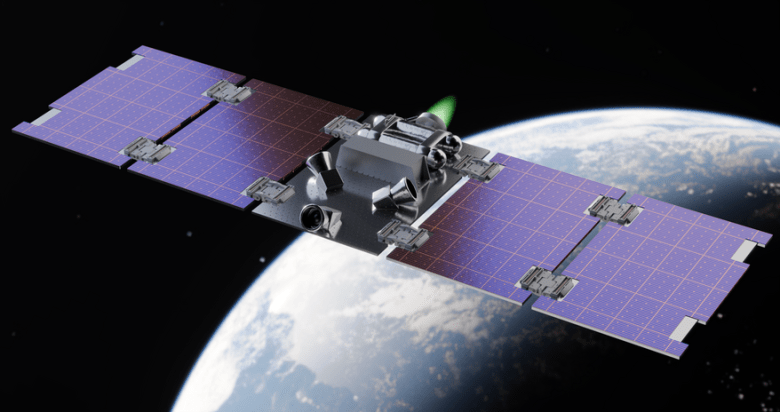
Samara Aerospace, a San Francisco-based satellite bus developer, has raised $10 million in seed funding to advance a new approach to satellite stability that it says can significantly reduce vibration and improve performance in orbit.
The round was led by Balerion Space Ventures, with participation from Illinois Ventures, MFV Partners and Access Venture Partners. The funding was announced in December, the company said.
Most satellites today rely on reaction wheels to orient themselves in space, a mature technology that can introduce vibration and jitter, degrading image quality and pointing accuracy. Samara is pursuing a different method with its Hummingbird satellite platform, using movable solar panel hinges to control attitude. By adjusting panels up, down and sideways, the spacecraft can maneuver without traditional wheels.
Chief Executive and co-founder Patrick Haddox said the approach can make satellite platforms up to 1,000 times more stable than conventional systems, while also reducing size and mass without sacrificing performance.
The company expects to validate the technology in orbit in the near term. Hardware developed by Samara — one solar panel and two hinges — is flying aboard the Mira spacecraft built by Impulse Space, which launched in November on SpaceX’s Transporter-15 rideshare mission. Haddox said the system is powered on and awaiting its turn to conduct the on-orbit experiment. “We know it’s alive, and we know it turned on,” he said.
Samara sees near-term demand for the technology in Earth observation, where improved stability can translate into sharper imagery, and in optical communications, which require precise pointing for reliable data links. Haddox added that aerospace primes have also shown interest in the hinges for simplifying spacecraft design and increasing launch efficiency, as the flatter configuration allows more satellites to be stacked into a single launch.
The company plans to use the seed funding to support development toward its next major milestone: launching its first full Hummingbird satellite in the summer of 2027.