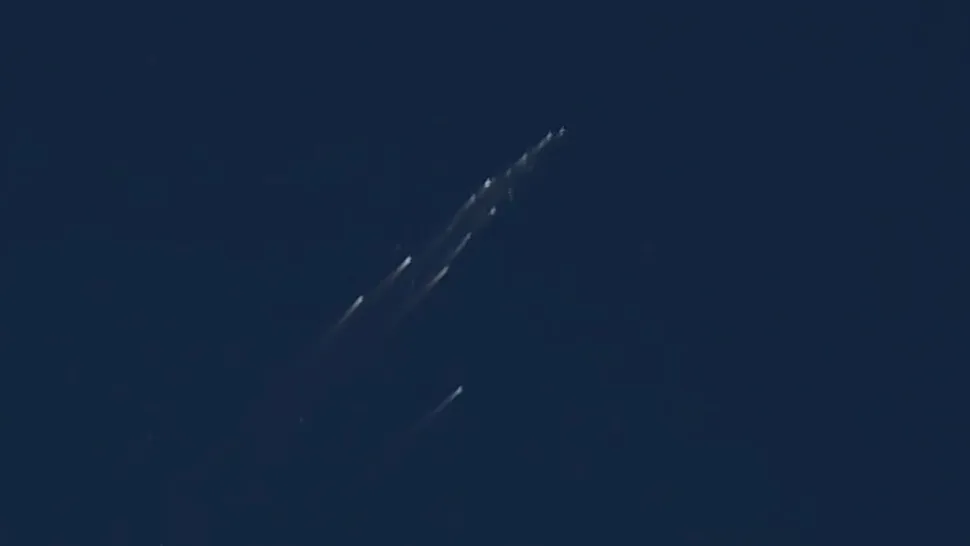
The European Space Agency’s Tango satellite disintegrated above the Pacific Ocean on Sept. 1, 2026. observed by a team of researchers from aboard a private jet. (Image credit: ESA/ROSIE/University of Stuttgart (HEFDiG))
Scientists aboard an instrumented Falcon 900 business jet recorded the atmospheric destruction of the European Space Agency’s Samba and Tango satellites over the South Pacific on August 31 and September 1, 2026. The back-to-back observations produced an unusually detailed dataset on how spacecraft fragment, which materials survive and what chemical compounds they release into the upper atmosphere.
Samba reentered at 21:39:38 UTC on August 31, followed by Tango at 21:30:31 UTC on September 1. The spacecraft were the final two members of ESA’s four-satellite Cluster constellation, which studied interactions between the solar wind and Earth’s magnetosphere for more than two decades.
Both satellites had been placed on targeted reentry trajectories over a remote area of ocean accessible from Tonga. ESA’s final prediction for Samba matched the actual reentry to within a second, allowing the Re-entry Observation of Satellites from the Infrared to UV, or ROSIE, team to position the aircraft close enough to capture the breakup.
The jet approached to about 120 kilometers from the reentry tracks. Researchers began observing each spacecraft at an altitude of roughly 90 kilometers and continued until the fragments faded between approximately 65 and 70 kilometers. The luminous events lasted about 50 seconds on average, considerably longer than most meteors because the satellites entered at relatively shallow angles and decelerated through the atmosphere.
Although both reentries occurred in daylight, their fireballs were visible to the naked eye. The spacecraft initially appeared as compact sources of light as their surfaces ablated, before abruptly breaking into tens of individually visible fragments.
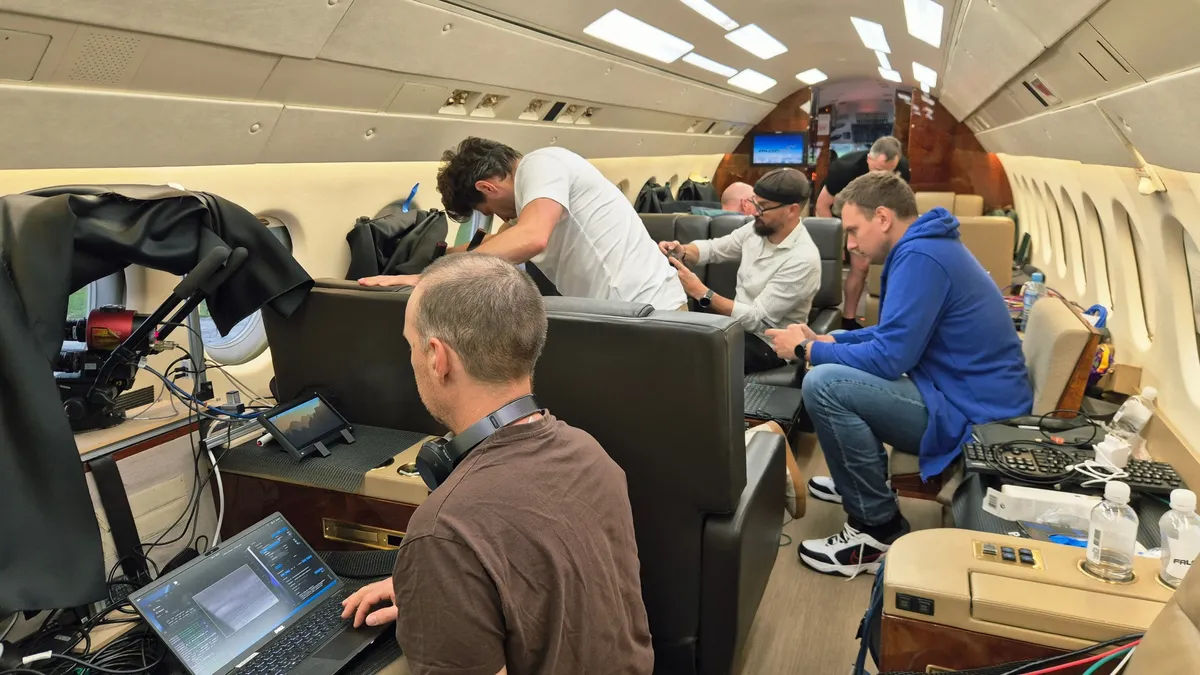
Researchers inside a private jet during a campaign observing the reentry of ESA’s Cluster Tango satellite on Sept. 1, 2026. (Image credit: Jiří Šilha)
Thirty instruments watched the satellites disintegrate
The ROSIE campaign carried 30 camera and spectroscopic instruments distributed among six observation stations inside the aircraft. Twenty-nine operated successfully during the two reentries.
The payload included tracking cameras, visible-light imagers, infrared cameras and spectrometers equipped with filters for specific atomic signatures. Together, the instruments were intended to establish where fragmentation occurred, how individual pieces behaved and when different spacecraft materials began to melt or vaporize.
Flying above most clouds increased the likelihood of an unobstructed view and reduced the amount of atmosphere between the instruments and the spacecraft. That improved both image quality and spectral measurements compared with observations made from the ground. During Tango’s reentry, the pilot banked the aircraft to keep the disintegrating spacecraft within the instruments’ field of view for several additional seconds.
The team attempted to identify seven chemical species, including signatures associated with titanium, sodium and potassium. Aluminum was a particular focus because it is widely used in satellite structures and is expected to oxidize as spacecraft material vaporizes during reentry.
Scientists are investigating whether increasing numbers of satellite reentries could inject meaningful quantities of aluminum oxide and other compounds into the upper atmosphere. Some atmospheric models suggest that such particles could affect stratospheric chemistry, including ozone-related processes, but the quantities produced, their chemical evolution and their long-term effects remain uncertain.
The Samba and Tango measurements will therefore be used to test whether atmospheric and spacecraft-breakup models reproduce the sequence observed during actual reentries. Researchers will analyze the data second by second to associate spectral emissions with specific stages of heating, fragmentation, melting and vaporization.
Four identical spacecraft created a rare experiment
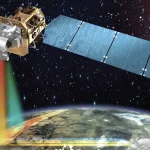
Cluster consisted of four nearly identical spacecraft named Rumba, Salsa, Samba and Tango. Launched in pairs on July 16 and August 9, 2000, they flew in formation through highly elliptical polar orbits extending from a few hundred kilometers to about 125,000 kilometers above Earth.
Each satellite carried 11 scientific instruments. Operating as a coordinated constellation allowed Cluster to make three-dimensional measurements of the magnetosphere and examine how it responds to the solar wind. The science mission formally ended on September 8, 2024, after more than 24 years in orbit, although controllers continued managing the spacecraft during their disposal phase.
Cluster’s orbit also created an unusual end-of-life opportunity. Unlike satellites whose reentries are dominated primarily by atmospheric drag, the Cluster spacecraft followed trajectories strongly influenced by long-term gravitational interactions involving Earth, the Sun and the Moon. Operators could predict and adjust their eventual impact corridors well in advance.
Salsa became the first Cluster satellite to reenter on September 8, 2024, and was also observed from an aircraft. That campaign found differences of up to 20% between expected and inferred upper-atmospheric density, demonstrating how atmospheric uncertainty can affect reentry predictions.
Rumba followed on October 22, 2025, but was not observed by ROSIE. Samba and Tango were maneuvered in November 2024 to direct their reentries toward remote areas of the South Pacific. Small additional burns on January 19 and 20, 2026, brought their reentry locations closer together so the same aircraft and team could return to Tonga, refuel and conduct the second observation about 24 hours later.
Because Salsa, Samba and Tango shared the same spacecraft design but reentered on different trajectories and under different atmospheric conditions, researchers can compare three real breakup events without many of the design differences that complicate comparisons between unrelated satellites.
The findings could support “design for demise,” an engineering approach in which spacecraft structures and components are selected or arranged to burn up as completely as possible. Better breakup models would also improve casualty-risk estimates and help engineers identify components that are most likely to survive to the surface.
ESA plans to expand the work with its Destructive Re-entry Assessment Container Object, or Draco, scheduled for launch in 2027. Draco will carry more than 200 sensors and four cameras to record its own destruction from inside, while a hardened capsule preserves the data. ESA also plans another airborne campaign, allowing researchers to correlate Draco’s internal measurements with external observations of the same reentry.