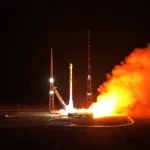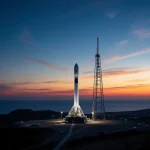
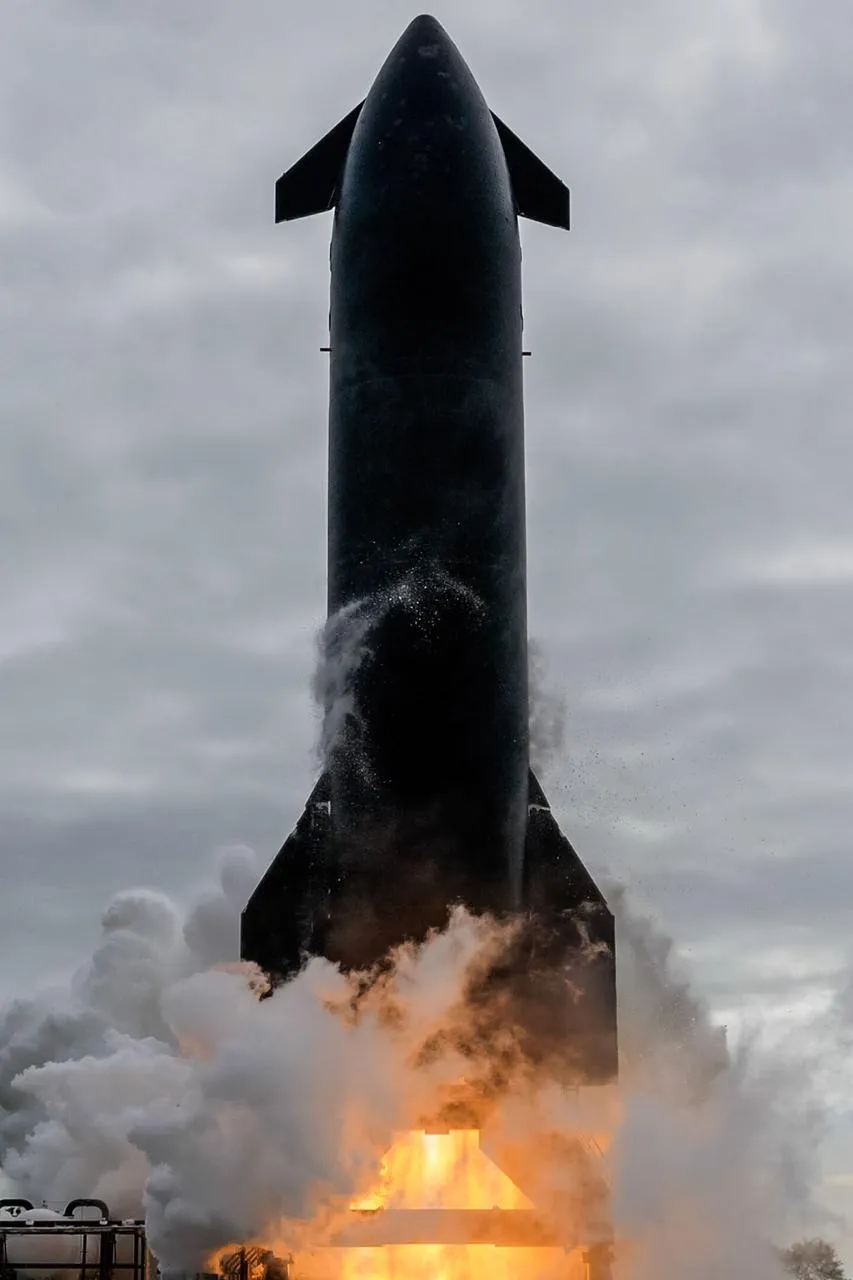
SpaceX fired all 33 Raptor engines on Super Heavy Booster 21 during a full-duration static-fire test at Starbase, Texas, on August 28, completing a major propulsion milestone ahead of Starship’s 14th flight test.
The roughly 15-second firing took place on the launch mount at Pad 2. Booster 21 remained restrained while its engines, propellant systems, flight computers and ground infrastructure operated through a launch-like ignition sequence.
SpaceX had rolled the booster from its production area to the pad on August 25. An earlier attempt to conduct the firing was halted before ignition, but the company subsequently completed the full 33-engine test and confirmed that Booster 21 is being prepared for Flight 14.
The test followed a separate propulsion campaign for Ship 41, the Starship upper stage assigned to the mission. That vehicle completed a single-engine firing simulating an in-space deorbit burn on August 19, followed by a 60-second static fire of all six Raptor engines on August 21 at SpaceX’s Massey’s test site.
Together, the tests substantially advance the two stages toward final integration, although SpaceX must still inspect the hardware, complete any required corrective work and conduct full-stack checks before launch.
A system-level test for Super Heavy V3
A full-duration booster static fire validates considerably more than the engines themselves. Firing 33 Raptors simultaneously exercises engine startup sequencing, propellant distribution, tank pressurization, thrust-vector-control hardware, avionics, electrical systems and the software responsible for monitoring and commanding the propulsion system.
The test also evaluates the interface between the booster and Pad 2. The launch mount must restrain the vehicle while managing acoustic loads, vibration, exhaust flow, heat and the rapid consumption of cryogenic methane and liquid oxygen. Water-deluge and flame-management systems are therefore part of the test article in practical terms, even though they remain on the ground.
Booster 21 is the third flight candidate from SpaceX’s current Starship V3 hardware generation, following the vehicles used for Flights 12 and 13. The configuration incorporates substantial changes intended to increase propellant capacity, improve performance and support higher operational cadence. Each new booster nevertheless requires acceptance testing because small differences in engines, plumbing, wiring and assembly can affect system behavior under full thrust.
Static-fire data will allow engineers to examine ignition timing, chamber-pressure trends, turbopump behavior, engine-to-engine interaction and structural response. SpaceX can also compare the results with telemetry collected from Booster 20 during Flight 13, using operational data to refine both hardware acceptance limits and flight software.
Ship 41 has completed two complementary engine tests
The Ship 41 campaign was designed to cover two different operating conditions.
The August 19 single-engine firing reproduced the type of burn needed after payload deployment to lower the spacecraft’s orbit and begin a controlled reentry. Demonstrating reliable engine restart in space is essential as Starship moves from suborbital testing toward missions that leave the vehicle in orbit.
The 60-second, six-engine firing on August 21 provided a broader check of the upper stage’s propulsion and propellant-feed systems. Ship carries three sea-level Raptors and three vacuum-optimized engines. Operating the complete set on the ground tests coordinated startup and sustained propellant delivery while exposing the vehicle to prolonged vibration and thermal loading.
Testing the upper stage at Massey’s while the booster campaign proceeds at the launch site also illustrates SpaceX’s effort to conduct Starship processing in parallel. That approach will be necessary if the company is to move beyond an experimental flight cadence. At higher launch rates, serial testing of each component would leave expensive pads and vehicles waiting on one another.
The immediate workflow is expected to include detailed post-test inspections of Booster 21 and Ship 41, any necessary engine or subsystem servicing, return of the vehicles to the launch complex and stacking on Pad 2. SpaceX will then need to verify the integrated vehicle and ground systems before committing to a flight date.
Flight 14 is intended to make Starship an orbital payload carrier
Flight 14 is expected to represent a larger programmatic step than the static-fire tests alone suggest. SpaceX plans to fly Starship into orbit for the first time, moving beyond the deliberately suborbital trajectories used during the first 13 integrated tests.
The company is also expected to deploy an initial batch of operational Starlink V3 satellites. Flight 13 released 20 satellites on a suborbital trajectory as a deployment demonstration, after which the spacecraft reentered. Delivering satellites into a sustainable orbit on Flight 14 would turn Starship from a developmental test vehicle into an orbital payload carrier.
Starlink V3 is central to the commercial case for Starship. SpaceX has said the new spacecraft are expected to provide roughly 10 times the broadband capacity and data density of its current satellites. The company ultimately plans to carry as many as 60 on a single Starship mission, a payload scale that would be difficult to reproduce with Falcon 9.
That capability could change the economics of Starlink deployment. A larger satellite bus can accommodate more powerful communications payloads, additional antennas and greater electrical generation, while Starship’s volume and mass capacity can reduce the need to optimize every component around Falcon 9’s payload constraints. The tradeoff is greater dependence on one launch: a failed Starship mission would place substantially more spacecraft and production value at risk.
Recovery plans remain tied to flight and regulatory readiness
SpaceX has discussed attempting the first return of a Starship upper stage to the launch site during Flight 14, potentially using the tower’s mechanical arms to capture Ship 41. The company has already caught Super Heavy boosters three times, but an upper-stage catch would require Starship to complete an orbital flight, reenter over a controlled corridor and arrive at Starbase with sufficient guidance and propulsion margin.
Such an attempt remains dependent on regulatory authorization and SpaceX’s final mission design. A tower return would add substantially more complexity than an ocean landing because the vehicle must pass over or near populated and industrial areas before reaching a precise capture point.
Flight 13 provided relevant data by demonstrating improved upper-stage reentry and landing performance. Its Ship 40 vehicle remained intact after its Indian Ocean splashdown, while Booster 20 was lost during its landing sequence. Those results give SpaceX reasons to advance upper-stage recovery testing while continuing to refine the new Super Heavy configuration.
If SpaceX elects not to attempt a tower catch, Ship 41 and Booster 21 can still perform controlled ocean descents that generate propulsion, thermal-protection and guidance data without exposing the launch complex to the additional risk of a returning vehicle.
The orbital mission will also be closely watched by NASA. Starship is the basis for the Human Landing System being developed for future Artemis lunar missions, and that architecture depends on capabilities extending well beyond a single orbital launch. SpaceX must demonstrate repeated launches, orbital propellant transfer, long-duration cryogenic-fluid management and uncrewed lunar landing operations before carrying astronauts.
Booster 21’s static fire does not resolve those broader development challenges, but it moves the next V3 vehicle pair through one of the most demanding ground tests. Flight 14 will determine whether SpaceX can convert that ground performance into an orbital mission, operational satellite deployment and another step toward full vehicle recovery.