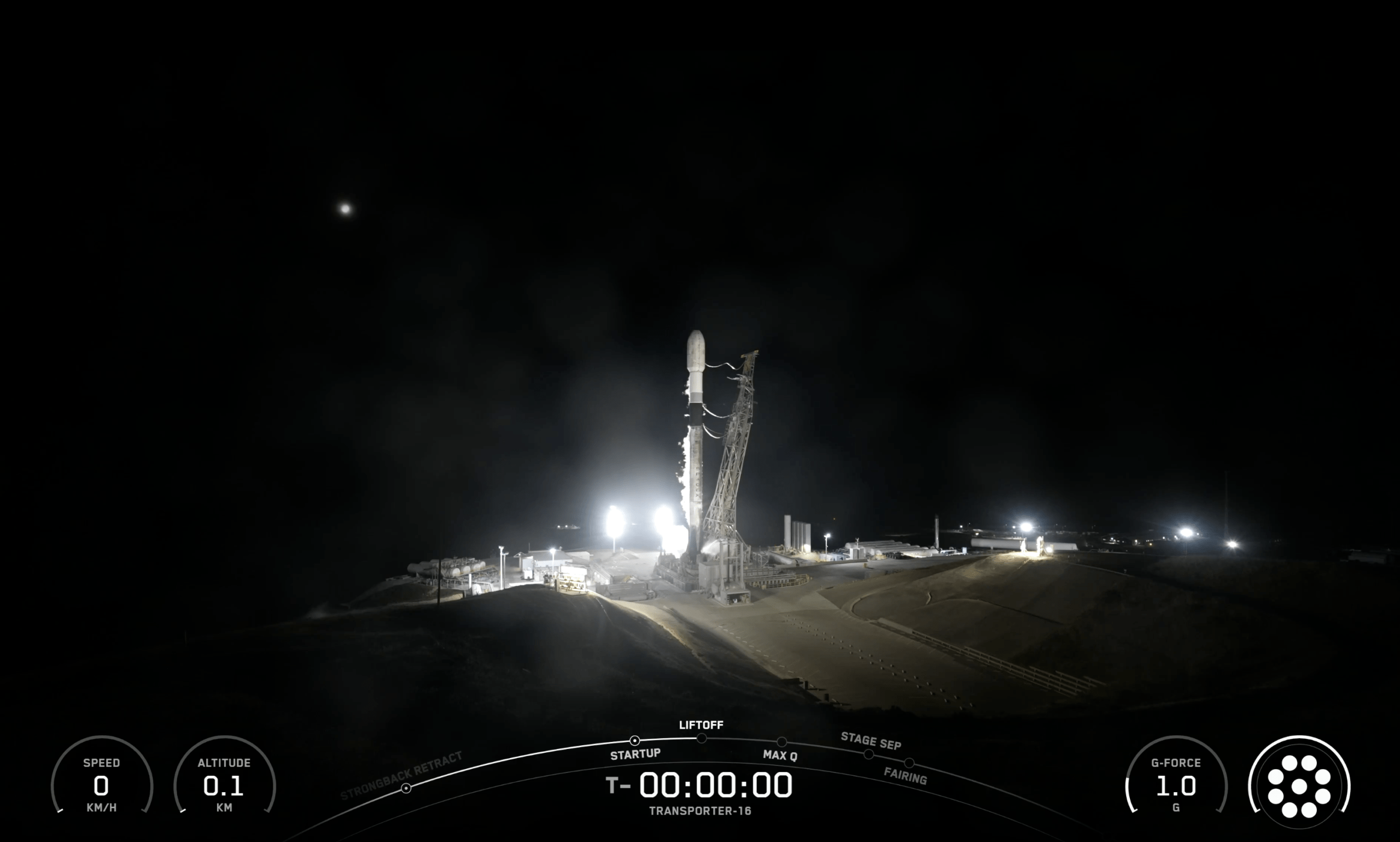
SpaceX launched its Transporter-16 rideshare mission from Vandenberg Space Force Base, sending 119 payloads into orbit in what the company said is its first rideshare flight of 2026.
The mission carried a broad mix of satellites and technology demonstrators spanning Earth observation (EO), radio frequency (RF) sensing, communications and in-orbit services. Further details are expected as payloads begin commissioning and early operations in orbit.
A significant portion of the manifest is focused on expanding EO capabilities. Satellites onboard include eight spacecraft from OHB Italia for the IRIDE constellation, along with six synthetic aperture radar (SAR) satellites from ICEYE, including units for undisclosed customers.
Additional EO payloads include two high-resolution Newsat Mark-V satellites from Satellogic, two satellites built by AAC Clyde Space, and one satellite from SatVu carrying a mid-wave infrared payload designed to monitor heat signatures. Satlantis also contributed a satellite designed for sub-meter resolution imaging.
Beyond optical observation, the mission includes multiple RF sensing payloads aimed at improving situational awareness. Spire Global launched eight satellites to track maritime, aviation and weather activity, while Sierra Nevada Corporation deployed three satellites focused on detecting dark vessels and GPS jamming signals from low Earth orbit.
Unseenlabs added its 20th satellite to enhance maritime domain awareness, and the Norwegian Space Agency, in collaboration with SFL Missions Inc., launched a satellite to strengthen Norway’s maritime monitoring capabilities.
Communications technology was another focus area of the mission. The Hellenic Space Agency deployed three satellites—PeakSat, ERMIS-3 and OptiSat—to advance laser communication systems, including terminals supplied by Astrolight and TESAT.
Other communications demonstrations include a maritime connectivity test satellite from ArkEdge Space, a broadband communications cubesat from Tron Future Tech, and a secure communications satellite developed by a consortium of Romanian institutions.
The mission also featured a range of hosted payloads and in-orbit service platforms. Momentus launched its Vigoride-7 orbital transfer vehicle carrying 10 hosted payloads, including demonstrations of robotic in-space assembly and advanced computing systems.
Exotrail deployed its Spacevan-002 platform, supporting payloads testing atomic timing, deployable solar arrays and optical communications. K2 Space launched its Gravitas satellite, equipped with a 20 kW electric propulsion system and hosting multiple undisclosed payloads, including for the U.S. Department of Defense.
D-Orbit also launched its latest ION satellite, which will deploy four satellites and host additional payload demonstrations, while Varda Space Industries sent its W-6 reentry vehicle as part of its ongoing in-orbit manufacturing programme.