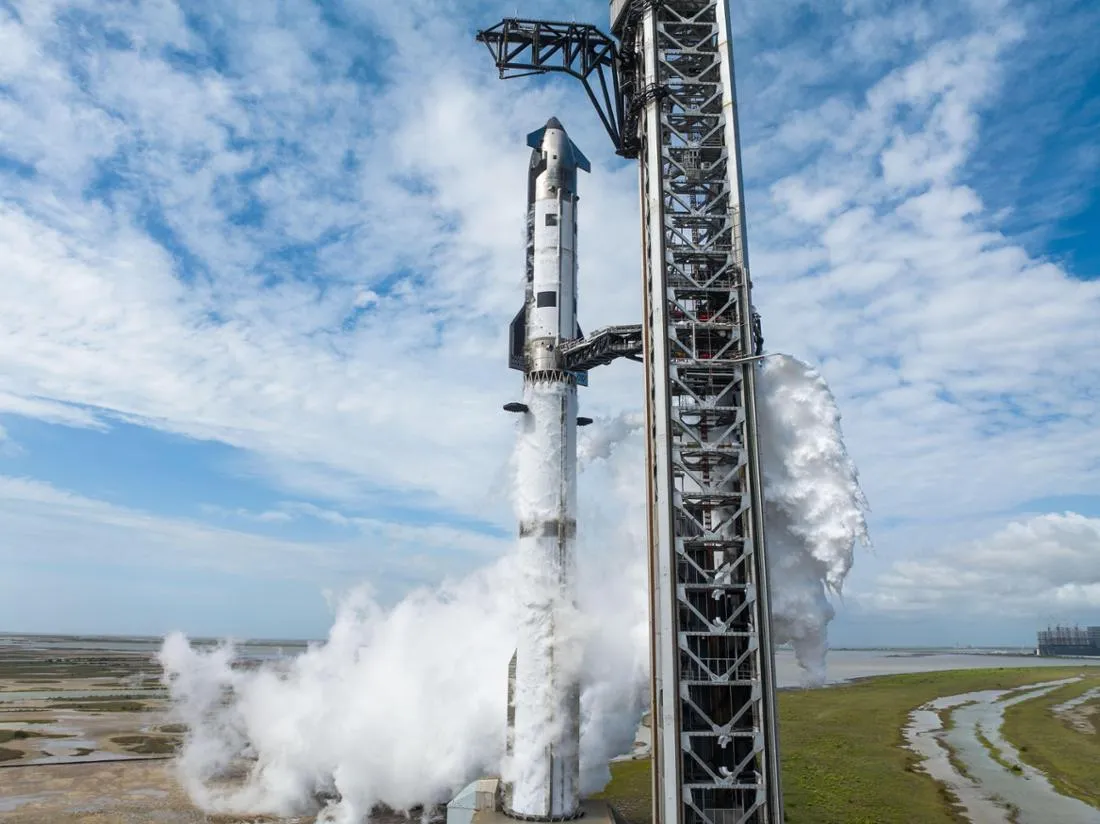
SpaceX has moved Super Heavy Booster 22 from Mega Bay 1 to the Massey’s test site at Starbase, where Ship 42 has joined it for cryogenic proof testing ahead of their planned pairing on Starship Flight 15. The mission could launch roughly one month after Flight 14 if the preceding flight meets its objectives and SpaceX secures the necessary regulatory approvals.
Booster 22 and Ship 42 reached Massey’s while SpaceX continued preparing Booster 21 and Ship 41 for Flight 14, currently targeted for around mid-September. Both Flight 14 vehicles remain at the production site pending rollout to Pad 2.
Flight 14’s performance will shape the objectives and schedule for Flight 15. If the mission validates the vehicles, flight profile and recovery systems, SpaceX could attempt to catch Booster 22, Ship 42 or both at Pad 2 during Flight 15. Any such attempt would depend on post-flight engineering reviews, vehicle readiness and approval from the Federal Aviation Administration.
Ship 42 previously completed two cryogenic test campaigns on the ship stand at Massey’s before returning for what is expected to be another round of testing. Cryogenic proof tests expose the vehicle’s tanks and structure to the low temperatures and internal pressures associated with propellant loading and flight.
During these campaigns, SpaceX typically loads liquid oxygen into the vehicle’s oxygen tanks and uses liquid nitrogen to simulate methane loading. Engineers monitor tank pressures, temperatures, composite overwrapped pressure vessels and structural strain gauges while the vehicle remains loaded for several hours. The process is intended to identify leaks, deformation or other structural problems before engines are installed.
If Ship 42 clears its remaining proof tests, its next major production milestone will be Raptor engine installation in Mega Bay 2, followed by an eventual static-fire campaign at Pad 2.
Booster 22 was assembled and staged inside Mega Bay 1 before its overnight transfer to Massey’s. On September 4, cameras operated by NASASpaceflight recorded the booster thrust simulator returning from the test site to the production area, clearing the Massey’s stand for Booster 22.
The thrust simulator holds a Super Heavy booster and applies hydraulic loads through its aft section to reproduce forces generated by its Raptor engines. This allows SpaceX to verify the structural response of the booster without conducting a live engine firing.
Massey’s upgraded tank farm can support full booster-scale cryogenic loading, allowing SpaceX to conduct Super Heavy proof tests away from the orbital launch complex. Booster 22 is expected to undergo a multi-day cryogenic campaign before returning to Mega Bay 1 for engine installation. It will subsequently require a static fire at Pad 2 before Flight 15.
Flight 14 remains SpaceX’s immediate priority and is planned as Starship’s first dedicated orbital attempt from Starbase. Ship 41 is expected to perform insertion burns, deploy operational Starlink V3 satellites and return along an ocean recovery trajectory.
SpaceX had considered attempting a tower catch of Ship 41 following the landing accuracy demonstrated by Ship 40, but removed that objective from the immediate Flight 14 plan. Booster 21 is also not scheduled to return to Pad 2 for a tower catch. Additional soft-landing performance data and completion of the FAA safety case for a return over land remain prerequisites.
SpaceX has indicated that it wants to attempt a ship catch in the coming months, followed by the first reflight of a Starship upper stage late in 2026 or early in 2027. Pad 2 is currently the only operational orbital launch mount at Starbase while Pad 1 undergoes reconstruction.
A successful Super Heavy catch on Flight 15 would restart booster recovery operations at Starbase and mark the first catch involving a Block 3 vehicle. A successful Ship 42 catch would be more consequential, representing the first tower recovery of an orbital-class upper stage. Attempting both recoveries during one mission would substantially increase operational complexity and would require Flight 14 to demonstrate the necessary guidance, propulsion and landing performance.
SpaceX has filed a communications authorization application for Flight 15 identifying Starbase as the launch site and describing an orbital second-stage mission. The requested operating window runs from September 28, 2026, through March 28, 2027. The application has not yet been granted and may be amended as mission planning advances.
A best-case Flight 14-to-Flight 15 turnaround could be approximately one month. Cryogenic test problems, an aborted proof campaign or an anomaly during Flight 14 could extend that schedule. Completion of Flight 14 and its post-flight review will determine whether SpaceX proceeds with a booster catch, a ship catch or a dual recovery attempt on Flight 15.