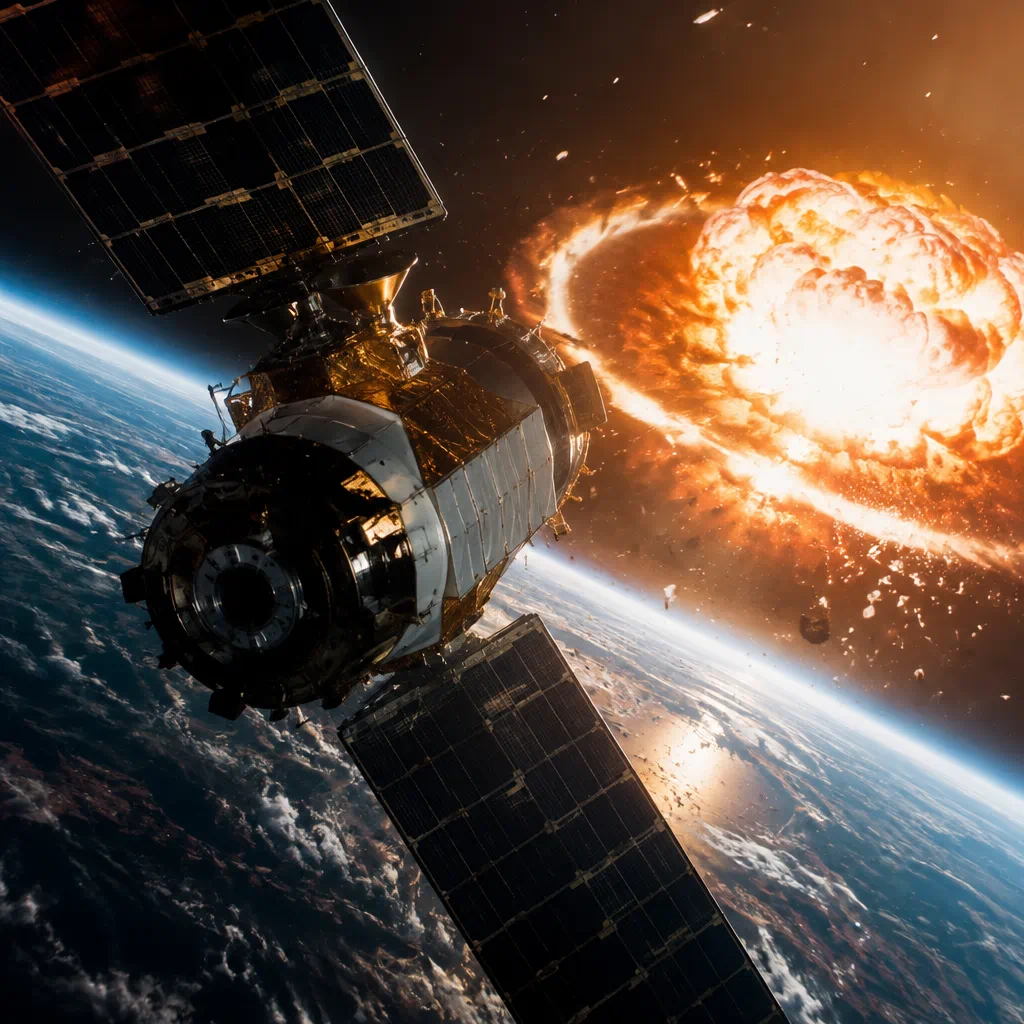
The paper, titled Effects of a Nuclear Detonation in Low Earth Orbit, was submitted to arXiv on November 6, 2026 by Zachary Petersen, Hong Qin, Sarah Thiele, and Sébastien Philippe. It responds to growing concern that nuclear weapons could be used in space to target the more than 13,000 satellites now operating in low Earth orbit.
The authors note that the danger extends well beyond the initial X-ray burst of a detonation. Electrons released by radioactive fission products can become trapped in Earth’s magnetic field, forming an artificial radiation belt that repeatedly exposes satellites over time. The study links this process directly to satellite failures, collisions, and atmospheric drag.
In the central case modeled, a one-megaton detonation at an altitude of 500 kilometers over the South Atlantic disables approximately 98 percent of modeled satellites within one week. The researchers tested whether greater hardening would help. Tripling the assumed radiation tolerance of the spacecraft delayed widespread failure by only days, with approximately 97 percent still disabled within two weeks.
The loss of satellite maneuverability drives a second wave of damage. With spacecraft unable to avoid one another, the study projects approximately 20 collisions within two years. Atmospheric drag removes many disabled spacecraft from lower altitudes over time, but the authors find that replacement satellites could remain exposed to residual radiation and debris for years afterward.
The findings demonstrate how a single detonation could cause lasting, large-scale damage to orbital infrastructure. The authors state that their results support efforts to prevent the deployment and use of nuclear weapons in space.
The 35-page paper includes four main figures and supplementary information with two additional figures, four tables, and detailed methods. It is classified under Physics and Society, with cross-listings in Earth and Planetary Astrophysics and in Instrumentation and Methods for Astrophysics.