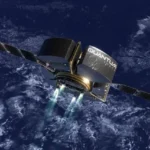
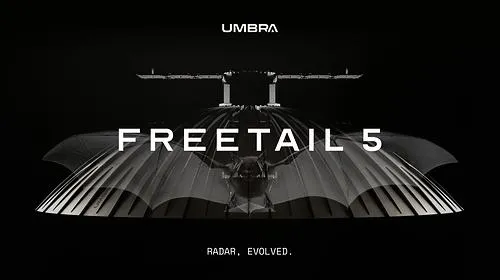
The announcement, made November 23, 2026, from Santa Barbara, California, builds on Umbra’s existing synthetic aperture radar systems. The company describes Freetail 5 as the next evolution of its SAR platform, refining a proven system that has been improved over 14 missions. Umbra positions the spacecraft for U.S. and allied operational and advanced research missions.
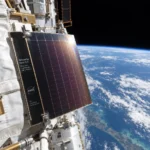
Freetail 5 pairs Umbra’s patented high-gain mesh antenna and RF payload, configurable up to 4 GHz of imaging bandwidth, with a software-defined architecture that can continuously evolve capabilities on orbit. The system delivers significantly increased radar transmit power across 20 square meters of deployed area and supports radar imaging with hundreds of high-quality 25 cm images per satellite per day, extending to resolutions as fine as 5 centimeters. The payload will support single, dual, and quad polarization image products, and the spacecraft will operate in both polar and mid-inclination orbits.
The spacecraft is being manufactured at Umbra’s 50,000-square-foot facility in Goleta, California. It deepens the company’s vertical integration, with 100 percent Umbra-developed flight software and 90 percent Umbra-built components, the highest share of any Umbra spacecraft to date. The bus uses flight-proven selective redundancy across critical subsystems and is compatible with both dedicated launch and rideshare configurations across U.S. and international launch providers.
“The next generation of space capability will be measured by what each spacecraft can achieve,” said David Langan, CEO of Umbra. “We’re building Freetail 5 to deliver the performance, resilience and mission flexibility of much larger systems in a highly agile platform. With four times the radar power, twice the antenna area and hourly global revisit, Freetail 5 is designed to collect more across greater areas to deliver unprecedented operational value.” Langan added that because the company designs, builds and flies its own systems, it can translate experience on orbit into engineering breakthroughs that redefine what each spacecraft can do.
Umbra says Freetail 5 can be configured for a broad range of missions. These include multistatic imaging, formation flight, single-pass 3D imagery, non-Earth imaging, direct-to-theater downlink, and hosted payloads. The platform also supports high-resolution all-weather, day-night SAR imaging with sub-centimeter scale coherent change detection for defense, intelligence, environmental monitoring, disaster response, and scientific research, as well as single and multiple-satellite microwave search and geolocation, and wide-area maritime search for vessel detection.
According to Langan, Freetail 5 represents a new standard for space-based intelligence that will create significant advantage for the United States and its allies. The company frames the platform as expanding the missions its spacecraft can perform while continuing to advance the SAR capability at the foundation of its business.
The first planned system is expected to launch in early 2028, with commercial availability by midyear and a larger constellation to follow.