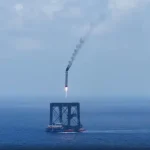
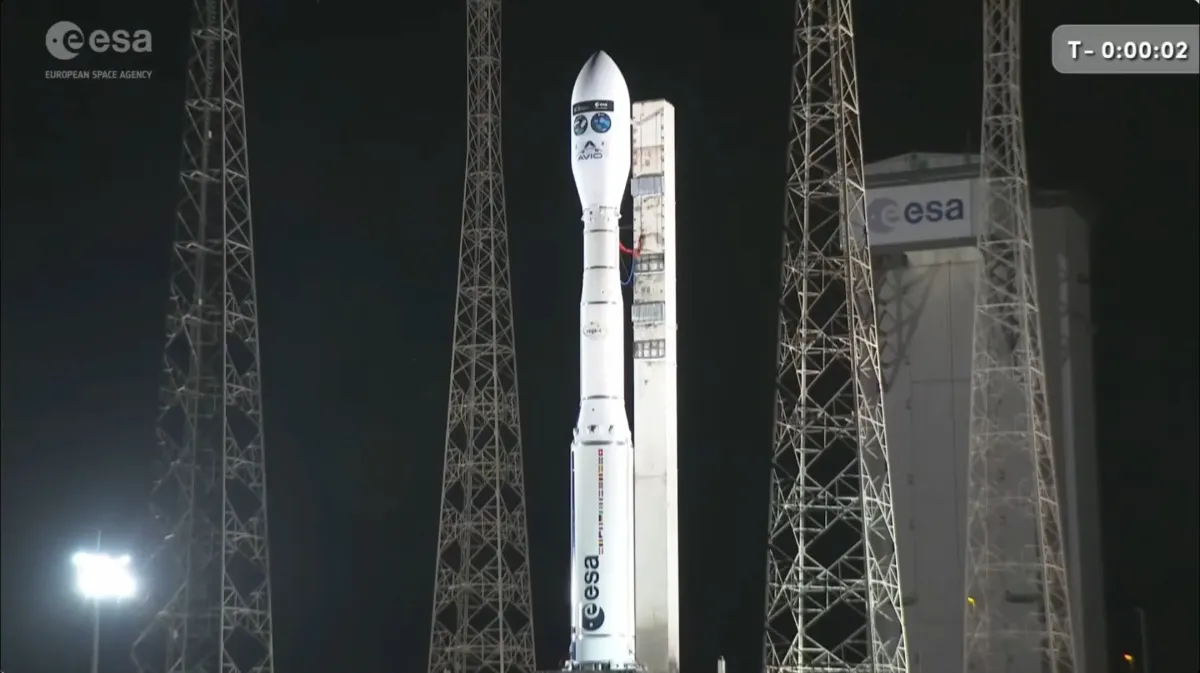
A Vega C rocket launched the FLEX and Copernicus-3C satellites from Europe’s Spaceport in Kourou, French Guiana on Sept. 14, 2026 at 9:21 p.m. EDT (10:21 p.m. local time in Kourou and 0121 GMT on Sept. 15). Credit: ESA
Europe’s Vega-C rocket launched ESA’s FLEX research satellite and the European Union’s Copernicus Sentinel-3C environmental monitoring spacecraft from Europe’s Spaceport in French Guiana on September 15, 2026, completing a dual-payload mission to an approximately 820-kilometer sun-synchronous orbit.
The VV30 mission lifted off at 01:21 UTC, or 10:21 p.m. local time on September 14. Sentinel-3C and FLEX were deployed into their designated orbits during a flight lasting one hour and 56 minutes. ESA’s European Space Operations Centre in Darmstadt, Germany, subsequently received signals from both spacecraft, confirming successful separation and initial contact with ground controllers.
The mission used a Vespa dual-launch adapter to carry the two satellites within Vega-C’s payload fairing. The 1,143-kilogram Sentinel-3C was mounted above the adapter and released first. The 397-kilogram FLEX spacecraft was enclosed inside the adapter and deployed approximately one hour later following additional maneuvers by the launcher’s upper stage.
The different deployment sequences demonstrated Vega-C’s ability to deliver two Earth observation spacecraft to distinct orbital positions during a single mission. Both satellites were built by Thales Alenia Space as prime contractor, with contributions from suppliers across Europe.
Mission teams have now begun the launch and early orbit phase, during which controllers will check the health of the spacecraft, configure onboard systems and prepare the scientific instruments for commissioning.
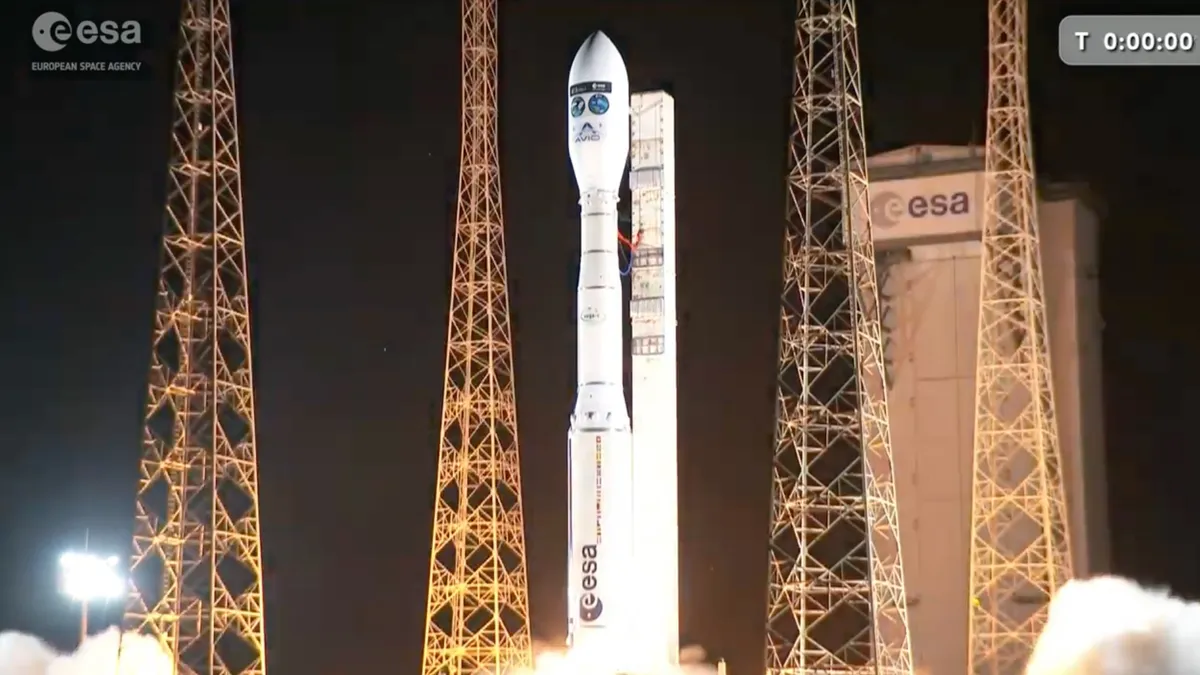
A Vega C rocket launches the FLEX and Sentinel-3C Earth-observation satellites to Earth orbit from Kourou, French Guiana on Sept. 14, 2026. (Image credit: ESA/Avio)
FLEX Targets Photosynthesis From Orbit
FLEX, short for Fluorescence Explorer, is the eighth Earth Explorer mission developed through ESA’s FutureEO research program. It is the agency’s first satellite designed specifically to measure photosynthetic activity from space.
The spacecraft carries the Fluorescence Imaging Spectrometer, or FLORIS, which detects the faint glow emitted by vegetation during photosynthesis. This solar-induced fluorescence is invisible to the human eye but provides a direct indicator of how efficiently plants are converting sunlight and atmospheric carbon dioxide into energy.
FLEX is expected to produce global vegetation-fluorescence maps with a ground resolution of approximately 300 meters. Its measurements will help researchers assess plant health, ecosystem productivity and vegetation stress while improving models of carbon and water exchanges between plants and the atmosphere.
The data also have potential applications in agriculture and food-security research because they can reveal changes in plant function before those changes become clearly visible through conventional optical imagery. Unlike measurements based mainly on vegetation color or canopy structure, fluorescence provides information more directly related to active photosynthesis.
FLEX will initially fly in tandem with Sentinel-3A. Sentinel-3 observations will supply complementary atmospheric and surface information, including clouds, aerosols, water vapor, surface temperature, land-cover type and additional vegetation parameters. Combining nearly simultaneous measurements from the two missions will help researchers isolate the weak fluorescence signal and place it in its wider environmental context.
ESA plans eventually to move Sentinel-3C into the tandem position now occupied by Sentinel-3A.
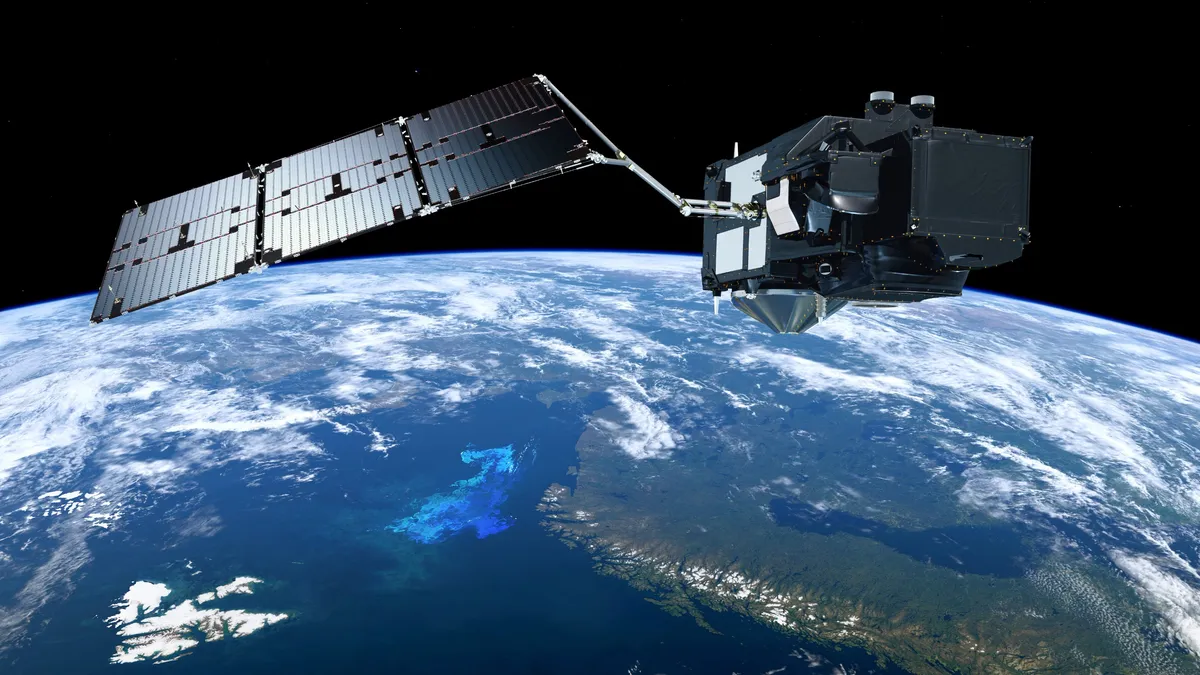
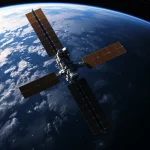
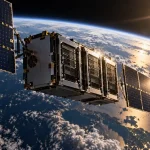
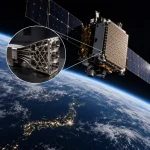
Artist’s illustration of a Sentinel-3 satellite in orbit. (Image credit: ESA/ATG medialab)
Sentinel-3C Extends Copernicus Data Continuity
Sentinel-3C is the third spacecraft in the Copernicus Sentinel-3 series, following Sentinel-3A and Sentinel-3B, launched in 2016 and 2018. Both earlier satellites remain operational, while Sentinel-3C will provide additional capacity and preserve continuity as the constellation ages.
The spacecraft carries four principal science instruments: the Ocean and Land Colour Instrument, Sea and Land Surface Temperature Radiometer, Synthetic Aperture Radar Altimeter and Microwave Radiometer. Together, they measure ocean color, sea- and land-surface temperatures, sea-surface height, wave conditions, ice characteristics, vegetation and inland-water levels.
Those observations support ocean and weather forecasting, climate monitoring, agricultural assessment, wildfire and drought mapping, water-resource management and studies of long-term environmental change. The mission also delivers near-real-time marine and atmospheric information used by operational forecasting services.
Copernicus is owned and managed by the European Union, while ESA is responsible for developing the Sentinel spacecraft. Following Sentinel-3C’s commissioning and in-orbit testing, EUMETSAT will take responsibility for routine satellite operations and the delivery of marine and near-real-time atmospheric products. ESA will continue providing land, cryosphere, inland-water and offline atmospheric products.
Vega-C Completes Eighth Flight
The 35-meter-tall Vega-C can place up to 2,300 kilograms into low Earth orbit. The 210-tonne launcher uses three solid-propellant stages, followed by a restartable liquid-propellant upper stage that performs the precision maneuvers required to deploy payloads into their assigned orbits.
ESA leads the Vega-C program, with Italy’s Avio serving as prime contractor and design authority. Avio also operated the VV30 launch, its second Vega-C mission since taking over launch-service responsibilities from Arianespace.
VV30 was Vega-C’s eighth flight since the rocket debuted in July 2022. With both spacecraft safely in orbit, attention now shifts to instrument commissioning, establishment of the FLEX–Sentinel tandem configuration and the transfer of Sentinel-3C to routine EUMETSAT operations.