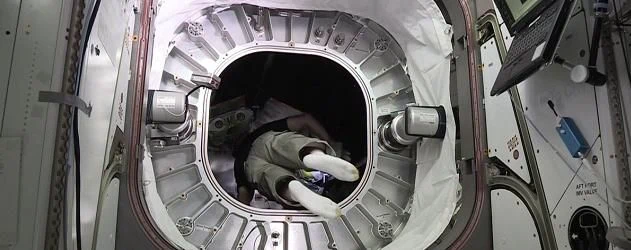
NASA astronaut Jeff Williams has ingressed the Bigelow Expandable Activity Module (BEAM) on Monday, the first time an American has entered an inflatable module in space. The milestone came after teams on the ground helped with a scavenger hunt on the Station to replace a missing part that was required for Monday’s historic event.
BEAM:
Following its launch inside SpaceX’s CRS-9 Dragon on 8th April and its installation to the Node 3 Aft port on 16th April, BEAM was inflated – also termed “expanded” – at the end of last month after sitting dormant on the Station port for over one month.
 It took Jeff Williams two attempts after the initial expansion showed unacceptable readings on the pressure curve. Following several hours of patient work, the module finally expanded to its full size during the May 28 attempt.
However, more work was required ahead of opening the hatch and entering the module.
During last week, BEAM successfully completed an 80-hour leak check and the crew began activities to prepare the vestibule for BEAM ingress. However, the path to completing the work to allow for ingress hit a snag.
See Also
- LIVE: BEAM Events
- ISS Section
- L2 ISS Section
- Click here to Join L2
“The crew removed the Node 3 Aft Negative Pressure Relief Valves (NPRV) that have been in place since Node 3 was originally flown, and installed Inter Module Ventilation (IMV) Valves,” noted ISS Status information. “During the activities, it was discovered that the Node 3 Aft Starboard IMV Flexible Coupling was missing.
“This coupling is needed to connect the ducting to the starboard IMV on the IMV return leg between BEAM and Node 3. This flex coupling is unique to this location and there are no spares on orbit or alternate locations to scavenge from.”
 Vestibule operations continued as planned. However, teams knew they had to work a solution to the missing coupling – which resulted in a Failure Investigation Team (FIT) meeting on the ground.
Astronomy
(adsbygoogle = window.adsbygoogle || []).push({});
The solution came in the form of a bag, which was first tested on the ground before Williams was told to utilize one on the Station.
“The crew installed the BEAM Intermodule Ventilation (IMV) Jumpers (ducts) between the Node 3 (N3) Aft bulkhead and the BEAM IMV valves on the BEAM forward bulkhead. The crew also completed the N3 Aft STBD IMV valve to duct connection utilizing a Kynar bag to replace a missing flexible coupler,” added status information (L2).
“A vestibule depress was completed to verify that the newly installed BEAM IMV Jumpers were correctly installed.”
 With the troubleshooting complete and BEAM passing leak checks, all was set for Monday’s historic ingress.
Houston pressed ahead with the go for Williams to open the hatch early into his shift on Monday. There wasn’t a live feed of the event due to troubleshooting with the video feed (KU Band).
Williams first loosened four bolts and noticed a release of air indicating BEAM was at a higher pressure that initially expected.
Williams officially opened the hatch at 08:47 UTC. Along with Russian cosmonaut Oleg Skripochka, Williams entered BEAM for the first time to collect an air sample and begin downloading data from sensors on the dynamics of BEAM’s expansion.
*Click here for more Bigelow News Articles*
The astronaut reported that the interior of BEAM looks “pristine”. However, he added the temperature was on the cool side – with Houston adding they recorded 44F as the temperature at bulkhead – but no condensation was visible. He then took air samples, as is the procedure for entering a new module.
 Additional ingress opportunities to deploy other sensors and equipment in BEAM are scheduled for Tuesday and Wednesday.
The hatch to BEAM will be closed after each entry.
BEAM is a technology demonstrator, with the challenges providing engineers with lessons learned ahead of moving on to larger expandable modules.
The larger modules are likely to play a huge role in the exploration of deep space.
The BEAM module is hoped to be a stepping stone designed to gain useful in-flight experience of how expendable technology works with human spaceflight activities before the notional launch of the two B330 modules at the beginning of the next decade.
 The groundwork for the next phase came via an agreement earlier this year that will see Bigelow deliver two fully functional B330 modules to ULA for notional launches in 2020.
Currently, the first of these two modules is slated to be ready for launch by late-2019, with the second module ready sometime in 2020.
While the exact orbital inclinations and orbits of the two B330s is not currently known, Bigelow noted that both B330s could be free-flying orbital labs while the option exists – pending approval from NASA – to dock one of the B330s to the ISS.
 Bigelow’s long-term aspirations include orbital modules, which can also be used for space tourism purposes, through to large-scale commercial space stations.
Per the company’s “Gate 1 report”, Bigelow has previously presented NASA with a modified version of the Olympus module, which would be a craft carrier.
The company has also proposed modules that could be launched and placed on the surface of the Moon and potentially on the surface of Mars.
Images: NASA, L2 and renders from L2 artist Nathan Koga – The full gallery of Nathan’s (SpaceX Dragon to MCT, SLS, Commercial Crew and more) L2 images can be *found here*)
(To join L2, click here: //www.nasaspaceflight.com/l2/)