
Tag: AAS
-

Rubin Observatory spots an asteroid that spins fast enough to set a record
An artist’s conception zeroes in on a main-belt asteroid called 2025 MN45, which makes a full rotation in less than two minutes. (Credit: NSF-DOE Vera C. Rubin Observatory / NOIRLab / SLAC / AURA / P. Marenfeld) Astronomers say they’ve found an asteroid that spins faster than other space rocks of its size. The asteroid,…
-

NASA’s Webb Space Telescope scores big at America’s premier astronomy meeting
NASA’s James Webb Space Telescope captured this infrared view of NGC 346, a dynamic star cluster that lies within a nebula 200,000 light-years away. Science credit: NASA, ESA, CSA, Olivia C. Jones (UK ATC), Guido De Marchi (ESTEC), Margaret Meixner (USRA). Image processing: Alyssa Pagan (STScI), Nolan Habel (USRA), Laura Lenkić (USRA), Laurie E. U.…
-
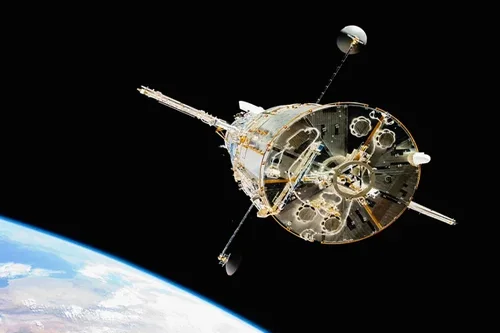
NASA’s TESS probe chalks up its first Earth-sized planet in habitable zone, plus a ‘Tatooine’ planet
Astronomers report that NASA’s Transiting Exoplanet Survey Satellite, or TESS, has detected its first Earth-sized planet lying in its parent star’s habitable zone, plus its first planet orbiting two stars. The Earth-sized planet, known as TOI 700 d, is orbiting a cool M-dwarf star a little more than 100 light-years from Earth in the southern…
-

Supernova leftovers preserve evidence of a messy blowup that wrecked two stars
This artist’s view shows a white dwarf star accumulating material from a nearby red giant star. Ultimately, the white dwarf erupts into a supernova. (Instituto de Astrofísica de Canaria Illustration / Romano Corradi) In what sounds like a cosmic episode of “CSI,” sleuthing astronomers have figured out what touched off a stellar explosion 545 million…
-

Scientists look for new ways to track the technosignatures of alien civilizations
An artist’s conception shows a crumbling megastructure known as a Dyson sphere orbiting a distant star. Could such structures produce detectable technosignatures? (Danielle Futselaar Illustration) Could extraterrestrial civilizations leave their fingerprints as chlorofluorocarbons in planetary atmospheres, or the waste heat generated by industrial processes, or artificial bursts of neutrinos or gravitational waves? That’s what a…
-
Could Barnard’s Star harbor an icy home for life? Astronomers weigh the options
An artist’s conception shows three planets around a red dwarf star. (NASA / JPL-Caltech Illustration) Where’s the nearest exoplanet with conditions that are right for life? Over the past couple of years, astrobiologists have talked up Proxima Centauri b, which is sitting just 4.2 light-years away. But Villanova University astrophysicist Edward Guinan favors a world…
-
Canadian radio telescope takes the search for puzzling fast radio bursts into a new era
One of the radio antennas of the Canadian Hydrogen Intensity Mapping Experiment, or CHIME, spreads out beneath the night sky near Penticton, B.C. (CHIME Photo) A new radio telescope in British Columbia’s Okanagan Valley has detected 13 new sources of mysterious extragalactic phenomena known as fast radio bursts, including the second known source of repeated…
-
Hubble team has bad news for aliens: Red dwarfs seem to wipe out life’s necessities
An artist’s conception shows the red dwarf star AU Microscopii with a hypothetical planet and moon in the foreground. (NASA / ESA Illustration / G. Bacon) Red dwarf stars have been seen as the biggest potential frontier for alien life, in part because they’re the most common stars in our galaxy. But observations made using…
-
3-D views reveal ‘Orion’s Dragon’ in space
A color-coded image that’s based on SOFIA infrared data shows “Orion’s Dragon” in the Orion Nebula, more than 1,300 light-years from Earth. (NASA / USRA / DLR Image) Spectral readings from the Orion Nebula have charted the cosmic weather patterns for powerful stellar winds that have created a bubble of material that’s 12 light-years wide,…
-
‘Oumuamua’s discovery points to plethora of interstellar objects in our galaxy
This artist’s impression shows the first interstellar object discovered in the solar system, ‘Oumuamua. (NASA / ESA / Hubble Illustration / M. Kornmesser) The cigar-shaped object known as ‘Oumuamua may be the first interstellar interloper to be discovered, but it’s not likely to be the last. Statistics suggest that there are lots more space rocks…