
Tag: Planets
-

NASA’s Dawn probe snaps close-ups of Ceres’ formerly mysterious white spots
A mosaic of images from NASA’s Dawn spacecraft shows a prominent mound of bright material on the western side of Cerealia Facula on dwarf planet Ceres. (NASA / JPL-Caltech / UCLA / MPS / DLR / IDA Photo) The once-mysterious bright spots shining on the surface of the dwarf planet Ceres are getting their closest…
-
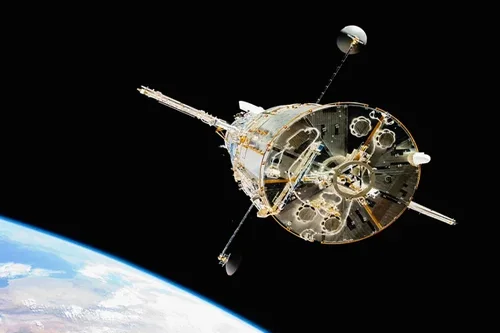
It’s full of stars! NASA’s planet-hunting TESS probe sends back its first test image
This test image from one of the four cameras aboard the Transiting Exoplanet Survey Satellite, or TESS, captures a swath of the southern sky along the plane of our galaxy. (NASA / MIT / TESS Photo) One month after its launch, NASA’s Transiting Exoplanet Survey Satellite has sent back an initial test image that shows…
-

Pluto’s champion recounts first mission to icy world – and gears up for the next one
The 1991 stamp that served as the rallying cry for the New Horizons mission to Pluto is “updated” by members of the New Horizons science team on July 14, 2015, the day the spacecraft flew past Pluto. Principal investigator Alan Stern is at far left. (Credit: Bill Ingalls / NASA) It took nine years for…
-
SpaceX launches NASA’s TESS spacecraft on mission to seek out alien planets
SpaceX’s Falcon 9 rocket lofts NASA’s TESS probe into space. (NASA via YouTube) SpaceX has launched NASA’s Transiting Exoplanet Survey Satellite, or TESS, kicking off a mission aimed at surveying nearly the entire sky for exoplanets. The probe rose into space atop a SpaceX Falcon 9 rocket, sent up from Cape Canaveral Air Force Station in…
-
SpaceX and NASA delay launch of TESS planet hunter to check guidance analysis
An artist’s conception shows the Transiting Exoplanet Survey Satellite. (NASA Illustration) NASA and SpaceX say they’ll take more time to launch the Transiting Exoplanet Survey System, or TESS, just to make sure the $337 million mission will be on the right track to hunt for planets beyond our solar system. TESS’ liftoff aboard a SpaceX…
-

Our solar system has met its match: AI helps scientists find a star’s eighth planet
We’re not alone. At least when it comes to solar systems with the same number of major planets as ours. NASA today announced details about the recent discovery of an eighth planet circling Kepler-90, a sunlike star that’s 2,545 light years from Earth. The planet, dubbed Kepler-90i, is a sizzling hot, rocky planet that orbits its…
-

Ross 128 redux: Red dwarf sparks interest as a potentially not-so-weird locale for life
This artist’s impression shows the temperate planet Ross 128 b, with its red dwarf parent star in the background. (ESO Illustration) A red dwarf star that was previously thought to be the source of a weird signal from aliens turns out to have a temperate Earth-sized planet, astronomers reported today. The “Weird! Signal,” detected this…
-
Help NASA and New Horizons nickname the icy world they’re targeting after Pluto
An artist’s conception shows the New Horizons spacecraft flying past 2014 MU69, which scientists say could be a binary orbiting pair of bodies with diameters in the range of 11 to 12 miles. (NASA / JHUAPL / SwRI Illustration) 2014 MU69 just won’t cut it, so NASA and the folks behind the New Horizons mission…
-
Newfound dust belts suggest that Proxima Centauri has more than one alien planet
An artist’s impression shows the newly discovered belts of dust around Proxima Centauri, the closest star to our solar system. This sketch is not to scale — to make Proxima b clearly visible, it has been shown farther from the star and larger than it is in reality. (ESO Illustration / M. Kornmesser) Astronomers created…
-

Google Maps expands its interplanetary domain all the way out to Pluto
You can get an annotated view of Pluto from Google Maps. (NASA / JHUAPL / SwRI / Google) If you zoom way, way out on Google Maps, you can now find your way around places like Sputnik Planum, Seville Mons, Aphrodite Terra and Damascus Sulcus. Those are destinations on Pluto, Iapetus, Venus and Enceladus, just…