
Tag: Webb
-
With Webb, scientists make first detection of carbon molecule in protoplanetary disk
With new data collected by the joint NASA/European Space Agency/Canadian Space Agency James Webb Space Telescope, an international team of scientists has — for the first time ever — detected a carbon molecule within the protoplanetary disk of a star located in the Orion Nebula. The molecule, called methyl cation (CH3+), is quite unique. The…
-
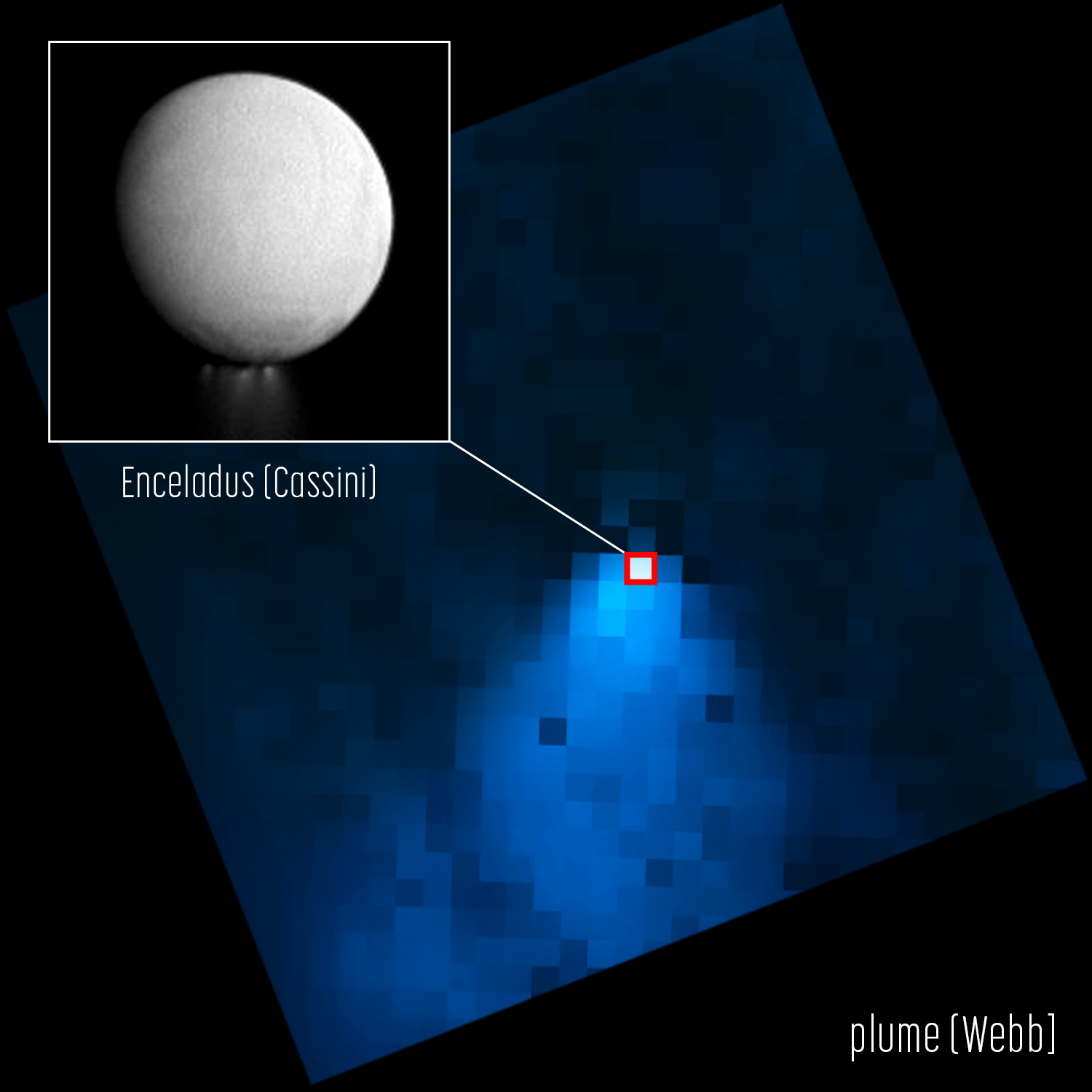
Megaplume of water vapor erupting on Enceladus caught by Webb Telescope
Enceladus, a frozen moon orbiting Saturn, has caught the interest of scientists because of the plumes of water vapor that erupt from its icy crust, which are possible evidence for a subsurface ocean. And an ocean means it has the potential for life (at least life as we know it). Now NASA’s James Webb Space…
-
Webb unveils the secrets of the early universe via deep field, peers into stellar nurseries
With help from the joint NASA/European Space Agency/Canadian Space Agency James Webb Space Telescope (JWST), scientists are peering deep into the universe and uncovering secrets that were previously hidden from visible and X-ray telescopes. The JWST advanced deep extragalactic survey (JADES) utilized Webb’s incredible deep-field surveying abilities to create a deep field that shows over…
-
Webb directly images young star’s asteroid belt; discovers two additional dusty disks
Using the joint NASA/ESA/CSA James Webb Space Telescope, a group of astronomers has directly imaged three dusty disks — the outermost being an asteroid belt — surrounding a young star. The outermost of the disks was first discovered by NASA’s Infrared Astronomical Satellite in 1983 and has since been imaged in detail by the Hubble…
-
Using JWST, scientists observe silicate clouds and measure the temperature of exoplanets
With help from the joint NASA/ESA/CSA James Webb Space Telescope, two teams of scientists have made groundbreaking, first-of-their-kind discoveries on two exoplanets. One team utilized the immense power of Webb’s Mid-Infrared Instrument (MIRI) and Near-Infrared Spectrograph (NIRSpec) instruments to observe and characterize clouds and molecules in the atmosphere of an exoplanet located 40 light-years away.…
-
Webb peers at young star’s dusty disk, discovers an exoplanet, and uncovers star formation
At the 241st meeting of the American Astronomical Society (AAS) on Jan. 11, three teams presented research that utilized the capabilities of NASA’s James Webb Space Telescope. The first team used Webb to observe the dusty disk surrounding a young red dwarf star, the second to discover an exoplanet, and the third used the telescope’s…
-
As Webb begins observing exoplanets, scientists use Spitzer data & brown dwarfs to reveal how silicate clouds form
In a new study from a group of researchers in Canada, data from NASA’s now-retired Spitzer Space Telescope was used to determine the conditions under which silicate clouds form on distant exoplanets outside of our solar system — giving scientists insight into what’s inside the atmospheres of exoplanets similar in size, temperature, and composition to…
-
NASA, ESA, CSA release historic first images from the James Webb Space Telescope
NASA, the European Space Agency (ESA), and the Canadian Space Agency (CSA) have released the first set of full-color images taken by the James Webb Space Telescope — the world’s newest, most powerful, and largest space telescope. A total of five images were released, with the first image being unveiled by United States President Joe…
-

Seeing the universe in the Mid-Infrared with James Webb’s MIRI instrument
The James Webb Space Telescope (JWST), presently tracking toward a launch no earlier than December 22 on an Ariane 5 rocket from the Guiana Space Centre in South America, will revolutionize in-space astronomy, particularly with its Mid-InfraRed Instrument, or MIRI. The instrument itself requires special cooling to drop its temperature to just 6 Kelvin —…