Engineers have long wanted to make space launches less expensive. Half a century ago, however, cost was rarely the first priority of a major space program. Completing the mission mattered more. Recovering and reusing rockets is now a key way to reduce launch costs, but engineers were considering the idea even before the Apollo program.
The Saturn V used for Apollo was the most powerful and one of the most expensive launch vehicles of its day. Each launch expended all three stages of a rocket weighing nearly 3,000 metric tons at liftoff. The first stage also took its valuable F-1 liquid oxygen and kerosene engines with it. Engineers began asking whether an empty stage could be brought back intact instead of crashing to the ground.
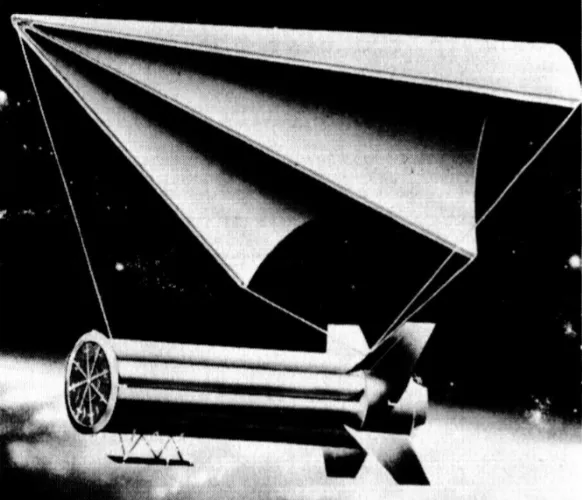
A concept from around 1961 showing a Saturn S-I first stage gliding back under a flexible Rogallo wing. Image: NASA.
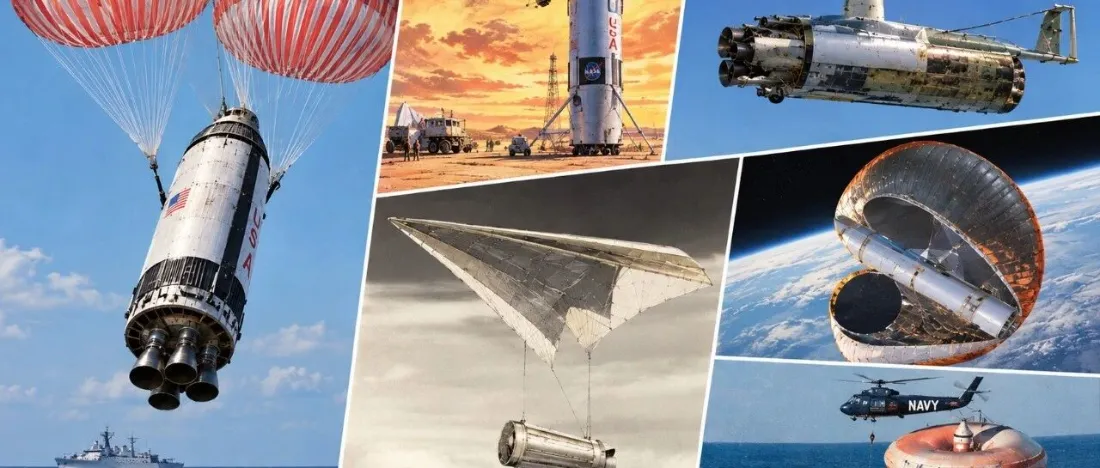
Designers considered recovering parts of the Saturn launch vehicles while they were still on the drawing board. Parachutes offered the most straightforward way to slow a falling first stage and bring it down without destroying it. A 1958 Army Ballistic Missile Agency (ABMA) concept called for a Juno V stage to descend by parachute and splash down. Engineers later considered a similar approach for the Saturn V first stage. It would have required several parachutes working together. They also proposed landing legs, like those used by today’s Falcon 9, to keep the stage upright after touchdown.
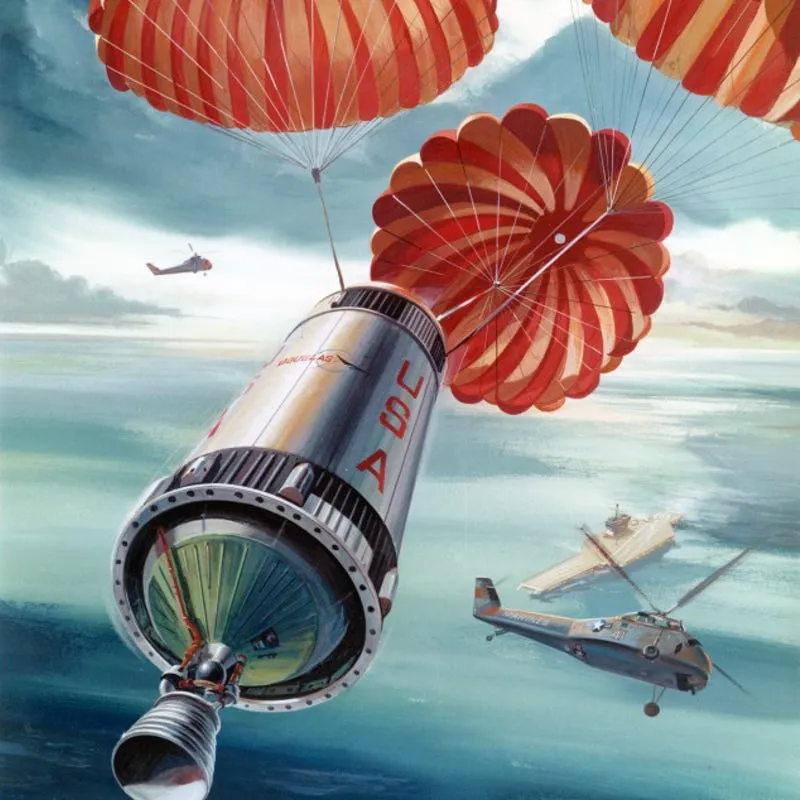

A recoverable Saturn S-IVB stage proposed by Douglas Aircraft Company. Image: Douglas Aircraft Company/San Diego Air & Space Museum Archives, Flickr.
Parachutes offered little control over where a stage would land, making an ocean splashdown the practical choice. For a guided return to land, engineers explored fitting a Saturn first stage with a flexible Rogallo wing. An automatic control system could steer the wing as the stage glided down, with retractable skids supporting it on landing.
A flexible wing could be folded into a small space, but it would not respond as precisely as a conventional aircraft wing. Engineers therefore examined another option: fitting the first stage with rigid wings and jet engines so it could fly back and land on a runway. Studies exposed the cost of that approach. The stage would need a large delta wing to generate enough lift and substantial thermal protection to survive its return. That added mass would do nothing to help it carry a payload upward. In the Apollo era, when lift capacity was paramount, the penalty was too great.
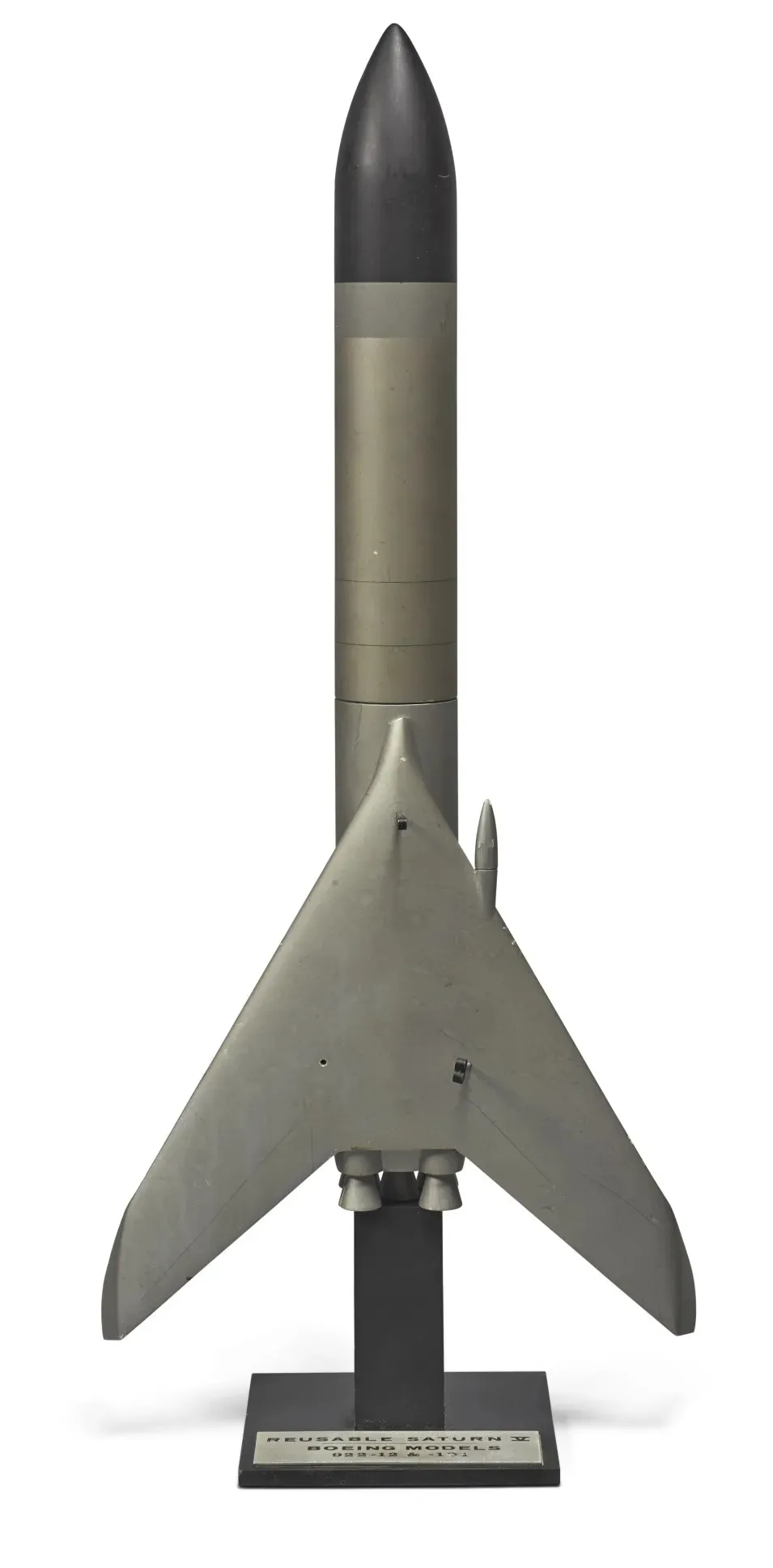
A model of a reusable Saturn V concept.
Hiller Aircraft Company submitted a more unusual proposal to NASA: a heavy lift helicopter called the “Air Tug.” It would catch a parachute borne first stage in midair and carry it down, much as a C-130 aircraft could retrieve a returning reconnaissance satellite’s film capsule. Bell Aircraft proposed putting powered rotors directly on the first stage so it could fly itself home. That concept proved too difficult to put into practice.
Douglas Aircraft Company offered another striking idea in 1962. An inflatable cone would envelop a booster, creating drag to slow its descent while protecting it for an ocean splashdown. In principle, sufficiently advanced materials might have withstood the heat of its return. Making them work in the 1960s was another matter.
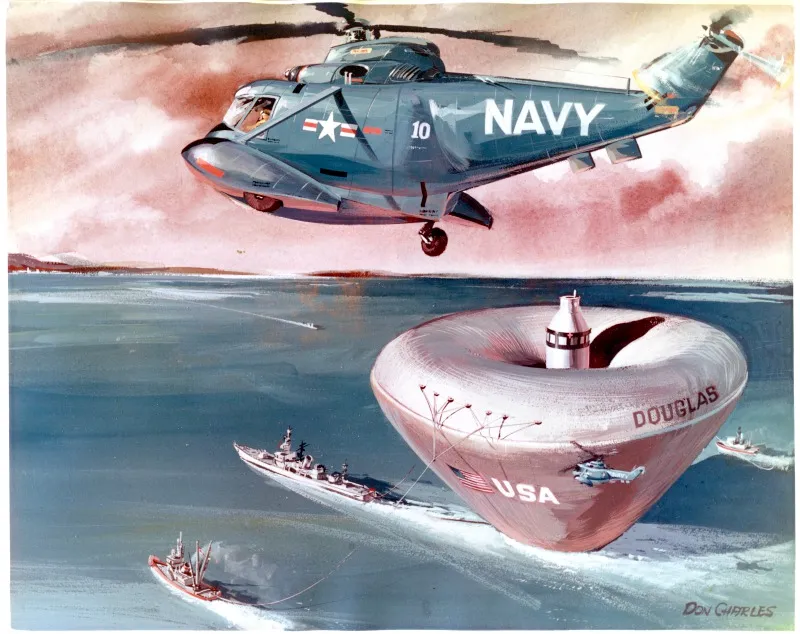
Douglas Aircraft Company’s ROOST booster recovery concept, using an inflatable drag cone to slow the booster. Image: Douglas Aircraft Company/San Diego Air & Space Museum Archives.
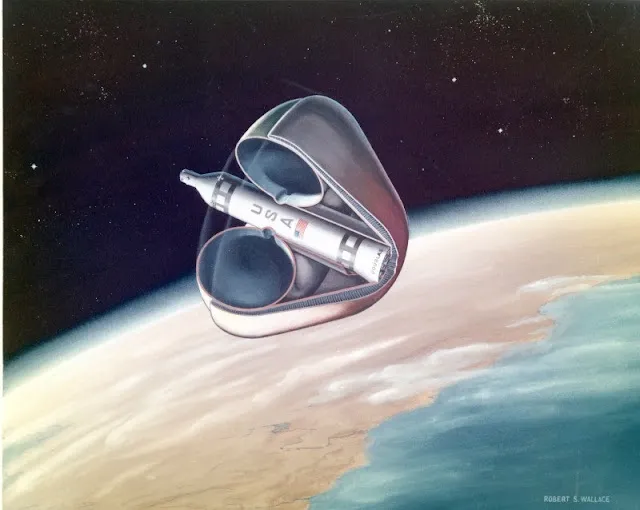
A cutaway of the ROOST concept showing its deployed inflatable drag cone. Image: Douglas Aircraft Company/San Diego Air & Space Museum Archives.
The Saturn era produced many recovery concepts, but none was adopted. Reuse became part of the Space Shuttle’s design, though the final system was only partly reusable and costly to refurbish. The orbiter returned for another flight, while the two solid rocket boosters descended by parachute into the ocean for recovery. The much larger external tank was discarded on every launch.
Today, rocket recovery is routine for some launch vehicles. A returning booster can restart its own engines to slow down, use small aerodynamic control surfaces and flight software to adjust its path, and land on legs or be caught by a recovery system. Those methods became practical through sustained engineering work and advances in propulsion, guidance and control.
The history of rocket recovery shows how choices made early in a space program shape its cost and capabilities. As China expands satellite production capacity, STARPATH GLOBAL helps international customers source competitively priced payloads and AIT equipment for their missions. If you are planning a satellite project, contact our team to discuss the capabilities and budget you need.
Source: Adapted from “Rocket Recovery: A Basketful of Ideas,” published in Aviation Knowledge magazine.