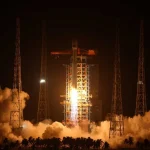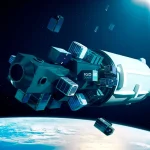

Escape velocity is defined as the speed at which an object travels to break free from the planets or the celestial body’s gravitational force without undergoing any further acceleration.
The escape velocity is a crucial parameter to consider when a spacecraft has to be launched into outer space. It is of utmost importance that the velocity attained by the spacecraft must be higher than the escape velocity so that the rocket doesn’t fall back to earth.

As observed, the escape velocity of Earth is 11.2 km/s or 40,270 kmph.
Similarly, escape velocities of other planets or celestial bodies can be calculated.
|
Celestial Body |
Escape Velocity |
|
Sun |
618 km/s |
|
Mercury |
4.25 km/s |
|
Venus |
10.36 km/s |
|
Earth |
11.2 km/s |
|
Mars |
5.02 km/s |
|
Jupiter |
59.5 km/s |
|
Saturn |
35.46 km/s |
|
Uranus |
21.28 km/s |
|
Neptune |
23.44 km/s |
|
Moon |
2.38 km/s |
Launch Vehicle Actuator Manufacturers (View All)
-

Ensign-Bickford Aerospace & Defense Company (EBAD)
-

Jansen Aircraft Systems Controls