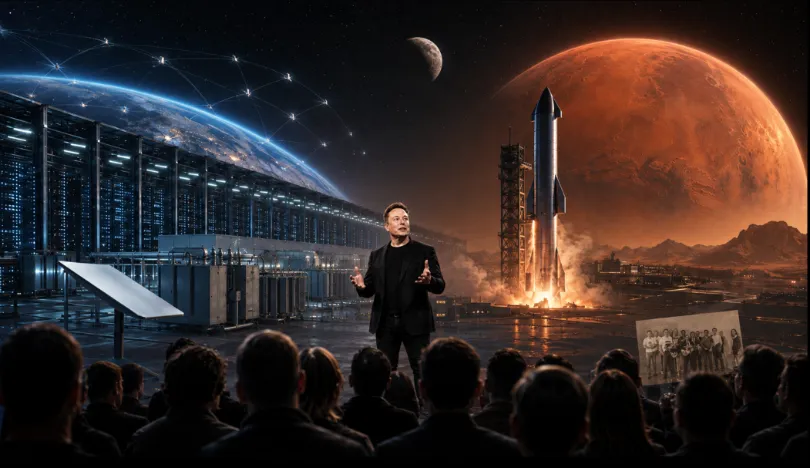
SpaceX CEO Elon Musk laid out a future for the company that extends far beyond rockets and satellite internet, telling employees that artificial intelligence could soon become SpaceX’s largest business and eventually account for 99% of its value.
During the presentation, which SpaceX published on August 11th, Musk said the company is targeting 10 gigawatts of AI compute capacity by the end of 2027, up from roughly 1.4 GW today. At the economics Musk expects for that capacity, he said 10 GW could eventually support between $300 billion and $500 billion of annual revenue.
“Our AI revenue will exceed all other SpaceX revenue probably in September, like next month, and will significantly exceed all other SpaceX revenue in the fourth quarter,” Musk told employees. “AI has become an extremely important part of SpaceX’s future.”
The message was striking for a company whose identity has been built around rockets, spacecraft, and satellite communications. Musk now sees those businesses increasingly converging with AI infrastructure into a single system spanning terrestrial data centers, software, satellites, launch vehicles and, eventually, industrial operations beyond Earth.
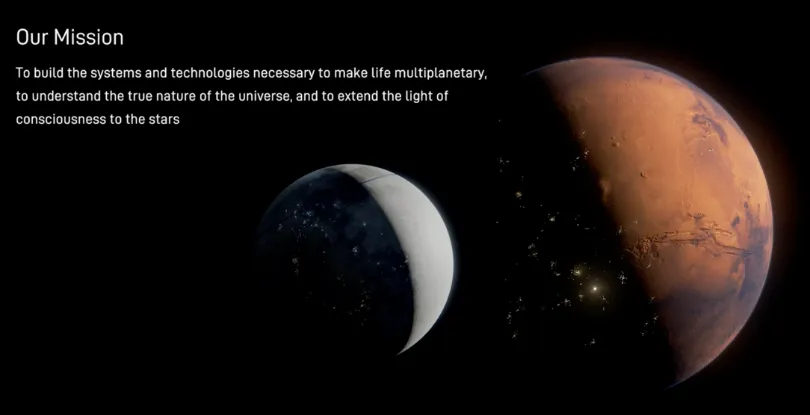
SpaceX Mission Slide from the August 11th All Hands Presentation by Elon Musk
SpaceX Targets 10 GW of AI Compute by the End of 2027. “We Must Win on AI.”
SpaceX ended the second quarter with approximately 1.4 GW of nameplate AI compute capacity, up from 1 GW in the first quarter and just 400 MW a year earlier. The company expects to exceed 2 GW by the end of 2026 and has set an ambitious target for 10 GW by the end of 2027. SpaceX spent roughly $15.8 billion on AI compute infrastructure during the second quarter alone according to its earnings report. Musk put a simple economic framework around the target during the all-hands.
“The value per watt is probably going to be 30 to $50,” Musk said. “Which means if we bring 10 gigawatts of AI online by the end of next year, it will be $300 billion to $500 billion a year in revenue. Big numbers.”
That would represent a dramatic transformation of SpaceX’s revenue mix. The AI segment generated $2.6 billion of revenue in the second quarter, up 213% sequentially, with $1.6 billion coming from new agreements providing customers such as Anthropic and Alphabet access to compute at the Colossus data center sites. SpaceX said the AI segment also reached positive adjusted EBITDA during the quarter, which came to the surprise of many analysts and research firms.
Musk went considerably further than the near-term revenue target. He told employees that within four or five years, AI could represent roughly 99% of SpaceX’s total value, which will be “astronomical” as he put it. This was emphasized throughout the company’s all-hands; the AI push was the most important message of the presentation.
The reasoning extends beyond the current surge in compute demand driven by the rapid adoption of large language model applications. Musk expects that the future economy is going to be dominated by not just digital intelligence (AI), but also robots, both of which he expects will require enormous quantities of compute power and energy. He framed the expansion of computation as part of a much larger increase in civilization’s ability to harness energy. Even if humanity eventually consumed one million times more energy than it does today, Musk argued, we would still be harnessing less than 1 millionth, or 0.0001%, of the Sun’s total energy output. In his view, becoming a civilization capable of harnessing substantially more of the Sun’s energy is a natural next step in technological development, and solar energy is more abundant in space, which is how the space business and the AI business relate to each other.
Minihard Shows the Physical Scale of the AI Buildout
The physical infrastructure required to support that ambition is already taking shape around SpaceXAI’s Tennessee data center operations.
One of the newest projects is a facility Musk has dubbed “Minihard,” being built near the company’s existing Memphis-area compute infrastructure. Musk has said Minihard will contain the same 220,000 Nvidia GB300 GPUs as the larger “Macroharder” facility, connected with 800-gigabit networking, but arranged in a substantially denser configuration. The building associated with the project has reportedly been permitted at roughly 312,000 square feet and $659 million. The additional 220,000-GPU installation could require more than 400 MW of power on its own. Tesla Megapacks are also being deployed around the campus to provide energy storage and help stabilize power delivery to the enormous compute loads.
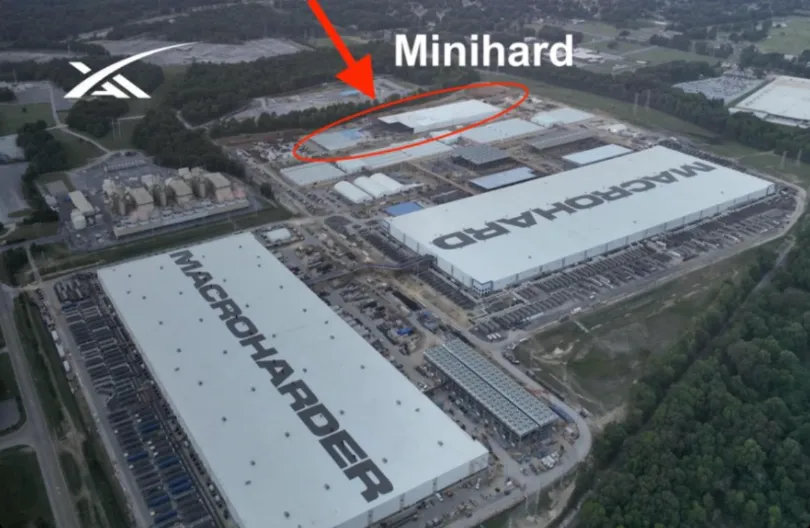
SpaceXAI Macrohard, Macroharder, and Minihard data centers. Image Credit: SpaceX
These facilities form part of the 1.4 GW of nameplate compute SpaceX currently reports, centered around its Memphis and Southaven infrastructure. The company’s challenge now is to multiply that capacity roughly sevenfold in less than a year and a half.
Train on Earth, Run Inference in Space
SpaceX’s long-term AI architecture will not be entirely terrestrial. Musk expects frontier model training to remain on Earth, where giant tightly interconnected computing clusters can be supported by terrestrial power systems, cooling infrastructure and high-bandwidth networking.
The location of inference could be very different.
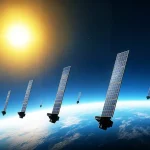
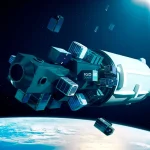
As AI becomes embedded in phones, vehicles, robots and other devices used by billions of people, SpaceX expects a growing portion of everyday inference workloads to move into orbit. The company has already announced plans for Starmind, a future constellation of AI computing satellites based around Nvidia hardware, with initial launches expected as early as 2027. Space ultimately offers access to enormous amounts of solar energy without the terrestrial constraints facing data centers on Earth. Musk’s longer-term architecture combines reusable Starship launches, solar power, AI satellites and semiconductor manufacturing through the planned Terafab initiative.
The logic is closely tied to SpaceX’s original mission. A launch system capable of moving massive amounts of material into orbit becomes considerably more valuable if the largest future demand for infrastructure is itself moving into space.
Starship Could Increase Annual Mass to Orbit From 2,500 Tons to Millions
Musk used another part of the all-hands presentation to put Starship’s potential scale into perspective. SpaceX currently delivers roughly 2,500 tons of payload to orbit each year using Falcon, according to Musk. With a mature, rapidly reusable Starship system, he believes that figure could eventually exceed 1 million tons annually and potentially reach 10 million tons per year.
The jump from 2,500 tons to 1 million tons would represent a 400-fold increase. At 10 million tons, annual launch capacity would be roughly 4,000 times the current level.
“When you think about it, we go from 2,500 tons a year to 1 million, potentially 10 million tons per year,” Musk said during the company’s recent earnings call. “It’s really a ridiculously profound difference.”
That is the scale Musk believes is required not merely to launch satellites, but to build permanent industrial infrastructure in orbit and eventually establish self-sustaining civilization on the Moon, Mars and beyond.
Starship’s latest development phase is also directly tied to Starlink. SpaceX says the first two flights of its V3 Starship vehicles have positioned the program for upcoming orbital operations, recovery attempts and deployment of operational Starlink V3 satellites. A recent Starship test successfully deployed 20 V3 satellites and established communications with all of them. Each future Starship launch carrying V3 satellites is expected to add more than 20 times as much network capacity as a typical current-generation Falcon 9 Starlink launch.
Starlink Passes 13 Million Subscribers
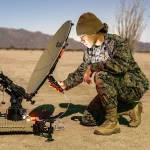
While AI dominated the presentation, SpaceX’s existing connectivity business continues to expand rapidly. One of the slides shown to employees states Starlink has surpassed 13 million consumer subscribers across 167 active markets. Starlink Mobile, the company’s direct-to-cell service delivered through partnerships with mobile network operators, now reaches approximately 22 million monthly users through 36 MNOs.
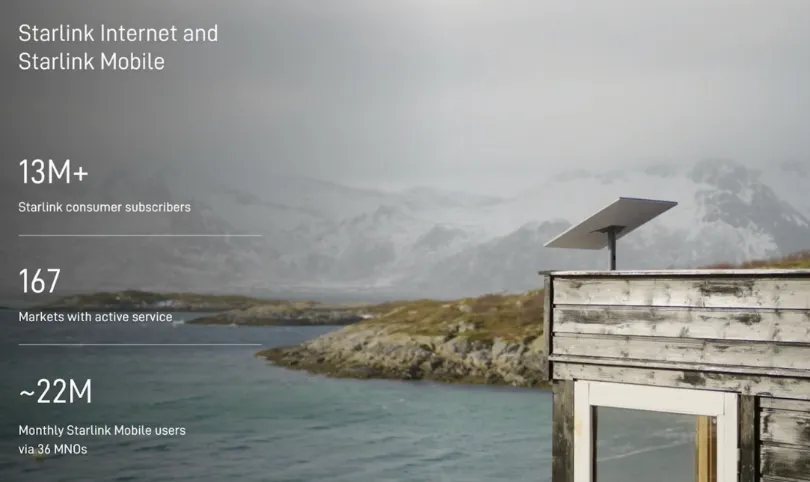
Image Credit: SpaceX All Hands Presentation
Musk reiterated his belief that Starlink could eventually carry a very large share of global internet traffic. SpaceX said during its second-quarter earnings call that V3 satellites are roughly an order of magnitude more capable than V2 satellites, while the company ultimately expects to launch about an order of magnitude more of them. The SpaceX CEO also briefly discussed Starshield, its government-focused satellite business. Musk said little could be disclosed about the program but described it as an important component of U.S. national security.
From a Tiny El Segundo Warehouse to a Space and AI Company
Musk opened part of the presentation by looking back at how far SpaceX has come since 2002.
The company began in a small facility in El Segundo, California, with a team that had never built an orbital rocket. Its first three Falcon 1 launch attempts failed. The fourth reached orbit in September 2008, an event that helped keep the young company alive.
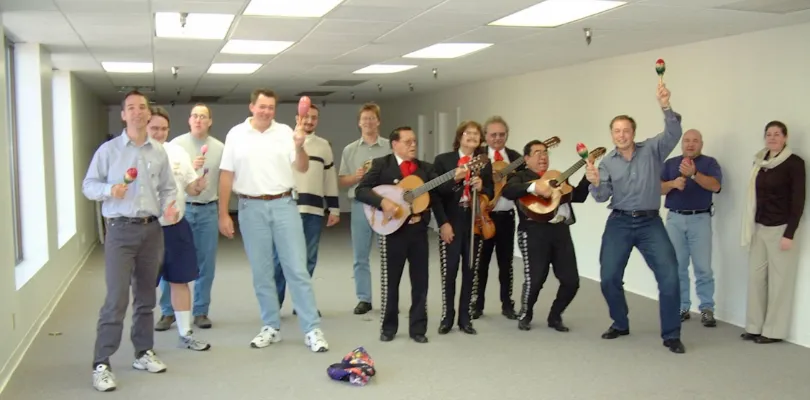
SpaceX Team in 2002
The same trial-and-error approach later defined SpaceX’s pursuit of reusable orbital rockets. After a series of failed recovery attempts, SpaceX successfully landed a Falcon 9 first stage back at Cape Canaveral in December 2015. It completed the first successful Falcon 9 landing on a drone ship in April 2016, then achieved the world’s first reflight of an orbital-class rocket booster in March 2017.
At the time, critics questioned whether an orbital booster could reliably land at all, and whether customers would be willing to trust payloads to a previously flown rocket. Reuse has since become fundamental to SpaceX’s launch model, with Falcon boosters now routinely flying many missions.
Today the company encompasses Falcon, Dragon, Starship, Starlink, Starshield and a rapidly expanding AI operation that includes Colossus infrastructure, Grok, X and its planned integration with Cursor.
The contrast between the 2002 photograph shown during the presentation and the infrastructure SpaceX is building today was one of Musk’s central points: technologies that initially appear unrealistic can become routine once the underlying engineering problem is solved. It’s a matter of iteration by a stellar team deeply committed to the mission.
“You Have My Word”
Despite the scale of the AI discussion, Musk ended by tying the company back to the mission that has defined SpaceX since its earliest years. A slide shown during the presentation described that mission as building the systems and technologies necessary to make life multiplanetary, understand the true nature of the universe and “extend the light of consciousness to the stars.”
He also made a personal promise, to which the team burst out in applause and cheers.
“One of the nice benefits of this also is that anyone at SpaceX who wants to go to the Moon or Mars will be able to go in the future,” Musk said.
“You have my word.”