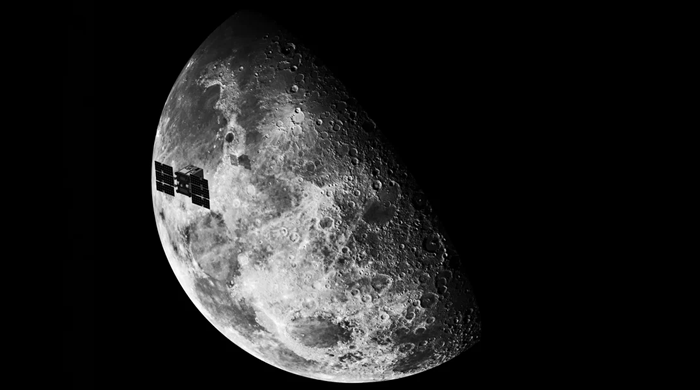
Benchmark Space Systems has been selected to conduct a Phase 1A/1B feasibility and design study under the Defense Advanced Research Projects Agency’s (DARPA’s) Lunar Assay via Small Satellite Orbiter (LASSO) program. The study will evaluate the technologies and spacecraft architectures required to operate safely and persistently in low lunar orbit (LLO), one of the most demanding operational environments in space.
Benchmark and selected partners will evaluate mission viability, autonomous navigation performance and architectural readiness for LLO operations. The lunar environment is notoriously shaped by steep terrain gradients and gravitational anomalies that demand advanced propulsion, onboard navigation and autonomous maneuvering.
Benchmark’s Expansion Beyond Propulsion: Sapphire as a Mission-Class Architecture
The LASSO award builds on Benchmark’s increasing role in vehicle-level programs for the U.S. government, including development campaigns with the Air Force Research Laboratory and NASA focused on next-generation orbital transfer vehicles. The award reinforces Benchmark’s evolution beyond propulsion into integrated spacecraft capability development.
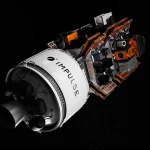
At the center of the feasibility study is Benchmark’s Sapphire architecture, which incorporates a hybrid propulsion approach combining high-thrust chemical propulsion with high-efficiency electric propulsion. DARPA has highlighted hybrid approaches as essential for credible LLO mission concepts. Additionally, Sapphire’s terrain navigation and hazard avoidance, and delta-V optimization are key components being assessed to determine mission viability.
Why LASSO Matters
LASSO is structured to advance the foundational technologies needed for future lunar science, logistics, and reconnaissance missions across civil, commercial, and defense applications. Very low lunar orbit enables high-resolution sensing and localized resource assessment but demands spacecraft systems capable of operating at the edge of today’s technical limits. By focusing on feasibility and design rigor in Phase 1, LASSO aims to reduce risk and improve confidence in future mission concepts that support sustained lunar activity and broader cislunar domain awareness.
“This award marks an important step in advancing a credible path toward sustained operations in very low lunar orbit, one of the hardest challenges in spaceflight,” Ryan McDevitt, CTO of Benchmark Space Systems. “We will rigorously evaluate how hybrid propulsion, autonomy, and spacecraft design can converge to meet DARPA’s expectations. Demonstrating viability at this stage is a critical milestone toward enabling future cislunar activity.”