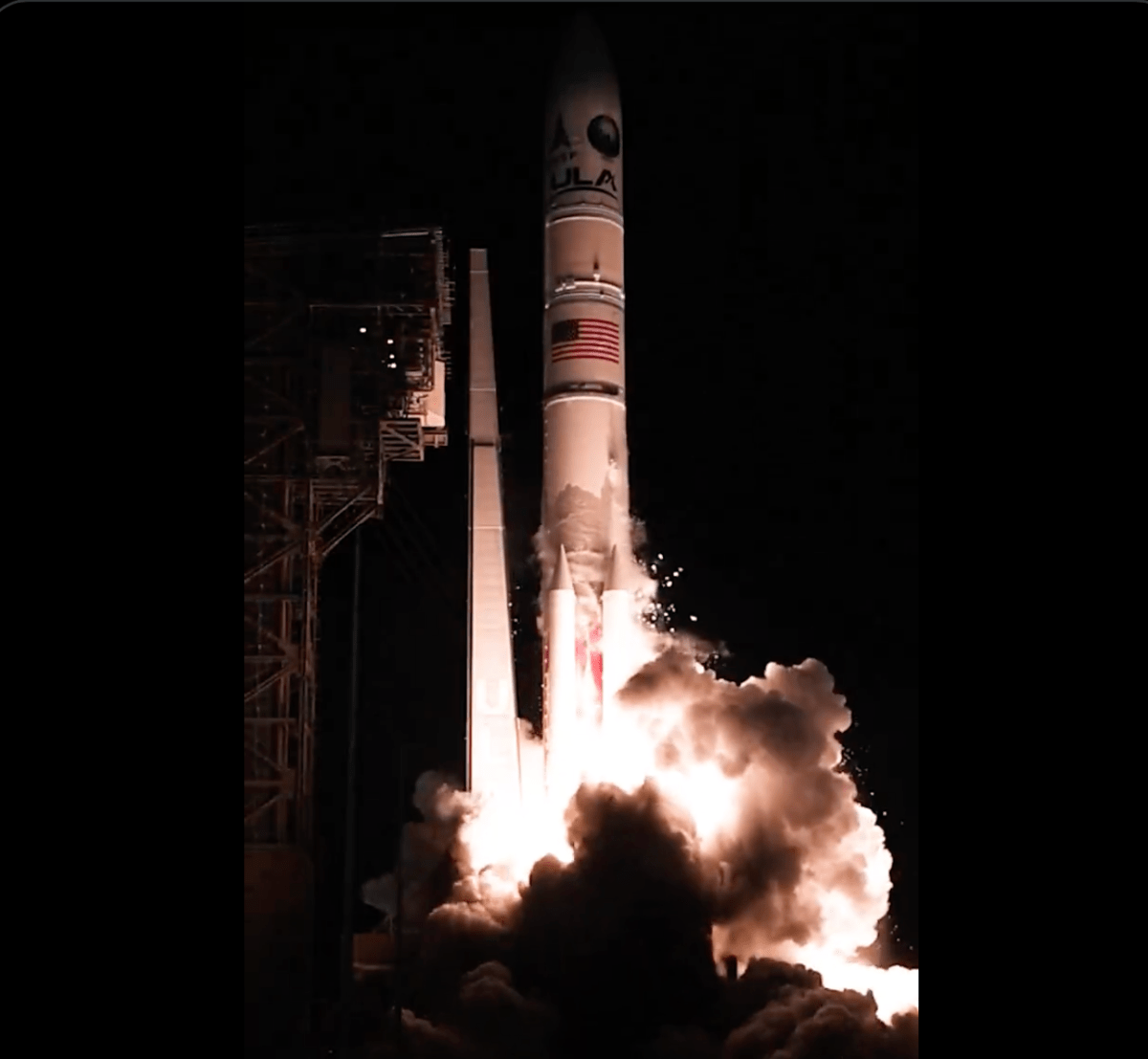
United Launch Alliance’s Vulcan rocket successfully carried multiple U.S. Space Force payloads to geosynchronous orbit on Feb. 12, despite encountering a performance anomaly with one of its solid rocket boosters early in flight, the company said.
The mission, designated USSF-87, lifted off shortly after 4 a.m. from Cape Canaveral Space Force Station in Florida on a roughly 10-hour trajectory. It delivered spacecraft supporting the Space Force’s Geosynchronous Space Situational Awareness Program (GSSAP) along with an undisclosed experimental payload.
ULA confirmed that one of the vehicle’s four solid rocket motors experienced an issue soon after liftoff. Gary Wentz, the company’s vice president for Atlas and Vulcan programs, described the problem as a “significant performance anomaly,” though the rocket continued its mission.
“Despite the observation, the Vulcan booster and Centaur performed nominally and delivered the spacecraft directly to geosynchronous orbit,” the company said in a statement. “The integrated U.S. government and contractor team is reviewing the technical data, available imagery, and establishing a recovery team to collect any debris. We will conduct a thorough investigation, identify root cause, and implement any corrective action necessary before the next Vulcan mission.”
Space Systems Command (SSC), which oversees U.S. military launch activities, said it will coordinate closely with ULA before future national security launches. The agency’s System Delta 80 unit will apply mission assurance procedures to determine flight readiness.
It remains unclear whether the anomaly will affect ULA’s upcoming launch schedule, which includes a GPS III satellite mission planned for March, a next-generation missile-warning satellite in May, and Space Development Agency spacecraft in June.
Vulcan is one of only two launch vehicles currently certified to carry the Defense Department’s most critical missions, alongside SpaceX rockets. Blue Origin’s New Glenn is pursuing certification after its recent flights.
ULA officials have said the company is aiming to significantly increase its launch cadence. Interim Chief Executive John Elbon told reporters earlier this week that existing hardware should support a higher tempo in 2026.
“We have an inventory of already built rockets that will allow us to get up to that rate through this year,” Elbon said before the launch. “What we need to do is execute our launch activities at the Cape and at Vandenberg, and that’s very achievable for us.”
Wentz added that USSF-87 represented the type of complex national security mission the Vulcan system was designed to support, involving heavy payloads delivered directly to geosynchronous orbit.
“This is the type of mission that the team actually designed this launch vehicle to support,” he said prior to liftoff. “It’s significant payloads to very complex orbits, multi-manifested, national security space, direct to GEO.”
The GSSAP satellites on board are part of a constellation that monitors objects and activities in geosynchronous orbit, often described as a “neighborhood watch” for high-value spacecraft. SSC said data from the program improves orbital predictions and enhances collision avoidance capabilities.
In addition to surveillance payloads, the mission carried research, development, and training systems intended to help Space Force personnel refine on-orbit maneuver tactics and improve spacecraft resilience in the geosynchronous environment. Officials declined to disclose further details.