The U.S. Space Force has awarded Rhea Space Activity Inc. (RSA) a contract to further develop its autonomous navigation software, AutoNav, as part of a project aimed at improving satellite maneuverability and resilience in contested space environments.
The project, known as VANGUARD—short for Vision-based Autonomous Navigation and Guidance for Unassisted Approach, Rendezvous, and Deployment—was selected under SpaceWERX’s Sustained Space Maneuver (SSM) Challenge, which supports the exploration of advanced technologies for satellite mobility and on-orbit operations.
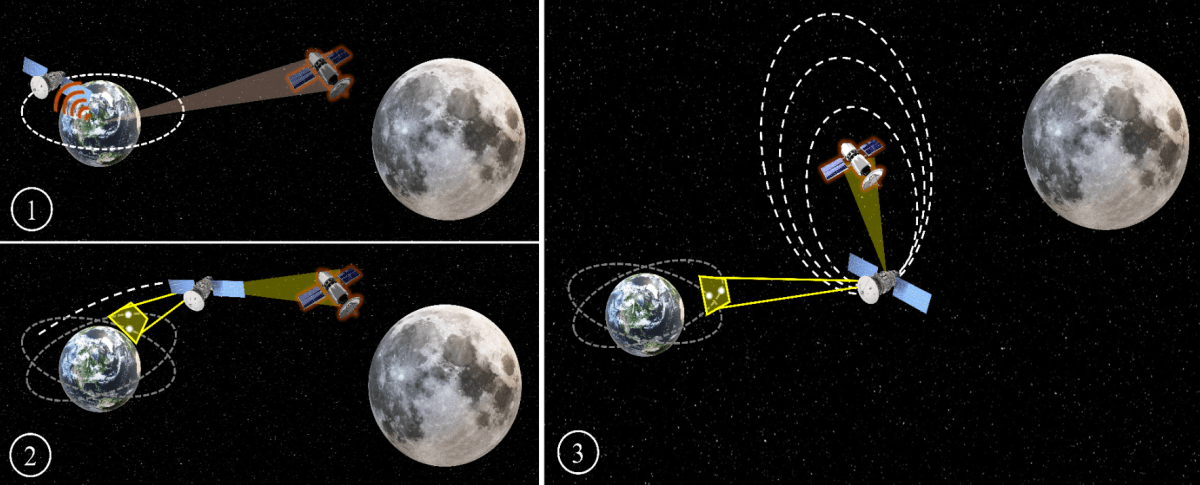
VANGUARD is designed to add autonomous rendezvous and proximity operations (RPO) capabilities to AutoNav, enabling spacecraft to approach, operate near or dock with other objects in Earth-centric orbits without relying on GPS. RSA said the system uses onboard cameras and a flight computer to image the sky and cross-reference observed stars and satellites with known positions stored in the Space Force’s Unified Data Library (UDL).
“One of the main outcomes of this project is a hardware-in-the-loop simulation environment to prove out the system capabilities,” said Jake Singh, missile system guidance, navigation and control engineer at RSA and principal investigator for VANGUARD. “We are running our flight software on representative hardware through simulated RPO scenarios in low-Earth and geostationary orbits to evaluate and improve its GNC capabilities, and developing tools for operators to automate missions.”
Autonomous RPO capability is considered a foundational requirement for a range of space activities, including on-orbit servicing, such as satellite assembly, inspection and repair, as well as active debris removal, which aims to reduce collision risks from defunct spacecraft and spent rocket stages. More advanced missions, including surveillance and reconnaissance, also rely on precise proximity operations.
RSA said the VANGUARD project is intended to give operators greater flexibility in planning and executing such missions, particularly in environments where GPS signals may be unavailable or degraded.
“Suppose the U.S. Space Force wants to rendezvous with a resident space object in geostationary orbit,” said Cameo Lance, co-founder and chief operating officer of RSA. “VANGUARD will allow Guardians to quickly plan a mission for one of our satellites to rendezvous with the object, and have it autonomously approach it, characterize it, and service it if needed.”
The Space Force has increasingly emphasized autonomous and resilient space operations as it prepares for a more congested and contested orbital environment, including future activity in cislunar space between the Earth and the Moon. RSA said VANGUARD is intended to support those objectives by improving the security and sustainability of U.S. space infrastructure over the long term.