
Blue Origin is a US-based aerospace manufacturer and launch company focused on developing technologies to enable sustainable, cost-effective and routine access to space. Founded in 2000 and headquartered in Kent, Washington, the company’s primary objective is to advance reusability in rocket propulsion, a key factor in lowering the cost and increasing the frequency of space missions. Through a combination of in-house design, testing and production, Blue Origin has established a family of liquid-fueled rocket engines that power both its own launch vehicles and those of external partners.
The propulsion development strategy centers on reusable engine systems that minimize refurbishment needs while maintaining high performance and safety margins. The engines are built to withstand multiple flight cycles, thereby supporting faster mission turnaround and reducing dependency on expendable hardware. The product line includes hydrogen-fueled engines optimized for high efficiency and upper-stage performance and methane-fueled systems designed for high-thrust, booster-class applications suitable for both orbital and suborbital vehicles. Blue Origin’s engine portfolio serves a wide spectrum of missions from suborbital human spaceflight and scientific research aboard the New Shepard vehicle, to orbital launch systems such as New Glenn and in-space propulsion for future lunar and deep-space operations. Each engine platform is engineered with specific thrust, efficiency and reusability characteristics aligned with the requirements of the corresponding vehicle stage and mission profile.
All propulsion systems are developed and tested at Blue Origin’s facilities in West Texas, Alabama and Florida, ensuring end-to-end control over manufacturing, testing and integration processes. This vertically integrated approach allows the company to maintain consistent quality standards, streamline design updates and rapidly transition technologies between different engine programs. By focusing on reusable propulsion architectures, liquid oxygen–hydrogen and liquid oxygen–methane engine cycles and scalable production methods, Blue Origin contributes to the broader evolution of sustainable space transportation.
BE-3PM – The Versatile Hydrolox Engine for Suborbital and Vertical-Landing Missions
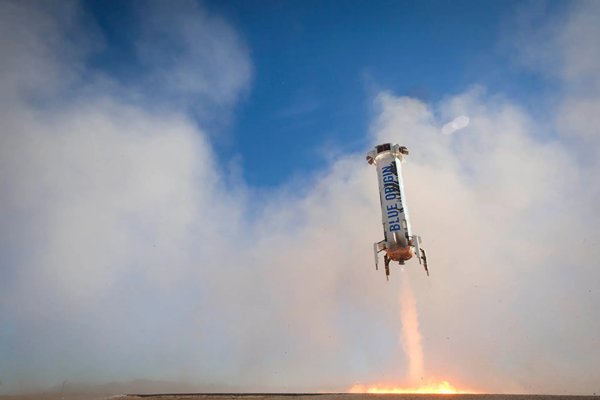
The BE-3PM is a liquid hydrogen/liquid oxygen (hydrolox) engine developed by Blue Origin for use on the New Shepard suborbital launch vehicle. Representing the first new hydrogen-fueled rocket engine designed and produced in the United States in over a decade, the BE-3PM marked a significant advancement in reusable propulsion technology. The design combines high efficiency, deep throttling capability and restart performance, making it well-suited for missions that require both powerful ascent and precise, controlled landing operations. The BE-3PM produces 490 kN (110,000 lbf) of thrust at full power and can throttle down to approximately 89 kN (20,000 lbf). This deep-throttling range enables Blue Origin’s vertical landing operations, allowing the engine to perform high-thrust liftoff followed by controlled deceleration and soft landing during descent. The capability to shut down and reignite mid-flight provides operational flexibility, a key feature for reusable flight systems that must transition seamlessly between launch, coasting and landing phases. The engine operates on a closed expander cycle, a configuration that uses heat absorbed from the combustion chamber and nozzle to drive the turbopumps. This approach provides high efficiency, low operational complexity and clean combustion characteristics — essential for reusability and ease of maintenance between flights. The use of liquid hydrogen and liquid oxygen as propellants results in a high specific impulse (~450 seconds in vacuum) and minimal soot or residue, reducing refurbishment requirements after repeated use. The BE-3PM was designed and built for Blue Origin’s New Shepard system, which carries both scientific payloads and crew on suborbital flights that cross the Kármán line (100 km altitude) before returning to Earth. During each mission, the BE-3PM powers the rocket to ascent and then reignites during descent to perform a precision vertical landing, a key step in achieving full vehicle reusability. This performance has been demonstrated in numerous successful New Shepard flights, validating the engine’s restart reliability, throttle control and structural endurance over multiple flight cycles. Through the BE-3PM, Blue Origin demonstrated that reusable, high-throttle hydrogen propulsion could be effectively integrated into a vertical takeoff and landing (VTOL) launch vehicle. The engine’s combination of precision throttling, clean propellant use and reusability embodies the company’s broader goal of making spaceflight more sustainable through “fly, land, and reuse” engineering principles.
BE-3U – The Upper-Stage Hydrolox Engine for Orbital Missions

The BE-3U is a vacuum-optimized variant of Blue Origin’s BE-3 hydrogen/oxygen engine family, developed to provide high-efficiency propulsion for orbital upper-stage missions. Designed to operate exclusively in the vacuum environment of space, the BE-3U builds upon the proven architecture of the BE-3PM while incorporating structural and performance modifications that enable superior thrust efficiency and sustained operation in low-pressure conditions. Intended for integration on the upper stage of Blue Origin’s New Glenn orbital launch vehicle, the BE-3U serves as the final propulsion stage responsible for orbit insertion, payload deployment and orbital transfer maneuvers. The engine operates on liquid hydrogen (LH2) and liquid oxygen (LOX) — a propellant combination known for the high specific impulse and clean combustion characteristics. By providing the efficiency of the hydrolox cycle, the BE-3U provides a vacuum thrust of approximately 710 kN (160,000 lbf), offering significant performance for heavy-payload and extended-duration missions. The engine employs an expander cycle, but optimized for vacuum conditions with an extended nozzle that maximizes exhaust expansion and thrust efficiency. The adaptation increases the specific impulse to roughly 450 seconds, making it one of the most efficient upper-stage engines in the class. The design also includes restart capability, enabling multiple engine burns for complex mission profiles such as orbit circularization, transfer orbits and deorbit maneuvers. The versatility allows spacecraft and payloads to reach a variety of orbital inclinations and altitudes within a single mission. It is structurally configured for vacuum-only operation and does not require the deep throttling range used in vertical-landing applications. The performance focus is instead on thermal management, long-duration burn stability and restart reliability, ensuring precise orbital adjustments and efficient fuel use across multiple engine cycles. The BE-3U’s use of hydrogen and oxygen propellants supports clean engine operation and long-term reusability, minimizing carbon buildup and component wear between flights. This design philosophy aligns with Blue Origin’s overarching approach to sustainable, reusable propulsion systems, reducing refurbishment requirements while maintaining consistent performance across multiple missions. The engine’s role within New Glenn’s upper stage underscores the significance in Blue Origin’s broader orbital architecture. It enables the vehicle to deliver large payloads to a range of orbits including geostationary transfer orbit (GTO), medium Earth orbit (MEO) and beyond while retaining the company’s core emphasis on reusability and cost reduction. Through the BE-3U, Blue Origin extends the hydrolox propulsion expertise from suborbital operations to orbital-class missions. The engine combines proven expander-cycle reliability with vacuum-optimized performance, representing a key step in the company’s effort to build a family of reusable engines that can operate efficiently across all phases of flight from launch to orbit to deep-space exploration.
BE-4 – The Methalox Engine for First Stage and Heavy-Lift Vehicles
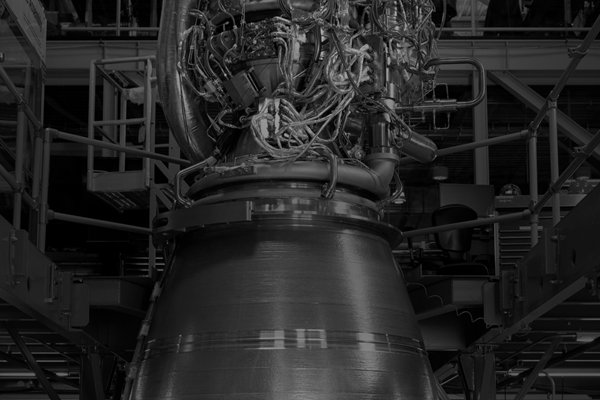
The BE-4 is Blue Origin’s first oxygen-rich staged-combustion engine, developed to provide high-thrust propulsion for orbital-class boosters while maintaining long-term reusability. Designed to burn liquefied natural gas (LNG, primarily methane) and liquid oxygen (LOX), the BE-4 represents a shift toward methalox propellant combinations—offering cleaner combustion, simpler engine maintenance and improved performance stability compared to legacy kerosene-fueled systems. Producing approximately 550,000 pounds-force (2,450 kN) of thrust at sea level, the BE-4 is engineered for use on large first-stage boosters. It serves as the primary propulsion system for Blue Origin’s New Glenn orbital launch vehicle and is also selected as the main engine for United Launch Alliance’s Vulcan Centaur rocket, marking the adoption by multiple commercial and national-security launch providers. The engine is designed for multiple flight cycles with minimal refurbishment between launches, aligning with Blue Origin’s goal of reducing cost per launch through high-reliability reusability. The BE-4 operates on an oxygen-rich staged combustion (ORSC) cycle, in which a portion of the oxidizer and fuel are pre-burned in a pre-burner to drive the turbopumps before entering the main combustion chamber. This approach allows for high chamber pressures, efficient propellant use, and precise mixture control, yielding strong performance and cleaner exhaust. The ORSC design, while technically complex, ensures stable operation under high thermal and mechanical loads—key for engines intended for repeated use. The use of methane as the primary fuel provides several engineering and operational advantages. Methane combustion produces significantly less carbon soot than kerosene-based propellants, reducing the potential for coking within injector elements and turbomachinery. The BE-4’s design enables autogenous pressurization, using heated gaseous methane and oxygen from the engine itself to pressurize the propellant tanks—eliminating the need for separate helium systems and reducing overall vehicle complexity. The BE-4’s engine structure and nozzle assembly are designed for durability, incorporating additively manufactured components and high-strength alloys capable of sustaining repeated thermal cycles. Each engine undergoes full-scale hot-fire testing at Blue Origin’s West Texas and Huntsville, Alabama facilities to validate performance, throttle control and long-duration firing stability. The BE-4’s reusability and performance characteristics make it a core component of next-generation heavy-lift infrastructure. It enables New Glenn’s reusable first stage to deliver large payloads to low Earth orbit (LEO), geostationary transfer orbit (GTO), and beyond, while maintaining competitive cost efficiency. The adoption by multiple launch systems demonstrates the flexibility and suitability for both commercial and government missions. Through the BE-4, Blue Origin advances the propulsion strategy from suborbital and upper-stage hydrogen systems to high-thrust, booster-class methane engines, completing a family of reusable propulsion technologies that support all mission phases from launch to orbit to beyond Earth’s atmosphere. The BE-4 serves as the foundation for Blue Origin’s heavy-lift capability and a key enabler of sustainable orbital access for future missions.
BE-7 – The Lunar and Deep-Space Propulsion System

The BE-7 is Blue Origin’s high-efficiency liquid hydrogen and liquid oxygen (hydrolox) engine, developed specifically for lunar landers and deep-space propulsion systems. It represents the company’s entry into precision descent and in-space mobility technologies, supporting missions that require accurate thrust control, restart capability and sustained operation in a vacuum. The engine is designed to power Blue Origin’s Blue Moon lunar lander and future in-space systems that form part of the company’s contribution to NASA’s Artemis program and broader lunar surface logistics architecture. Producing approximately 10,000 pounds-force (44.5 kN) of thrust, the BE-7 is optimized for precision landing and controlled descent in low-gravity environments. It operates using a closed expander cycle, which uses heat absorbed from the combustion chamber and nozzle to power the turbopumps — a cycle known for efficiency, reliability and clean combustion characteristics. The hydrolox propellant combination provides a specific impulse of around 450 seconds, among the highest in operational chemical propulsion systems, making it well-suited for missions requiring high delta-v and long-duration thrust efficiency. The BE-7’s design focuses on deep throttling capability, allowing the engine to vary the thrust level to accommodate different phases of descent and landing. The precision control is essential for soft-landing operations on the lunar surface, where even small deviations in thrust can significantly affect landing accuracy and vehicle stability. The engine’s capability for multiple in-space restarts supports complex mission profiles, including orbital insertion, descent maneuvers and return trajectories. Development and testing of the BE-7 are conducted at NASA’s Marshall Space Flight Center in Huntsville, Alabama, under partnership agreements that allow Blue Origin to utilize specialized vacuum chambers and test facilities for hydrolox propulsion. Since the first hot-fire test in 2019, the BE-7 has accumulated extensive cumulative burn time under vacuum conditions, validating its performance, cooling systems and restart functionality. The engine’s hydrogen-oxygen propellant combination aligns with NASA’s long-term vision for a sustainable lunar presence, as both elements can be derived from in-situ resource utilization (ISRU) — specifically, from water ice deposits on the Moon. This capability positions the BE-7 as a candidate for future refuelable, reusable lunar systems capable of supporting surface exploration, cargo delivery and eventual crewed missions. Designed for integration with Blue Origin’s Blue Moon lander and potentially other lunar or cislunar spacecraft, the BE-7 provides a propulsion foundation for precision landing, ascent and orbital transfer. By focusing on reusable deep-space propulsion, Blue Origin’s BE-7 supports the transition from near-Earth operations to sustained exploration beyond Earth orbit. The engine’s combination of precision control, efficiency and adaptability makes it a central component of the company’s efforts to establish a reliable propulsion infrastructure for lunar and planetary missions.
Integrated Reusability and Propulsion Architecture
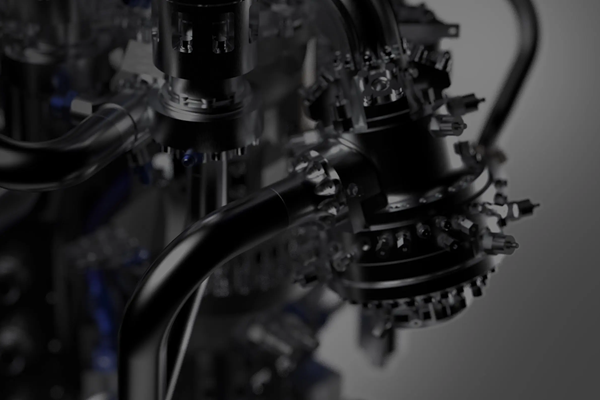
Reusability in propulsion design affects every stage of the launch and mission process, from vehicle architecture and materials selection to ground support logistics and maintenance planning. By focusing on durable components, high-efficiency turbomachinery and clean combustion cycles, Blue Origin ensures that engines can be recovered, inspected and re-flown with minimal performance degradation. The company’s emphasis on cryogenic propellants, liquid hydrogen and liquid oxygen in the BE-3 and BE-7, and liquefied natural gas (methane) and liquid oxygen in the BE-4, demonstrates a consistent strategy of developing high-efficiency, low-residue propulsion systems that are inherently compatible with repeated use. The adoption of methane/oxygen combustion in the BE-4 introduces key operational benefits such as cleaner burn profiles and autogenous tank pressurization, simplifying reuse cycles and reducing dependency on consumable pressurization systems. The hydrogen/oxygen expander-cycle engines (BE-3 and BE-7) emphasize high specific impulse, fine throttle control and restart capability, making them suitable for precision landing, upper-stage and deep-space operations. At the system level, this approach to reusability has broader implications for launch economics and mission design. Engines capable of multiple uses reduce the cost per flight and enable more frequent operations without major hardware replacement. This supports higher launch cadence, flexible scheduling and more responsive access to orbit, attributes that are essential for both commercial satellite deployment and future exploration missions. By combining cryogenic reusability, methalox efficiency and deep-space adaptability under a cohesive design philosophy, Blue Origin is developing a propulsion architecture that links suborbital, orbital and lunar systems into a scalable framework.
About Blue Origin
Blue Origin is a privately funded US aerospace manufacturer and space-services company founded by Jeff Bezos in 2000. The company is headquartered in Kent, Washington. Blue Origin’s core mission is to develop and operate reusable rocket propulsion systems, launch vehicles and in-space systems, aiming to enable increased access to space. The engine portfolio, launch vehicle development and spacecraft ambitions span suborbital, orbital and deep-space applications. Blue Origin has developed a portfolio of reusable liquid-fueled rocket engines, utilizing both hydrogen/oxygen and methane/oxygen propellant combinations, each engineered for multiple flight cycles to reduce operational costs and enhance reliability. The company’s launch vehicle lineup includes the New Shepard, a suborbital rocket designed for crewed and research missions, and the New Glenn, a heavy-lift orbital vehicle capable of delivering large payloads to orbit. To support engine production, testing, and integration, Blue Origin operates a network of manufacturing and test facilities across the United States, including major sites in Kent, Washington; Huntsville, Alabama; Van Horn, Texas; and Cape Canaveral, Florida. These facilities form the backbone of the company’s end-to-end development approach, covering everything from design and assembly to static testing and launch operations. Blue Origin emphasizes propulsion reusability, high efficiency and long-term cost reduction, positioning itself for missions including commercial launches, lunar landers and beyond.